Manufacturing luxury fragrance packaging is an unforgiving discipline. A single micrometer of deviation in a glass mold or a fractional drop in furnace temperature can transform a highly anticipated product launch into a catastrophic logistical failure. This definitive manual demystifies the strict engineering realities and financial strategies behind the creation of premium perfume bottles.
The Complete Perfume Bottle Production Roadmap: A Macro Overview
The journey from a conceptual sketch to a hermetically sealed, retail-ready luxury vessel is not merely a process of melting glass. It is an intricate, sequential ballet of chemical engineering, thermodynamic control, and micrometer-level precision. The roadmap is strictly defined by five absolute milestones: establishing the proper material matrix and tooling strategy, controlling the immense heat of gob formation, neutralizing volatile internal stresses through annealing, executing value-add surface decorations, and finally, enforcing unyielding physical tolerances to prevent evaporation. Mastering this timeline is the absolute prerequisite to securing your supply chain.
Step 1: Pre-Production: Material Selection and Mold Cost Strategy
The foundation of a zero-leak, luxury fragrance package is cemented long before the factory machines are turned on. The preliminary phase dictates the chemical compatibility, aesthetic brilliance, and ultimate financial viability of the entire production run. The immediate challenge buyers face is navigating the treacherous waters of material selection across the entire packaging system, and comprehending the true cost barriers of custom molding.
Comprehensive Material Selection: Glass, Surlyn, and Zamac
A high-end perfume bottle is a tightly integrated system of disparate materials, each serving a highly specialized function. The glass vessel must act as an inert sanctuary for volatile organic compounds, while the overcap must deliver a tactile and visual psychological anchor. Ignoring the synergy between these elements is the fastest route to devaluing the final product.
Contrary to amateur assumptions, standard soda-lime glass does not chemically degrade fragrance. Its flaw is entirely visual. Soda-lime contains trace iron impurities that naturally impart a faint, undesirable greenish or bluish tint to the glass walls. For luxury positioning, this is an unacceptable compromise. The absolute baseline for premium fragrance is High-flint glass (Extra-clear glass). Through a meticulous refinement process that strips away these metallic impurities, high-flint glass achieves a crystalline, colorless transparency. This optical purity acts as an invisible canvas, perfectly rendering the true, unadulterated color of the perfume liquid housed within.
Ascending to the closure system, the material choices define the consumer’s tactile experience. For transparent caps, the industry apex is Surlyn—an advanced ionomer resin patented by DuPont. Unlike cheap acrylic or polypropylene, Surlyn possesses an extraordinary resistance to aggressive essential oils and ethanol, preventing the cap from clouding or degrading over time. Furthermore, its unique molecular flow allows for injection molding with virtually imperceptible parting lines, mirroring the clarity of polished crystal. When extreme luxury is required, brands pivot to Zamac (an alloy of Zinc, Aluminum, Magnesium, and Copper). Zamac’s high specific gravity delivers a cold, heavy, metallic heft that immediately communicates intrinsic value the moment the consumer lifts the cap from the bottle.
Standard Public Molds vs. Full Private Customization Costs
The architectural blueprint of the bottle is executed through molding. Brands must decisively choose between utilizing existing factory geometries or investing in proprietary silhouettes. This choice fundamentally alters the procurement timeline and the minimum financial exposure required to initiate production.
| Mold Strategy Type | Initial Investment (Est.) | MOQ Threshold | Development Lead Time |
|---|---|---|---|
| Standard Public Mold | $0 (No tooling fees) | 5,000 – 10,000 units | Immediate availability |
| Full Private Custom Mold | $1,500 – $3,500+ | 30,000+ units | 30 to 45 Days |
⚠️ The Total Cost of Ownership (TCO) Reality
It is a common, yet fatal, procurement error to attempt cost-cutting during the prototyping phase. Consider a boutique fragrance house executing a 30,000-unit production run. Investing $3,000 in a private mold equates to a nominal amortization of merely $0.10 per bottle. It appears to be a negligible increase. However, to bypass the critical 3D resin mockup and the $500 sample trial mold—rushing blindly into mass tooling to save time and a few hundred dollars—invites absolute disaster. If an undetected dimensional mismatch between the custom glass neck and the sourced metal pump manifests on the automated filling line, the outcome is severe. A seemingly minor 10% leakage failure rate on a batch of $2.00 landed cost items instantly vaporizes $6,000 in ruined components and oxidized fragrance juice, completely eclipsing the initial “savings.” Mathematical prudence dictates that physical sample validation is a non-negotiable insurance policy.
Step 2: Core Manufacturing: Melting, Forming, and Annealing
Once the blueprint is validated, the process moves to the brutal, high-temperature reality of the factory floor. The true mastery of glassmaking does not merely lie in reaching the requisite melting temperatures, but in the microscopic control of fluid dynamics and thermal dissipation during the shaping phase.
Gob Temperature Control and IS Machine Forming
Inside the furnace, the raw silica batch is liquefied at a staggering 1500°C. However, the critical juncture occurs when this molten lake is extruded and sheared into precise, glowing cylinders known as “gobs.” The gob is then dropped into the Individual Section (IS) machine for blow-and-blow or press-and-blow forming. The ultimate differentiator between a flawless luxury vessel and a highly defective batch is Gob Temperature Control.
The viscosity of the gob must be calibrated with absolute precision before it enters the blank mold. If the temperature fluctuates even slightly, the molten glass will flow unpredictably. This lack of control manifests physically as “Uneven Glass Distribution”—a fatal defect where the bottle exhibits thick, heavy bottoms but dangerously thin, fragile shoulders. In asymmetric or highly complex bespoke bottle designs, mastering gob viscosity is the sole parameter that prevents catastrophic scrap rates and stabilizes the final unit price.
Stress Elimination via Lehr Annealing
The moment the glowing bottle leaves the IS machine, it appears solid, yet its internal molecular matrix is in absolute chaos. Rapid, uneven cooling of the outer skin versus the inner core generates immense, invisible forces known as thermal stress. To neutralize this ticking time bomb, the bottles are immediately transferred onto a slow-moving conveyor belt through a specialized kiln called a Lehr.
Inside the Lehr, the glass is reheated to a specific temperature threshold, allowing the silica molecules to relax and realign, before being subjected to a meticulously controlled, hours-long temperature step-down. If a factory attempts to accelerate the annealing timeline to boost daily output, residual tension remains permanently locked within the vessel walls. Consequently, the glass will spontaneously shatter without any physical impact, triggered simply by the ambient temperature fluctuations experienced inside an ocean freight container crossing the equator.
Step 3: Value-Add Decoration and Surface Finishing
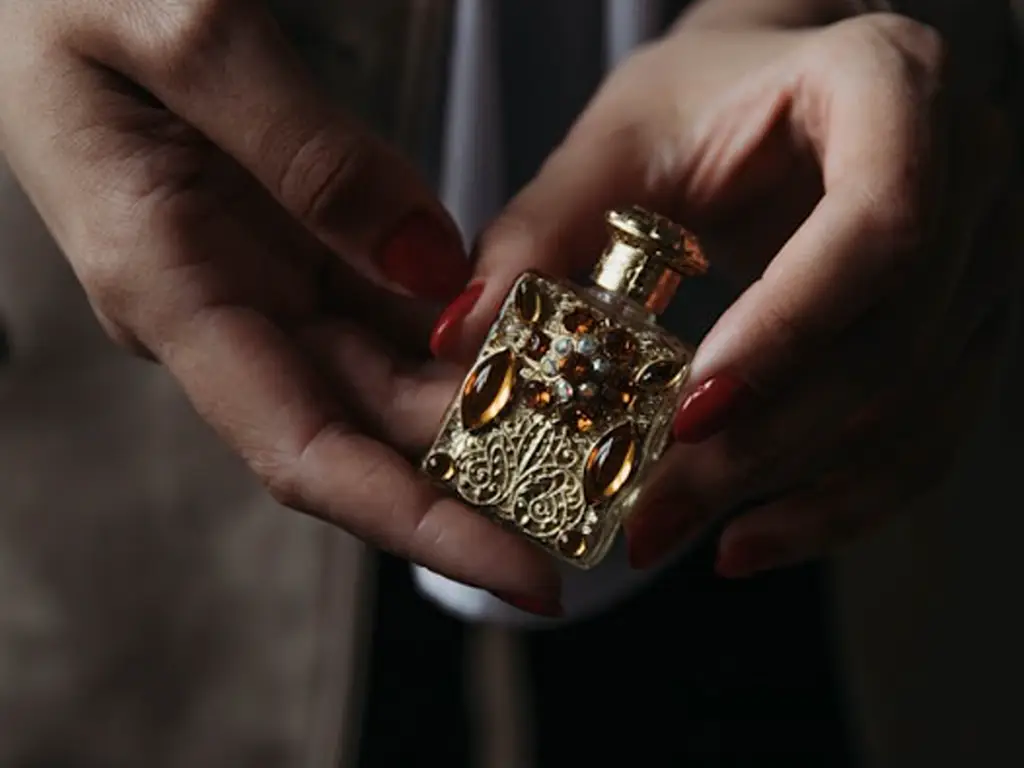
The annealed glass is essentially a blank canvas. To elevate a standard public mold into a recognizable brand asset, or to finalize a custom design, it must traverse the decoration floor. Surface finishing techniques serve dual purposes: amplifying the aesthetic prestige and, crucially, providing functional protection to the delicate chemistry housed inside.
- Acid-Etching (Frosting): A hydrofluoric acid bath alters the microscopic surface of the glass, creating a sophisticated, velvety matte finish that diffuses light and elegant masks internal plastic extraction tubes.
- Hot Stamping and Silkscreening: Precision branding utilizing ceramic inks or metallic foils that are baked into the glass matrix at high temperatures. This ensures the brand logo remains completely impervious to the highly solvent nature of spilled perfume ethanol.
- Functional UV Color Coating: While gradient sprays offer stunning visual depth, specific opaque or translucent UV coatings are engineered as chemical shields. They block destructive ultraviolet radiation (UV-A and UV-B) from penetrating the glass, thereby preventing the premature molecular degradation of photo-sensitive essential oils and exponentially extending the fragrance’s olfactory shelf life.
Step 4: Quality Control and Leak Prevention Engineering
The final phase of production is an uncompromising war against the industry’s most damaging and expensive consumer complaint: the slow, insidious evaporation and leakage of the fragrance. A beautiful bottle is worthless if it cannot retain its contents.
Mastering FEA Neck Tolerance for Flawless Pump Crimp
The interface between the rigid glass neck and the crimped metal micro-pump is a microscopic battleground. To ensure a hermetic seal, premium manufacturers strictly adhere to the dimensional guidelines established by authoritative bodies such as the European Aerosol Federation (FEA). For an industry-standard FEA 15 neck finish, the outer diameter tolerance must be ruthlessly guarded within an absolute ±0.15mm redline.
Glass molding tools inevitably wear down over thousands of heating and cooling cycles. If a worn mold permits even a fractional deviation—creating a subtle, imperceptible ovality that exceeds this ±0.15mm threshold—the consequences are irreversible. Regardless of the extreme pneumatic force applied by the crimping machine on the assembly line, the elastomeric gasket inside the metal pump will fail to achieve flush, 360-degree contact with the glass rim. This creates microscopic capillary channels, guaranteeing the slow, costly volatilization of the high-proof ethanol and rare essential oils over the product’s lifespan.
Thermal Shock and Polariscope Testing for Transit Safety
Before a batch is cleared for global export, it must survive rigorous destructive testing to validate its structural integrity. QA engineers utilize a Polariscope, passing polarized light through the glass to visually reveal vibrant, rainbow-colored birefringence patterns—the visual signature of any dangerous residual stress that managed to escape the Lehr annealing process. Furthermore, severe Thermal Shock Tests (subjecting the bottles to instantaneous hot-to-cold water bath deltas) simulate the brutal environmental extremes of international logistics, ensuring the heavy glass bases do not detach during winter warehouse transfers or summer tarmac loading.
Step 5: Strategic Sourcing: Benchmarking Factory Automation
Navigating the international packaging procurement landscape often exposes brands to a highly fragmented supply chain, where misaligned communication between mold makers, glass plants, and closure suppliers results in catastrophic launch delays and finger-pointing. Observing how established, mature manufacturers operate provides a blueprint for mitigating this risk. For instance, integrated facilities like Nuvole Glass demonstrate the sheer power of centralized capability. By maintaining an in-house CNC mold workshop, they effectively compress the private mold development cycle, significantly lowering the initial barrier and capital risk for customized designs. Once on the production floor, their reliance on precision electric furnaces specifically calibrated for high-flint glass formulas aggressively eliminates the ubiquitous green tint and uneven distribution faults common in budget facilities. Ultimately, to defend the unforgiving ±0.15mm FEA tolerance redline and completely eradicate leakage, they deploy 360-degree Automated Optical Inspection (AOI) systems across the assembly line. This integration of machine vision removes subjective human error, mechanically intercepting out-of-spec defects and ensuring that every delivered vessel is flawlessly primed for the final pump crimp.

Conclusion: Securing Your Packaging Supply Chain
Mastering perfume bottle production is a sophisticated exercise in risk management and precision engineering. From architecting the proper high-end material matrix—incorporating High-flint glass, Surlyn, and Zamac—to understanding the unforgiving mathematical realities of mold amortization, every decision carries heavy financial consequences. By demanding strict gob temperature controls and absolute adherence to FEA tolerances, brands can confidently scale their operations. Armed with this technical standard operating procedure, procurement teams are empowered to engage in equal, transparent negotiations with global suppliers, ultimately transforming a fragile liquid asset into a globally resilient luxury product.
Ready to Engineer Flawless Packaging?
Do not let compromised tolerances and fragmented supply chains derail your next fragrance launch. Partner with engineering experts who command the process from raw CNC tooling to automated optical inspection.
Consult the Experts Today