The vessel is vital in the refined world of viticulture as the vintage. The size of the wine bottle is a strategic move for wine producers, collectors, event planners, and the owners of the winery as it affects the aging potential of the wine as well as its brand positioning in the market. Every single millimeter of the glass and every micro-gram of sealing material determines the continuity of the liquid within as a leading manufacturer. This detailed manual is the ultimate source of information on the dimensions of wine bottles, nomenclature, and precision of engineering needed to preserve the world-class wine products.
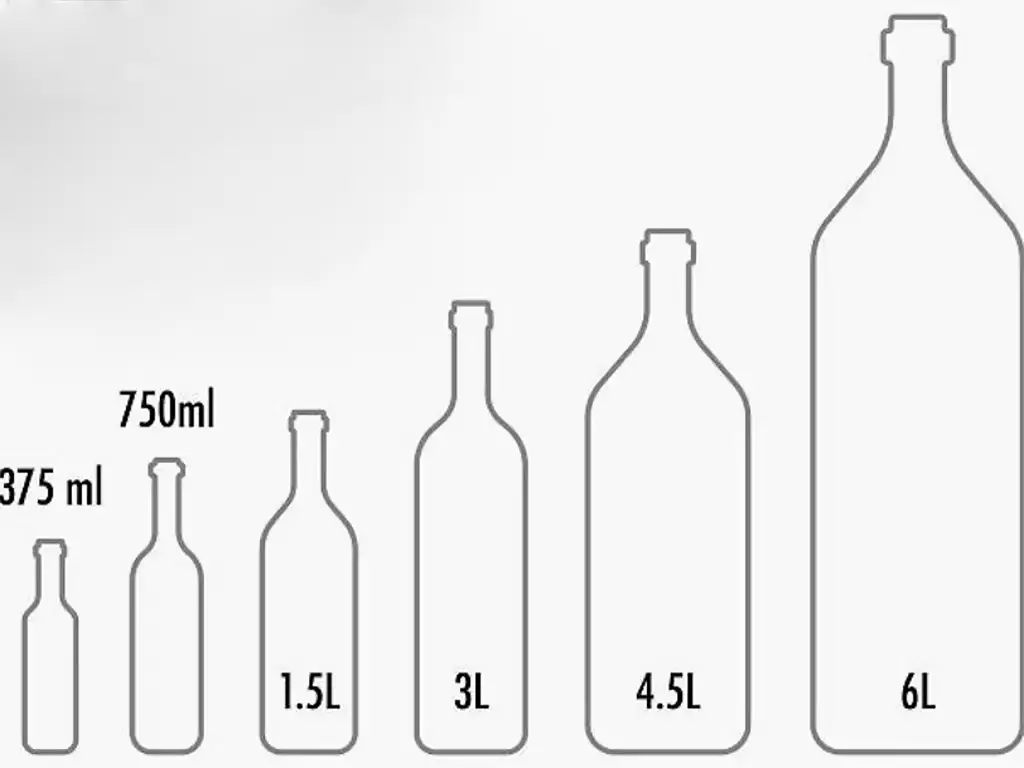
A Visual Guide: All Wine Bottle Sizes and Their Names
You may be a wine lover organizing a dinner with friends on the weekend, or a business manager and logistician creating a global supply chain, but to get the right size and name of every bottle, including the shape of the bottle, the first thing is to know them exactly. To the host, it has to do with making sure that all guests have a full glass; to the sommelier and producer, it has to do with the basis of perfect service and an ideal logistical organization.
From Piccolo to Standard: Small and Single-Serve Formats
With the large scale of collectible bottles, it is imperative to have the functional use of smaller sizes of wine bottles, including the traditional shape. These formats were designed to accommodate the requirements of portability, portion control and diverse consumption patterns. Small bottles offer an effective remedy to having to open a complete 750ml bottle, whether one is in a hurry to have a quick drink on-board or are on a mission to sample the best of the best. These sizes are carefully customized to different market segments, including the travel market up to the luxury gifting market.
- Split or Piccolo (187.5ml): This is the industry standard size of an aviation, hotel mini-bar or single-serve retail promotion; it is equivalent to one glass of wine and is one quarter the size of a full bottle.
- Demi or Half (375ml): This size equates to half full of a standard bottle, and it is often ordered when the value of a wine is very high, or when an individual in a fine-dining restaurant wants to sample the flavors, rather than the size, of the wine.
- Standard (750ml): The international standard in the industry that is irrefutable. This is the standard of wine production, retail inventory and professional cellar storage the world over.
Large Formats: The Cultural Legacy of Biblical Nomenclature
Along with the standard size, there is a long-standing naming tradition that the wine industry, including wine producers, employs dating way back to the earlier times in Champagne region. These large-volume ships are not only named after the literage but have been given a name of a biblical king and a historical figure. The initial reason why this system was invented was to classify the various scales of production and to make it easier to identify the bigger bottles in the cellars. These terms have evolved to be universal terms of classification over time giving a good classification system which assist producers, collectors and event planners to differentiate between different levels of capacity.
An example is a 3 liter bottle, which is referred to as a Jeroboam, the name of the first king of Northern Israel, and the 15 liter bottle as Nebuchadnezzar, the name of a king of Babylon. Long-term storage and high-capacity events are functionally important to these larger formats, contributing to an enhanced wine experience, but necessitate special properties of the glass, including high purity, a multifaceted polishing process, etc., to be structurally safe.
| Bottle Name | Volume (L/ml) | Standard Bottle Equivalent | Typical Servings (150ml) |
| Piccolo | 187.5 ml | 0.25 | 1.25 |
| Demi | 375 ml | 0.5 | 2.5 |
| Standard | 750 ml | 1 | 5 |
| Magnum | 1.5 L | 2 | 10 |
| Jeroboam | 3 L | 4 | 20 |
| Rehoboam | 4.5 L | 6 | 30 |
| Methuselah | 6 L | 8 | 40 |
| Salmanazar | 9 L | 12 | 60 |
| Balthazar | 12 L | 16 | 80 |
| Nebuchadnezzar | 15 L | 20 | 100 |
| Solomon | 18 L | 24 | 120 |
| Sovereign | 26.25 L | 35 | 175 |
| Midas | 30 L | 40 | 200 |
What is the Standard Wine Bottle Size?
The 750ml bottle acts as the unchallenged beacon of the worldwide wine business enterprise and holds a litre of wine. This volume is to be used as a foundation in ensuring a uniformity of the international logistics, retail shelf-space allocation and the designing of automated bottling infrastructure.
- The Historical Origin: There are a number of theories explaining the reasons behind having a 750ml size of wine bottles as the norm. The most popular historical account is that 750ml was the average capacity of the lungs of a glassblower prior to the development of automated glass blowing. This book was standardized in the 1970s as the international trade book to fit both the European Union and the United States metric system and make taxation and international trade easier.
- Normal Dimensions: Despite the variation in shapes, a typical 750ml bottle will be about 30cm in height and a base of 7.5cm in diameter, making it a key component in any wine collection. Professional production lines need to have a specific protocol of inspection, usually a +-3ml range, so that the quality is ensured and production is not overflowing or leaking when
The contemporary wine supply chain is specific to these dimensions. The industry uses this standard size to set the width of the shipping pallets and cardboard boxes, torque of the labeling machines, and depth of these shelves in wine refrigerators, especially when considering the role of a wine merchant throughout the industry.
Serving Guide: How Many Glasses are in Different Wine Bottle Sizes?
Converting milliliters into pours is a basic art when it comes to event planning so that a host does not run out but at the same time has a minimum amount of surplus for the perfect pour. Through the knowledge of the serving capacity of different size wine bottles, you are able to know the precise requirements of any event, be it a small toast or a big party.
- The Core Calculation: Generally, in a work environment, the standard portion size of a glass of still wine is 150ml (5oz). According to this measure, a regular 750ml bottle will produce 5 glasses of wine. When you are pouring sparkling wine out of flutes, you don’t tend to fill it quite as much – maybe 125ml (4oz), which can yield up to 6 glasses of wine.
- Small (2-4) Dinners: It is only necessary to have one standard bottle or a double magnum to have a nice quiet dinner. But when the menu has its own pairing with the dessert course, the 375ml bottle of Demi (2.5 glasses) is the best accompaniment to avoid the waste of the quality of late-harvest wines.
- Social Gatherings (8-10 People): In the case of a medium size party, it is most efficient to use 1.5L Magnum, named after the king of Judah. Serving precisely 10 glasses, it will make sure that all the guests receive the same glass, which will be kept at the same temperature and in the same style throughout the table.
- Large Milestone Events (20 or more): This is the place where larger formats are utilised as a functional asset. A 3L Jeroboam (20 glasses) contains 3 litres of wine and will serve as the center of one table, and a 6L Methuselah (40 glasses) can be used to serve a substantial number of wedding toast.
The Science of Aging: Why Bottle Volume Matters
A wine bottle serves as a safety barrier to the contents within the bottle in which the size of the bottle, including different bottle sizes, has a direct effect on the wine flavor in several years later. In spite of the fact that most of the individuals tend to select the size of the wine bottles according to the convenience, collectors tend towards buying bigger bottles since the wine is much more likely to age gracefully. The physical contact between the glass, the seal, and the amount of the wine in the bottle establishes the environment, which may accelerate or gradually develop the personality of the wine.
Oxygen-to-Wine Ratio: The Secret of Slower Oxidation
A wine cannot breathe without oxygen and excessive amounts of oxygen can result in a wine losing its freshness. Little air is trapped inside the neck of each champagne bottle. Even in larger bottles, like champagne bottles, this little air has to react with a very much greater quantity of wine. Since the size of the neck of a 1.5L Magnum tends to be similar to that of a typical bottle, the wine contained in it is exposed to significantly less per-drop oxygen.
This reduced exposure gives a longer shelf life to the wine, including white wines. The fresh fruit flavours and the bright acidity of the wine are maintained over many years in these bigger formats, allowing the wine time to evolve more rich and complex aromas, such as leather, spice, or dried fruits, without the wine becoming two-dimensional and stale too soon.
Thermal Mass: Protecting Wine from Temperature Fluctuations
Other than oxygen, bigger bottles are also more shielding against heat. In physics, a large quantity of liquid possesses what is termed as thermal mass, in that, it is far more difficult to alter its temperature. Heat requires a lot of energy and time to warm the largest bottles of 6 liters of wine as compared to warming a small 750ml bottle.
This acts as a buffer of safety. Large bottles, such as a Nebuchadnezzar bottle of Moet, do not respond to these sudden changes when shipping or when a home wine cooler experiences a minor hiccup in temperature. Maintaining the constant temperature of the wine also preserves the delicate elements of the wine that make it structured and smelly so that by the time the bottle is opened, it remains balanced and tasty.

How to Identify a High-Quality Wine Bottle
Glass may appear identical to a layman, but the technical quality of a bottle is the only factor that will make the difference between a perfect vintage and a bad one. A good quality bottle is, in fact, a finely-crafted instrument that is engineered to have a perfect seal over many decades.
The precision of the neck of a premium bottle has to be considered one of the most significant aspects. The inner diameter of top-tier manufacturing should be regular within ±0.5mm. Should there be any slight unevenness of the neck, the cork will not be the right size, and there will be little bubbles of “micro-leaks” which admit oxygen and spoil the wine. In order to avoid this, professional-grade bottles can utilize more sophisticated materials such as PTFE composite seals to make sure that the liquid remains inside and the air does not get in.
The rate of evaporation and chemical stability of a bottle is also enough to determine its quality. Whereas a normal bottle can lose as much as 3 percent of the contents to evaporation every year, a precision-made bottle loses less than 0.1 percent. Moreover, the quality of glass is also tested to be nearly completely inert to the corrosion of alcohol (> 99.9%), so that the glass will never bleed into wine. And lastly, seek out crystal-white glass; not only is its perfection of transparency worth its appearance, you can easily observe the color and condition of the wine, and that is what is essential to every serious amateur.
From Precision to Sustainability: The Nuvole Approach
A bottle should balance a technical and environmental accountability to fulfill the strict criteria of a perfect seal. Nuvole deals with this by incorporating such high-performance benchmarks in a sustainable manufacturing system. Using the production lines that maximize glass allocation, the process saves up to 25% of the material wastes without affecting the structural strength.
This principle of integrity is applicable to the world supply chain. In the case of Europe and Middle East, Nuvole offers a carbon-free packaging option with a maximum of 85% recycled material. This makes the bottle not only a high-precision, inert instrument of the wine, but also a responsible one to the planet- showing that the top level of the so-called zero-failure logistics can make both environmentally-friendly and long-lasting.
Storage and Racking: Managing Bottle Shapes and Weights
Buying a fine wine is one-half of the battle, the second half is to store it properly, this is definitely possible only when it is evident what space is occupied by one or another kinds of bottles, and why the construction must be that way. A lot of people who began to collect bottle are surprised to learn that the silhouette of the bottle is equally significant to the cellar organization as its volume.
Diameter and Rack Fit: Bordeaux vs. Burgundy Bottles
A major annoyance that is likely to be experienced when storing wine is the fact that not every 750ml bottle will fit in a standard rack. Which two shapes determine your shelving requirements:
- Bordeaux Style: These are easily identified by their having high shoulders and straight bodies, and are usually narrow, with a diameter of about 7.5cm, and they can easily fit almost any commercial racking system.
- Burgundy Style: These types of bottles are more sloping and have a more prominent base being significantly wider with an average diameter of between 8cm to 9cm.
This size difference poses great storage problems. Large size of Burgundy and Rhone-style bottles can mean that they do not fit into standard so-called compact racks, which are constructed to the thinner Bordeaux shape. Universal or wide-format racking (that could handle both types) will be required to prevent the scratching of costly labels or bottles becoming trapped.
Weight Considerations: Safe Stacking for Large Format Bottles
In this case, weight management is a safety issue and not merely a space problem when the size of the wine bottle is large. To bring this into perspective, a complete 6L Methuselah has a weight of around 10kg to 12kg (22 to 26 lbs). As you start piling up several large-format bottles, the pressure exerted on one shelf may be tremendous.
Normal wooden shelving is not always rated to support the focused mass of these giants, and is usually aesthetically attractive. We do not suggest the use of reinforced steel racking or keeping any bottle bigger than 3L at the lowest, surest step in your cellar to avoid this kind of structural accidents and catastrophic breakage of the glasses. The correct distribution of weight is important to keep the integrity of the structure of your storage system as safe as the glass.
Conclusion: Selecting the Perfect Bottle for Your Brand
The decision to use the right bottle sizes of wine is a balance between aesthetic brand positioning, technical aging needs and logistical fact. A 750ml bottle is an efficient and recognizable bottle whereas a Magnum or Jeroboam is a sign of wealth, rejoicing and strong belief in quality.
In Nuvole, we have end-to-end glass packaging solutions that combine high-tech multifaceted polishing of crystals and unparalleled structure. Using our carbon-neutral solutions, our commitment to turn your complicated 3D models into the glass containers of high quality with high brightness and our multilingual team to guarantee the seamless process of communication.
Frequently Asked Questions About Wine Bottle Sizes
Q: What is the biggest bottleneck of wine?
Although the largest standardized size is the 30L Midas, promotional bottles have gone beyond hundreds of liters.
Q: What is the importance of the environmental effect of glass wine bottles?
The efficiency of manufacturing a wine bottle and circularity determines its sustainability. The current green glass manufacturing is geared at curbing the extraction of raw materials by a maximum of 25% by refining molding. Also, the use of large proportions of recycled material- up to 85 percent- reduces the temperature of melting in furnaces, thus reducing energy use and carbon dioxide. More importantly, recycled glass of high quality is as stable chemically and as clear as the glass of the virgin glass, which means that the wine is not deprived of its protection.