This guide is more than just a simple tutorial on transferring liquids; it is a hardcore, technically sound manual designed to protect your expensive fragrances from oxidation, prevent dangerous glass micro-fractures, and eliminate the frustration of disastrous leaks. Understanding the exact mechanical structure of your vessel is the only way to ensure a flawless, spill-free transfer.
The Core Challenge: Diagnosing Your Refill Scenario
The vast majority of perfume refilling disasters—broken glass, sliced fingers, and ruined juice—happen for one simple reason: the user fundamentally misunderstood the anatomical structure of their perfume bottle. Modern fragrance packaging is an exercise in precision engineering.
According to the structural guidelines set by the European Aerosol Federation (FEA), the ubiquitous 15mm crimp-on pump standard (FEA 15) is specifically designed to create an impenetrable vacuum seal. This industrial standard exists to prevent oxidation and tampering, meaning it was intentionally designed to be irreversible. Therefore, before you grab any tools, you must diagnose your bottle type. Follow this quick 3-step diagnostic check to find your tailored path:
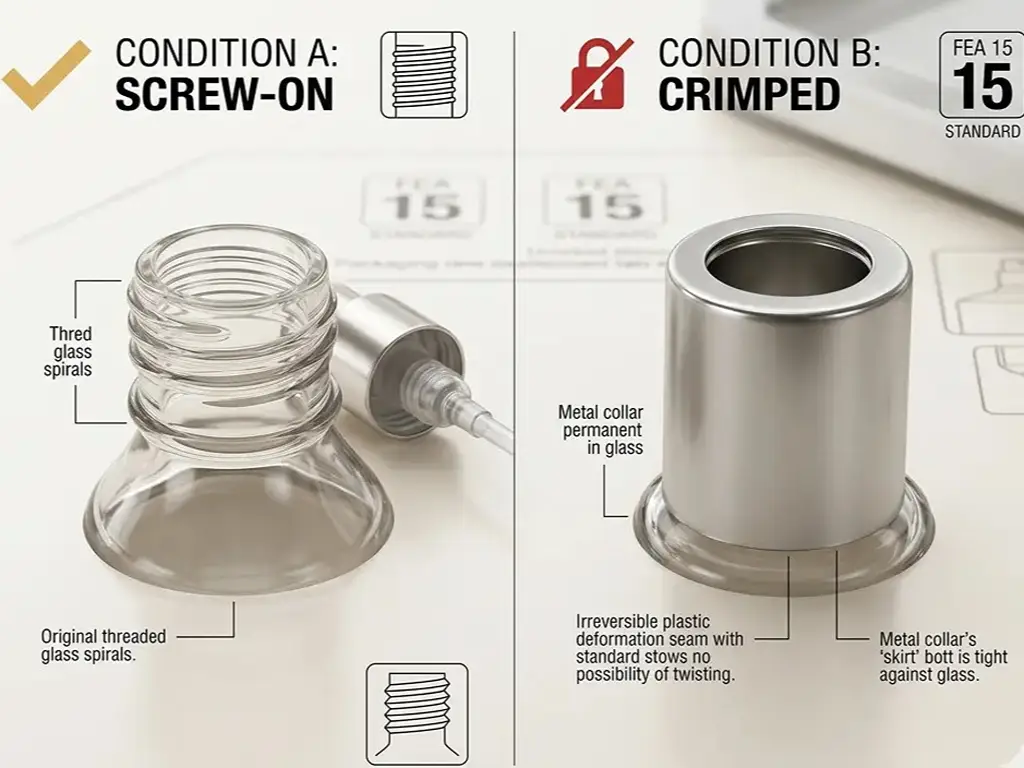
If you can grip the nozzle base and easily twist it counterclockwise to reveal threaded grooves.
👉 Non-DestructiveIf the nozzle is encased in a metal collar that sits flush against the glass and refuses to turn.
👉 Destructive PathIf your goal is to transfer liquid from a large bottle into a pocket-sized bottom-fill atomizer.
👉 Travel SolutionStep-by-Step Guide: How to Safely Transfer Your Perfume
Once you have diagnosed your hardware, absolute precision is required. We will strictly rely on physics and engineering principles to move the liquid safely. Locate your corresponding path below.
Before you begin the transfer process, ensure that you know how to open perfume bottle correctly, as many luxury flacons use permanent crimped seals that require specific tools to bypass safely.
Refilling Standard Screw-On Bottles
Step 1: The Non-Destructive MethodIf your bottle has threads, the process is non-destructive but requires finesse to prevent air-locks. You need a small polypropylene (PP) funnel or a blunt-tip medical syringe.
- The Funnel Suspension: Unscrew the pump. Insert the funnel stem, but do not let it rest flush against the glass. Lift it 1-2 millimeters. If the funnel blocks the opening, displaced air cannot escape, causing a pressure build-up that spits perfume everywhere. Pour slowly.
- The Syringe Extraction: Attach a clean, blunt-tip needle. Draw the fragrance from the source, insert the needle deep into the target bottle, and depress the plunger smoothly. This is the cleanest method available.
Decanting from Sealed Crimped Bottles
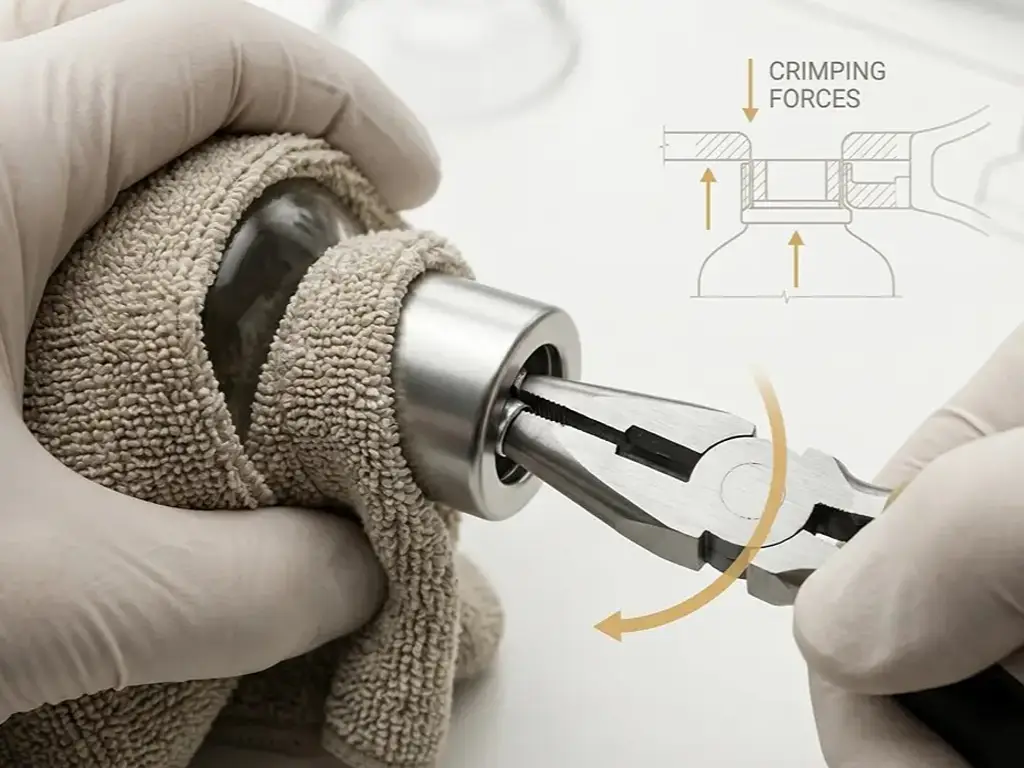
Step 2: The Destructive TransferTo safely dismantle a sealed FEA 15 bottle without shattering the glass and severing an artery, you must use mechanical leverage. You need heavy-duty needle-nose pliers and a thick microfiber cloth.
- Remove the Actuator: Pull the plastic spray button straight up and off.
- Protect the Glass: Wrap the neck tightly with the cloth. Bare pliers striking glass will cause catastrophic shattering.
- Peel the Orange: Grip the very bottom edge of the metal collar. Do not pull up. Pinch tightly and roll the pliers backward—like peeling an orange. Rip the aluminum skirt upward section by section until the tension is relieved and the cap pops off.
- Mandatory Decant: Once opened, the factory seal is dead forever. You must immediately transfer the juice to a new vessel.
Loading Bottom-Fill Travel Atomizers
Step 3: The Modern SolutionThese devices use a silicone one-way valve. The main reason they leak during filling is instantaneous air-lock inside the tiny chamber.
- Purge the Chamber: Before connecting, press the spray button on your empty travel atomizer 3-4 times to purge trapped air, creating negative pressure.
- The Rhythmic Pump: Align the base valve over the bare stem of the large bottle. Push down firmly, then let it rise. Wait 1 to 2 seconds between pumps. This pause gives the pressurized air time to escape. Frantic pumping forces liquid out the sides.
Regardless of which method you just used, or what kind of bottle you transferred your fragrance into, the very first thing you must do after completing the physical transfer is a Quality Assurance (QA) check.
- The Inversion Leak Test: Wipe the entire outside of your newly filled bottle with a dry tissue. Turn the bottle completely upside down and let it sit on a clean paper towel for exactly 5 minutes. Inspect the paper towel. If it is dry, your mechanical seal is sound.
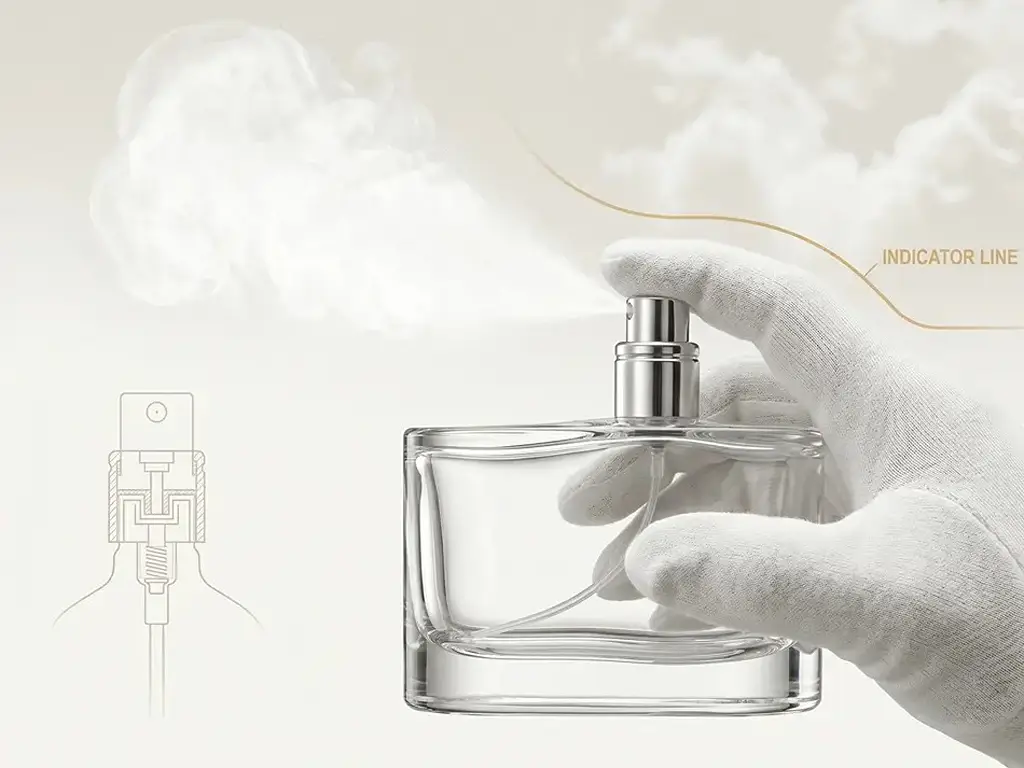
- Priming the Pump: Hold the bottle perfectly vertical and press the actuator down firmly 2 to 3 times into the empty air. You will hear a slight hiss before the liquid comes out. This exhausts the dead air out of the dip tube and establishes the initial vacuum lock, ensuring that the next time you reach for it, it sprays a perfect mist without sputtering.
Critical Precautions and Common Pitfalls to Avoid
Even with flawless mechanical execution, ignoring chemistry and physics can ruin your decanting project. Bypassing these common pitfalls separates the amateurs from the professionals.
One of the most catastrophic mistakes is filling a bottle to the absolute brim. Perfumes contain high concentrations of alcohol, which possesses a high coefficient of thermal expansion. If you fill the vessel to 100% capacity and the ambient temperature rises (for example, leaving it in a warm car or a sunlit room), the liquid will physically expand.
With no air gap to absorb this expansion, the hydraulic pressure will force the liquid up through the dip tube, rupturing the internal gaskets of the pump and causing permanent leakage. Always leave at least 10% to 15% of empty space at the top of the bottle—known in the industry as “headspace”—to act as a volumetric buffer.
Never decant fragrances in a bathroom after a shower or in a highly humid environment. Perfumery is a delicate balance of essential oils solubilized in ethanol.
High levels of atmospheric moisture can introduce water molecules into the open bottle during the transfer. This disrupts the chemical equilibrium, leading to a cloudy, milky appearance (a phenomenon known as maceration failure) and accelerating the souring of the top notes. You must execute your transfers in a cool, absolutely dry, and climate-controlled room to protect the juice.
After saving your expensive fragrance, pouring it into a cheap online replacement bottle is a fatal mistake. Low-grade glass alters the scent profile through chemical leaching, and generic nozzles squirt harsh streams instead of a fine mist. Why do original designer bottles perform so flawlessly? It all comes down to strict B2B manufacturing standards.
Whether you are a hardcore fragrance enthusiast replacing a broken bottle or an indie brand owner sourcing reliable packaging, understanding these benchmarks is crucial. Professional manufacturers like Nuvole Glass set the standard by utilizing Super Flint Glass—verified by three rigorous optical inspections—to guarantee absolute chemical inertness. Furthermore, instead of leaky generic sprayers, they engineer precision 1.0ml to 1.3ml high-dose pumps, backed by 100% vacuum testing. By demanding these manufacturer-level standards, you ensure your luxury fragrance retains its pristine quality and cloud-like mist.
How to Clean Empty Bottles and Remove Lingering Odors
If you intend to reuse a high-quality threaded bottle for a completely different fragrance, standard washing with soap and hot water will fail miserably. Fragrance molecules are highly lipophilic (oil-soluble), meaning they stubbornly cling to the microscopic pores of glass and plastic tubing. Furthermore, you must absolutely avoid standard Isopropyl alcohol (rubbing alcohol); its pungent, harsh chemical odor will permanently embed itself in the plastic dip tube, utterly ruining the scent profile of whatever luxury perfume you pour in next. You must use an industrial-grade solvent approach.
Purchase high-purity, unscented Ethanol (95% or higher), often sold as Perfumer’s Alcohol or high-proof grain alcohol. This is the exact base solvent used in fine fragrance formulation, meaning it will dissolve leftover oils without leaving behind a toxic scent footprint.
Fill the empty perfume bottle halfway with the pure ethanol. Screw the pump back on tightly. Shake the bottle vigorously for 60 seconds to allow the alcohol to strip the essential oils from the inner glass walls.
This is the most crucial step. You must pump the spray nozzle 15 to 20 times, shooting the alcohol completely through the internal springs, the dip tube, and the actuator nozzle. This flushes out the hidden residual oils trapped inside.
Unscrew the pump, discard the remaining alcohol, and place both the bottle and the pump in a dry, well-ventilated area for 24 to 48 hours. Ethanol evaporates rapidly, leaving you with a sterile container ready for a new scent.
Conclusion
Successfully refilling a perfume bottle requires more than just a funnel; it demands a fundamental respect for the engineering of the packaging and the delicate chemistry of the fragrance itself. By accurately diagnosing your bottle type, respecting the irreversible nature of crimped collars, and meticulously managing air pressure during transfers, you can protect your investment from spills and degradation. While the hands-on process of decanting provides a great short-term fix, the future of sustainable luxury undoubtedly lies in standardized, high-quality screw-on designs that honor both the artistry of the scent and the convenience of the user.
Don’t let inferior packaging ruin a masterful scent. Explore our collection of Super Flint Glass bottles and high-dose, cloud-mist pumps designed for perfection.
Consult with Nuvole Glass Experts