Perfume Bottle Spray Guide: The 4 Standards of a Perfect Mist
Every day you press the same tiny button on your perfume bottle. The bottle gets all the credit, the glass, the color, the weight in your hand, but the part you actually touch, hundreds of times, is the spray head. And it is the part that fails first: the mist turns into a jet, the button sticks, or the bottle quietly empties itself in a drawer.
This guide is about that button. If you wear fragrance, it tells you what to check before you buy. If you sell it, as a brand, distributor, or wholesaler, the same four standards become your sourcing checklist, because every consumer complaint about a spray is a business problem you inherit.
What Is the Spray on a Perfume Bottle? The Names and the Pump Inside
If you’ve ever wondered what the spray on a perfume bottle is called, the honest answer is: it depends on who’s talking.
- Atomizer — retail and refill culture; suggests a fine, oxygen-mixed mist. The classic term for refillable perfume bottles.
- Sprayer — repair and DIY contexts: “can I replace the sprayer on my perfume bottle?”
- Pump — the industry’s word for the whole dispensing mechanism, not just the button.
- Mister — a catch-all you’ll meet on multi-purpose spray bottles for everything from perfume to essential oils.
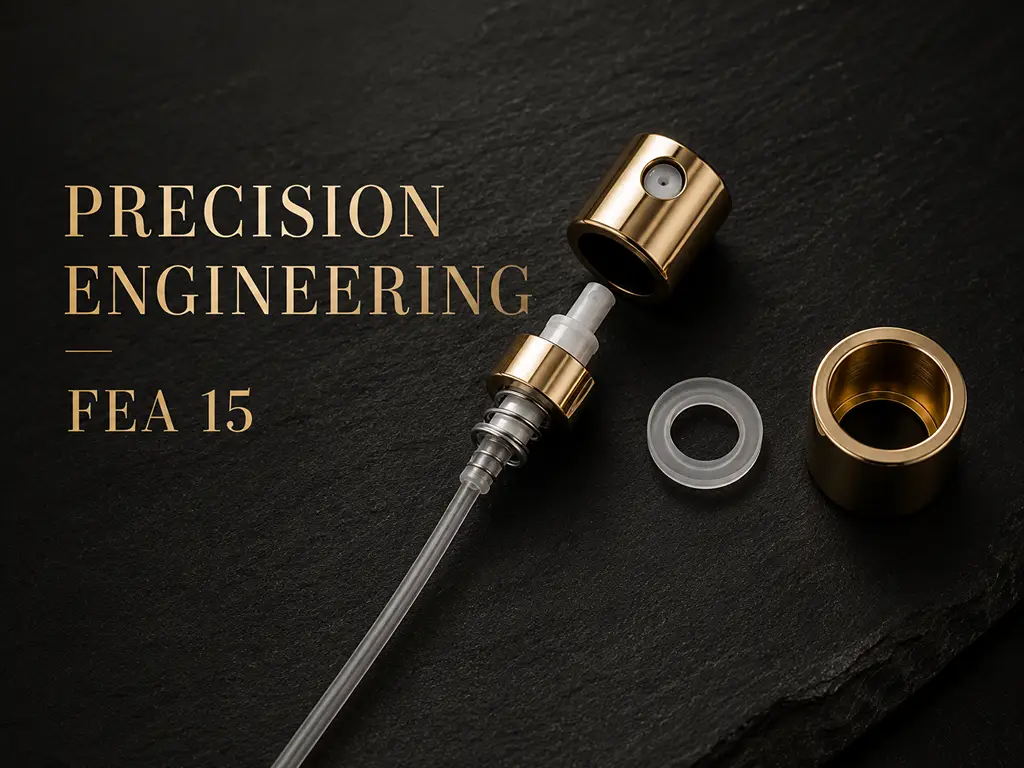
Whatever it’s called, the mechanism is the same. It’s also more precise than it looks. Think of a perfume bottle pump as a miniature syringe. Pressing the actuator drives fragrance up the dip tube, through a one-way valve, past a spring, and out through a tiny nozzle. Five parts do all the work:
- The actuator — the button your finger presses.
- The pump body — the cylinder that meters each dose.
- The valve — the one-way door that lets liquid out but not back in.
- The spring — returns the button for the next press.
- The gasket — the seal ring that keeps alcohol where it belongs.
Two of these five parts decide almost everything you feel: the valve and spring set how the spray performs, and the gasket sets whether it leaks. The glass is decoration; the pump is the product. For a consumer, that decides whether the bottle feels premium. For a brand, it decides returns, reviews, and repeat orders. Same five parts, two very different stakes.
The Four Standards of a Great Perfume Spray: Dose, Mist, Durability, and Control
Dose Volume: What 70, 100, and 130 Microliters Actually Feel Like
The most overlooked spec in fragrance is output per press, and the industry’s own numbers make it easy to check. Aptar, the world’s leading fragrance pump manufacturer, specifies its mainstream pumps (VP4, Essencia) at 70, 100, or 130–140 microliters per stroke (Aptar VP4, Aptar Essencia). That’s 0.07–0.14ml per spray. That’s why a 50ml bottle of perfume lasts somewhere between 500 and 625 sprays (Packamor, 2026).
That’s the spec sheet. Here’s the experience: at 100µl per press, building a proper scent trail means three or four presses. At 130µl, two or three. A deliberately high-dose pump, specified at 1.0ml or more per press, delivers the same coverage in one press, and heavy fragrance users notice the difference immediately: fewer presses, less wasted on the air, more intensity where they want it. The math works the other way too. A cheap low-dose pump isn’t saving you money; you pay for the same wear with extra presses and extra juice.
Read that spec the way a buying desk does and it stops being trivia. A low-dose pump means the same 50ml bottle delivers fewer satisfying wears, and every review that says “doesn’t spray enough” was written by a customer you paid to reach. Dose is a review-page risk before it is anything else.
Mist Pattern: A Cloud Is Measurable, Not Poetry
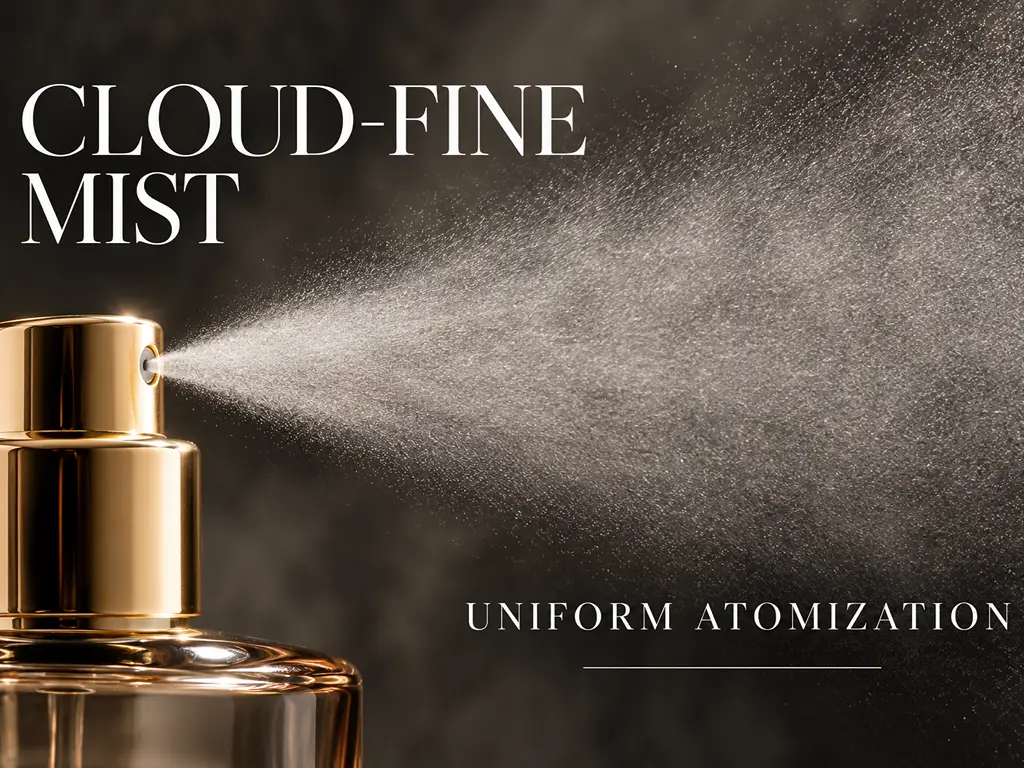
“Fine mist” is a phrase every listing claims and few deliver. But mist quality is droplet physics, measured with laser diffraction instruments in a lab.
Cosmetic spray research uses the Sauter mean diameter (SMD, d32) to describe mist fineness: smaller droplets mean a finer, more uniform cloud. A 2024 study of cosmetic spray atomization in Flavour Fragrance Cosmetics measured how this changes with the hardware: larger nozzle orifices produce coarser droplets, and higher spray pressure produces finer ones (Wang, Yuan & Huang, Atomization Effect of Cosmetic Sprays and Its Influencing Factors, 2024, DOI 10.20099/j.issn.1000-4475.2023.0256, full text).
In the real world, that difference shows up as a cloud versus a jet. A quality pump produces a soft, even cone that lands uniformly on skin or fabric. A cheap pump fires a wet stream with stray droplets: the classic toilet-water effect. A wet center, patchy edges, and fragrance that pools instead of diffusing. The structural difference is in the valve: ceramic micro-orifice valves atomize far finer than ordinary plastic ones. Your 30-second field test: spray once onto a tissue. An even, round gradient means fine mist; a wet center with splatter means a water jet.
For a brand, mist quality is the claim you make at the tester and have to deliver at the first press. A wet jet is the fastest way to lose a first-time buyer, and at scale, first presses happen thousands of times a day.
Durability: How Many Presses Before the Mist Dies
Pumps don’t fail suddenly; they degrade. The valve and spring are the moving parts, and their materials set the lifespan.
Plastic valve components with ordinary springs typically start spraying unevenly after tens of thousands of presses. Pumps built with ceramic micro-orifice valves and stainless steel springs are engineered for 100,000 presses or more without noticeable decline. Put that in perspective: at four sprays a day, a year of use is about 1,500 presses. So the real-world difference isn’t “will it last a year.” It’s whether the mist still feels new in year three. If a bottle’s spray turns weak or lopsided after a few months, the spring was the weak link.
You can test this in the store or at the mailbox: press a fresh bottle 20 times in a row. A quality pump stays crisp and even; a failing design starts to stick or fade by the end.
At business scale, durability is warranty math. A pump that dies early leaves a customer with a bottle they cannot finish and will not rebuy. The spring costs a fraction of a cent; the lost reorder does not.
Progressive Control: The Half-Press Feature That Changes How You Wear Fragrance
The newest differentiator in spray head design is progressive control, a pump that responds to how far you press it. Press halfway and it releases a light spritz; press fully and it delivers the full dose.
It sounds like a gimmick until you use it: one bottle now covers both the office-appropriate light touch and the evening full application, without carrying two concentrations. It’s also a reliable signal of a high-end pump, because the mechanism requires tighter valve engineering than a simple on-off spray. Few suppliers offer it at all; if you see it, you’re almost certainly looking at the top tier of pump hardware.
For brands, progressive control is a merchandisable difference: one SKU, two wearing modes. Because almost no supplier offers it, it works as a real positioning lever rather than a marketing line.
Where does all this leave you? Most pumps on the market are good at one or two of these four and ordinary at the rest. Nuvole, a glass packaging manufacturer that specializes in custom perfume bottles, is one of the few that packages all four into a single spray head: a 1.0–1.3ml dose per press, a cloud-like fine mist, 100,000-press durability, and progressive half-press control, verified by vacuum testing on every incoming pump batch and again after assembly. If you’re evaluating suppliers for a brand, their custom perfume bottle program and quality control process show exactly how each spec is measured and documented.
Why Perfume Sprays Leak — and What “Leak-Proof” Actually Means
Type “leak-proof perfume spray bottle” into any marketplace and you’ll get thousands of results, yet fragrance forums are full of people whose travel atomizers emptied themselves in a suitcase. The contradiction exists because leak-proof is a marketing adjective, not a standard.
A genuinely sealed spray is three layers of engineering: the seal ring material, the factory testing, and the long-term evaporation data. The stakes split the same way as the four rulers: what a consumer calls “my atomizer leaks” is what a distributor calls a returns line.
The Seal Ring: Why Rubber Gaskets Fail Against Alcohol
Start with an uncomfortable fact: your perfume is mostly solvent. Eau de parfum runs about 70–85% alcohol by volume, and fragrances overall range from 70 to 92% (Carrément Belle). The gasket between pump and glass sits in permanent contact with that solvent.
An ordinary rubber gasket slowly swells and softens in alcohol, the sealing surface deforms, and the bottle starts breathing. You lose fragrance drop by drop without ever seeing a “leak.” High-end systems use composite gaskets built from medical-grade silicone and PTFE (the same family as non-stick cookware), which shrug off alcohol for years. The International Perfume Bottle Association (IPBA) has long documented how sealing quality decides whether a bottle remains a treasure or becomes a science experiment on your dresser (IPBA).
The practical difference: a bottle with a quality gasket might lose well under one percent of its contents per year, while a failing one can quietly bleed several percent. Enough to notice by the time the season changes.
For anyone moving inventory, the gasket is where supplier quality shows up first. Leaking atomizers are freight claims, customs rejects, and a damaged reputation with retail buyers, all traced back to a part that costs a fraction of a cent.
Vacuum Testing: The Factory Check Most Cheap Sprays Skip
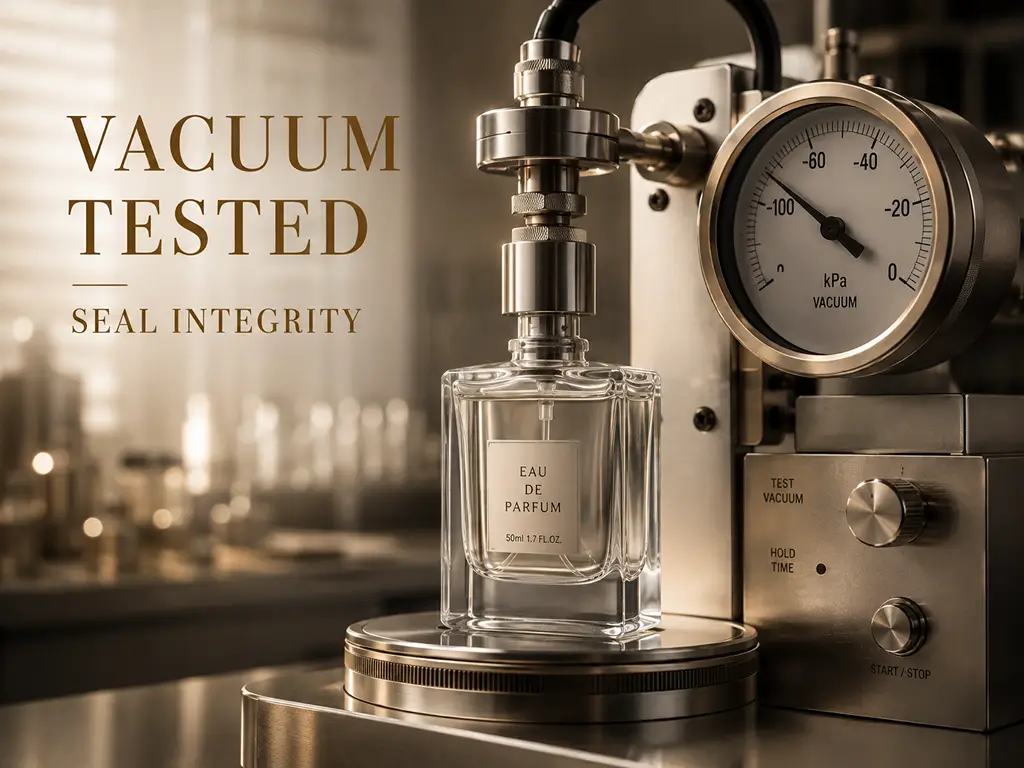
There’s a test that separates serious spray manufacturers from everyone else, and it’s invisible from outside: vacuum testing.
A vacuum test draws air out of the assembled bottle and watches whether the pressure holds. If the seal is flawed, the vacuum decays and the bottle fails before it ever ships. Quality-focused factories test twice: incoming pumps are spot-checked when they arrive, and every assembled bottle is tested again with its pump fitted. Many low-cost suppliers skip this step entirely, because testing costs money and you can’t see the difference in a product photo.
This is why two perfume sprays that look identical can be ten dollars apart. And it’s why asking a seller “do you run vacuum tests on assembled bottles?” is the fastest credibility filter you have.
For a sourcing manager, that same question is the cheapest supplier filter in the industry. It separates factories from resellers in one sentence, before you spend anything on samples.
Evaporation Rate: The Number That Tells You If a Spray Will Breathe
If you want one number to separate a sealed spray from a leaking one, ask about evaporation rate: how much fragrance the closed bottle loses per year.
Evaporation never stops. Alcohol vapor finds microscopic gaps between the gasket and the neck, pushed by the pressure difference between inside and outside. In a tight bottle that loss is nearly immeasurable; in a loose one it’s real money. To make it tangible: on a 50ml bottle, a modest-sounding 2% annual loss is about 1ml of fragrance, roughly ten sprays of perfume you paid for and never wore.
Most sellers have never heard this question. The ones who answer with a number and a test report are the ones you want to deal with.
For a brand, evaporation is shrinkage before the sale: product lost between the factory and the shelf. For a consumer, it is the bottle that smells empty too soon. Both are the same leak, counted on different ledgers.
The Bottle’s Supporting Role: Glass, Plastic, and the Neck Finish
The bottle deserves exactly two sentences of your attention in a spray discussion: as the spray system’s container and its interface.
First, material. Perfume contains 70–92% alcohol, and alcohol behaves very differently with plastic than with glass.
| Comparison Dimension | Glass Bottle | Plastic Bottle | One-Line Verdict |
|---|---|---|---|
| Long-term alcohol contact | Inert, no interaction with fragrance chemistry | Alcohol slowly permeates and can interact with the material | Glass wins for anything stored over months |
| Shelf life & evaporation | Tightest barrier available | Loses barrier performance over time | Glass wins for full-size bottles |
| Clarity & shelf presence | Crystal-clear brilliance, premium weight | Can mimic but never match depth and luster | Glass wins for display |
| Portability & break resistance | Heavier, shatters if dropped | Light, nearly indestructible in a bag | Plastic wins for travel |
| Cost at scale | Higher unit cost, higher perceived value | Cheapest option for giveaways and samples | Depends on your positioning |
Not all glass is equal either: cheap soda-lime glass looks faintly green or gray next to low-iron white flint glass, and amber glass adds UV protection that slows fragrance degradation.
Second, the interface. The pump meets the bottle at the neck finish, and that meeting point is standardized: most perfume bottles use the FEA 15 crimp neck, a 15mm finish defined by European standard EN 14854. The neck finish decides which pumps fit which bottles, and whether a broken sprayer can be replaced at all. More on that below.
For a brand, the same trade-off scales into unit economics: glass protects the formula and the shelf image, plastic cuts freight and breakage. Neither choice touches the spray standards above, which is why this section stays short.
Test Any Perfume Spray in 30 Seconds
Everything above fits into a quick ritual you can run on any bottle in your hand, whether it cost $5 or $50.
| Check | What to Do | What Passes Looks Like |
|---|---|---|
| Dose | Press once onto the back of your hand | A generous, even wet patch, not a barely-there film |
| Mist | Spray once onto a tissue from 15cm | A round, even gradient with no wet center |
| Rebound | Press 20 times in a row, listening | Crisp, even return; no sticking, no fading mist |
| Seal (quick) | Invert the bottle and shake gently | No drops at the neck, no scent on your fingers |
| Finish | Look at the collar where pump meets glass | Smooth, bright finish; no scratches or dents |
What you can’t test in thirty seconds: evaporation rate and long-term durability. For those, ask the seller whether assembled bottles are vacuum tested and whether they can share test records. The answer tells you more than the price tag does.
The same 30 seconds work at a trade show. A supplier who flinches at this checklist before you discuss MOQ just saved you a factory visit.
Replacing, Refilling, and Traveling with a Perfume Spray
Three practical situations account for most perfume bottle spray questions.
Can you replace the sprayer? Yes, if you know which type you have. Perfume pumps come in two mounting systems: crimp pumps, which are pressed onto the bottle neck with a metal collar and need a crimping tool to replace, and screw pumps, which simply thread on and off. The neck finishes themselves are standardized: EN 14854:2021, Glass packaging – Dimensions of neck finishes for aerosol and spray glass containers, defines the 11/13/15/17/18/20mm series commonly known as FEA 11, FEA 13, FEA 15, and so on, with sealing by ferrules per EN 14849 (EN 14854:2021). FEA 15 (15mm) is the workhorse for standard fragrance bottles; 13mm appears on minis, 20mm on oversized ones. If your replacement pump doesn’t match the neck system, no amount of forcing will help.
How do you refill without wasting half the bottle? Two tools make it clean: a small funnel for pouring, and a transfer pump that clips onto the original bottle’s nozzle and pumps fragrance directly into the new one. Bottom-fill travel atomizers, where the bottle docks onto the original sprayer and fills through its base, are the easiest of all and the least likely to spill.
What about flying? The TSA 3-1-1 rule covers perfume like any liquid: containers of 3.4 ounces (100ml) or less, packed in one quart-size clear bag (TSA). That’s exactly why 10–15ml travel atomizers dominate the market.
For brands, the neck finish decision is made once and locks everything after it: filling line, pump inventory, replacement parts. Choose FEA 15 before you order glass, not after.
For Brands: Sourcing a Perfume Spray That Meets the Four Standards
Everything above reads differently from a buying desk. The four standards stop being a consumer checklist and become four clauses in a supply agreement, and the leak tests become the quality clause. Here’s how that agreement gets built.
There’s a final level to this topic that most buyers never see: how the supply side actually works.
Sourcing a spray system for a fragrance line comes down to three decisions. First, stock versus private mold: stock pumps and bottles ship fast and skip tooling costs. Serious factories keep hundreds of stock molds, while private molds add 20–35 days for tooling and land the full cycle around 45 days. Second, neck finish compatibility: specify the FEA neck first, then match pump to bottle; getting this backwards is the classic first-order mistake. Third, the sample policy: it’s industry practice to offer free stock samples with the buyer covering freight. A supplier who won’t send a sample won’t pass a written spec.
| Stock vs private mold | Stock ships fast, no tooling fee; private mold 20–35 days |
| Timeline | Full cycle about 45 days (mold + production) |
| MOQ by bottle weight | 40–50g bottles: 50,000 pcs; 200–350g bottles: about 10,000 pcs |
| Samples | Free stock samples, buyer covers freight |
The single best advice for sourcing, though, is to reuse this article as your acceptance criteria: write the four spray standards and the sealing tests into your spec, and require vacuum test records per batch. Suppliers who can meet a written standard are suppliers you can scale with.
Choosing a perfume bottle spray is a five-minute decision that shapes three years of daily use. If you’re building a fragrance line, a partner like Nuvole Glass can walk you through stock designs, private molds, and free samples before you commit to anything.
References
- Aptar. “VP4 | Fragrance Pump.” https://aptar.com/en-us/products/vp4-high-performing-fragrance-pump
- Aptar. “Essencia SLP | Fragrance Pump.” https://www.aptar.com/en-us/products/essencia-slp-low-profile-fragrance-pump
- Wang Linjian, Yuan Minjia, Huang Zibin. “Atomization Effect of Cosmetic Sprays and Its Influencing Factors.” Flavour Fragrance Cosmetics, 2024(03): 23–27. DOI 10.20099/j.issn.1000-4475.2023.0256. https://xlxj.cbpt.cnki.net/portal/journal/portal/client/paper/5a2118429db39474a571279db43b91d0
- Carrément Belle. “Alcohol and perfume: the whole truth!” https://carrementbelle.com/blog/en/2021/10/13/alcohol-perfume/
- Packamor. “Spray Pumps for Perfume Bottles: A Practical Guide.” 2026. https://www.packamor.com/blogs/knowledge-hub/blogs-knowledge-hub-spray-pumps-perfume-bottles-guide
- CEN. “EN 14854:2021 — Glass packaging – Dimensions of neck finishes for aerosol and spray glass containers.” https://genorma.com/en/standards/en-14854-2021
- TSA. “Liquids, Aerosols, and Gels Rule.” https://www.tsa.gov/travel/security-screening/liquids-aerosols-gels-rule
- International Perfume Bottle Association (IPBA). https://perfumebottles.org/
- Nuvole Glass. “Custom Design.” https://www.nuvole-glass.com/custom-design/
- Nuvole Glass. “Quality Control.” https://www.nuvole-glass.com/quality-control/
- Nuvole Glass. https://www.nuvole-glass.com/