Perfume Bottle Materials Compared: Glass, Plastic, Metal and Ceramic
Perfume packaging materials should be selected around the formula, shelf life and dispensing system — not appearance alone. Among perfume bottle materials, glass is the default for alcohol-based fragrances because it is chemically stable and provides a strong vapor barrier. Plastic works best for selected samples and travel formats, while metal and ceramic require construction and compatibility checks. For solid perfume packaging, soft balms suit jars and tins, whereas twist-up tubes need a firmer, heat-stable base.
| Material | Best use | Main advantages | Main trade-offs | Relative cost |
|---|---|---|---|---|
| Glass | Full-size alcohol and oil perfumes | Chemically stable, strong barrier, premium feel, highly customizable | Heavy and breakable; raises freight and protective-packaging needs | Medium–high |
| Plastic | Samples, travel sizes and short-turn formats | Lightweight, shatter-resistant and inexpensive | Compatibility and vapor-barrier performance vary by resin and formula | Low |
| Metal | Protective shells and selected lined containers | Opaque, durable and distinctive | May need an internal liner; dents and tooling add complexity | Medium–high |
| Ceramic | Limited editions and statement bottles | Opaque, tactile and highly differentiated | Heavy and brittle; unglazed surfaces can be porous | High |
Why Glass Is the Default for Liquid Perfume
The container explains itself quickly. Perfume concentrate is dissolved in high-proof ethanol, and glass is one of the few container materials that never reacts with it: no leaching, no swelling, nothing migrating into the juice over years of storage. It is also a true vapor barrier, which leaves the closure as the only leak path, and it shows the liquid’s true color. That combination is why the industry has never settled on a substitute.
Plastic’s honest role is narrower. Thin-wall plastic suits travel sizes, samples and short-shelf-life launches; it fails at long-term storage of alcohol-heavy formulas. Many resins slowly swell in high-proof ethanol, and most plastics pass more vapor and oxygen than glass. Top notes fade; oxygen taint creeps in. If you do go plastic, ask which resin family it is and confirm compatibility with your formula.
Glass answers only half the question: a bottle protects nothing by itself. The juice still evaporates, degrades in light, or turns to sludge in the wrong container; what your perfume is decides everything you choose next.
Primary vs Secondary Perfume Packaging Materials
“Perfume packaging” can mean more than the bottle. Primary packaging touches or directly controls the formula; secondary packaging protects the finished unit and carries branding. A complete specification should name both, even when the bottle is the main sourcing decision.
| Packaging layer | Typical components | Material decision |
|---|---|---|
| Primary container | Bottle, vial, jar, tin or tube | Formula compatibility, light barrier, weight and breakage risk |
| Closure | Gasket, collar, screw cap and overcap | Seal performance, alcohol or oil resistance, and fit tolerance |
| Dispensing system | Pump, valve, spring, dip tube or roller ball | Dose consistency, corrosion resistance and formula compatibility |
| Secondary packaging | Paperboard carton, molded-pulp or paper insert, label and protective wrap | Transit protection, print finish, recyclability and retail presentation |
This guide concentrates on the primary system because it determines product stability, but the carton and insert still need enough strength to protect glass in distribution. Recycled or certified paperboard and molded-pulp inserts can reduce mixed-material complexity when they meet the required drop and compression tests.
Liquid Perfume Systems vs Solid Perfume Packaging
Liquid Perfume: Bottle, Closure and Dispenser
Perfume packaging splits into two engineering worlds that share almost no parts. Liquids (alcohol sprays, oil roll-ons) live or die by a three-piece chain: bottle, closure, dispenser. The closure (screw cap, or a crimped collar locking the pump onto a standardized 13–15 mm FEA neck) seals it; the pump delivers it. A leak is rarely “the bottle leaking”; it is one failed link in the chain, which is why leak tests run on the assembled bottle, not the empty glass.
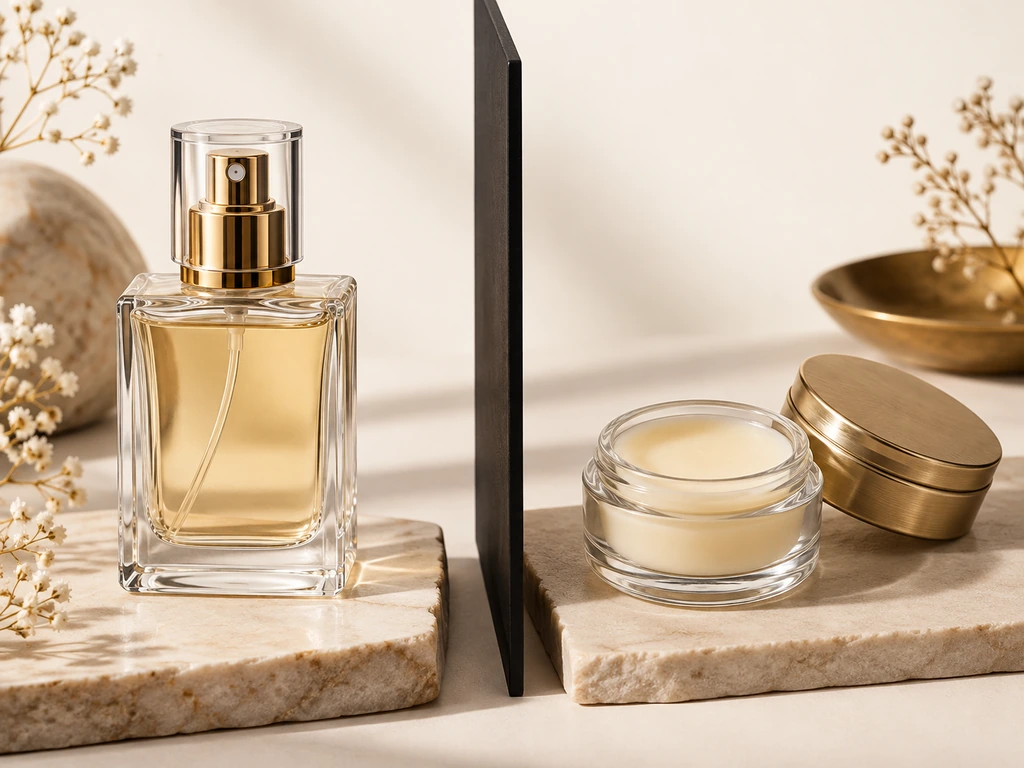
Solid Perfume Packaging: Jars, Tins, Compacts and Push-Up Tubes
Solids are the other world, with harder physics. A wax-and-butter base has no leak risk and no spray mechanism, but it is soft and lives in pockets and bags. Most blends begin softening around 30–40 °C, well within a summer handbag or a delivery van. The container must therefore match both the base’s hardness and the heat it will meet. The same solid can be a joy in a wide-mouth jar and a disaster in a push-up tube: the mechanism demands a stiffness a warm base cannot supply.
| Container | Works best with | Where it fails |
|---|---|---|
| Glass jar (screw lid) | Soft and medium balms; keeps oils stable | Drops break it; bulkier in a pocket |
| Metal tin (slide or pry lid) | Medium-firm balms; travel and pocket carry | Thin metal transfers heat fast in summer |
| Plastic push-up tube | Firm, deodorant-style bases only | Soft bases push out and never return once warm |
| Lip-balm-style twist tube | Firm balms in stick format | Soft or buttery bases smear and detach |
| Refillable compact | Premium balms and replaceable-pan programs | Hinges, magnets, adhesives and pans add compatibility checks |
| Paperboard push-up tube | Firm sticks and low-plastic positioning | Oil staining, moisture and soft formulas can compromise the pack |
The rule for makers is short: the softer the base, the more open the container. Butter-soft blends belong in jars or tins; push-ups are safe only once the base holds shape at 35 °C. Decide the container before you print a label. The failure surfaces as a customer complaint, not a lab result.
For solid perfume packaging, test more than heat resistance. Confirm oil compatibility, fill temperature, lid security, pan or adhesive stability, label area and how the user reaches the final grams of product. Refillable compacts can support a premium reuse model, while paperboard formats need a proven oil barrier and moisture performance rather than an unqualified sustainability claim.
How to Choose Perfume Packaging Materials for Light, Air and Heat
With the container form settled, three environmental threats decide the remaining material choices: ultraviolet light, evaporation, and heat. Each is where “just buy a pretty bottle” quietly goes wrong.
UV-Sensitive Formulas Need Colored Glass, Not “Glass”
The UV Misconception
Clear glass does not block UV light.
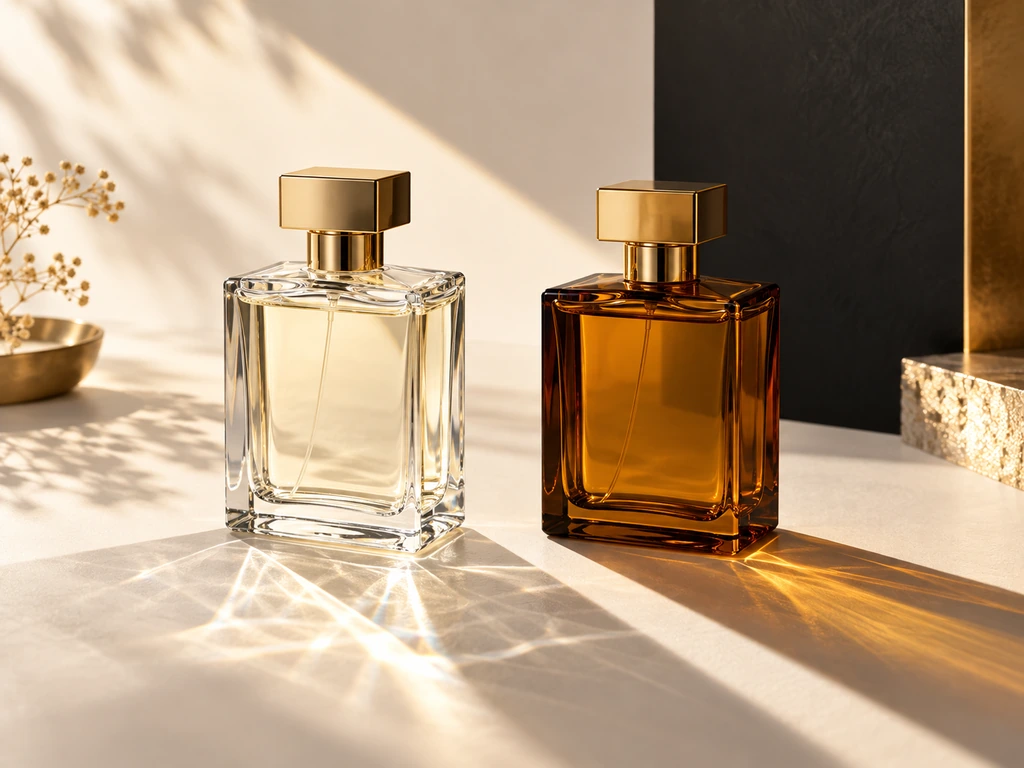
A transparent flint bottle lets ultraviolet straight through to the juice inside. UV protection comes from the color of the glass — or an opaque carton — not from “glass.”
It is the most repeated misconception in perfume packaging content, and its cost is faded, skunky juice on the shelf. Amber filters UV (the default for photolabile ingredients such as citrus oils), and other colors cut part of the spectrum. If your formula is light-sensitive, sits on a sunlit shelf, or needs a long shelf life, colored glass is a material requirement, not an aesthetic option. Transparent flint is fine only when the formula is light-stable and light is managed in transit and display, a decision made on purpose, not by default.
Volatile Formulas Need a Seal System, Not Just a Bottle
Evaporation is the second threat, and the mental model is backwards: perfume does not escape through glass walls. The escape route is the closure and pump, and their sealing materials set the evaporation spec. Ask suppliers for the rated evaporation of a filled, sealed bottle, and you will hear very different numbers by seal class. Performance systems built on medical-grade silicone and PTFE-type gaskets are quoted below 0.1% per year. Ordinary rubber seals, which also swell and harden after months in alcohol, are typically quoted in the 2–3% range.
Rated Evaporation, One Filled Bottle
<0.1% / year
Performance seal systems
Medical-grade silicone + PTFE-type gaskets
2–3% / year
Conventional rubber seals
Swelling and hardening after months in alcohol
Ask for the rated figure in writing. It is a spec, not a marketing claim.
For a long-shelf-life or high-value launch, ask for the seal spec and rated evaporation in writing. For fast-turn SKUs, a conventional seal is acceptable, but know which class you bought.
Heat-Soft Formulas Need Temperature Margin
The third threat is mostly solids, and consumers feel it first: a base that softens around 30–40 °C needs a container that still works when warm. That is precisely where push-up formats fail soft bases, turning them into un-pushable sludge after one hot day. The fix is usually the formula (firm the base) or the container (jar or tin instead of tube), decided before tooling. For liquids the question is quieter. High-proof formulas freeze far below retail conditions; the only practical check is pump residue crystallizing in the nozzle after long idle periods.
A solid that is fine at 20 °C can soften in a delivery van or handbag at 30–40 °C. Container mechanism and base hardness are one system; design them with margin.
This is shifting because solid perfume is growing faster than the packaging engineering around it: complaints about softened push-ups and hard-to-open tins are easy to find, and each is a small brand’s opening to ship a container that actually matches its base. The winners will treat light, air and heat as spec items, not surprises.
Glass Grades, Pumps, Seals and Finishes: Reading a Bottle’s Material Spec
Choosing materials is only half of it. You also have to read a supplier’s spec sheet. Four layers deserve scrutiny: the glass grade, the components inside the closure, the finishes, and the route by which your design gets made.
Glass Grades: Soda-Lime, High-White, Crystal-Clear Flint and Crystal
Commercial bottles form a ladder of four grades. Ordinary soda-lime glass is the workhorse, faintly green in thick sections. High-white glass is low-iron: whiter and clearer at the same wall thickness, and where “premium” usually starts. Crystal-clear flint (also called super-flint) tops the clear range: whiter still, freer of surface marks, and a grade you feel in the hand even when photos cannot show it. Crystal is a separate category defined by composition. Lead crystal is conventionally 24% or more lead oxide, while modern lead-free crystal substitutes barium or zinc oxides. Because leaded glass faces tightening contact restrictions, confirm yours is the lead-free system before signing.
| Grade | What it is | Fits which positioning |
|---|---|---|
| Soda-lime | Standard glass, faint green cast in thick walls | Mass-market and budget lines |
| High-white | Low-iron, clearer and whiter | Mainstream-premium |
| Crystal-clear flint (super flint) | Ultra-white, mark-free surface, tactile difference | Premium and luxury-clear lines |
| Crystal (lead or lead-free) | Defined by composition (24%+ PbO, or Ba/Zn systems) | Faceted, cut, statement bottles |
Two traps live on the ladder. Finishes hide grade: a sprayed or frosted bottle makes a low-grade blank look identical to flint in photos. The difference shows in hand and in transmitted light, so ask for uncoated grade-comparison samples before committing to a decoration. And heavy treatments need thick walls: multi-facet polishing physically removes glass, so a cut bottle must be designed for it from the mold stage. On the fringes: metal blocks light completely but dents and costs more to tool; glazed ceramic is handsome but heavy and brittle, and unglazed ceramic is porous, a genuine evaporation path for alcohol formulas.
Inside the Closure: Pump and Seal Materials
Three material positions decide whether a sprayer still works in year two. The valve core (ceramic micro-porous in high-end pumps, plastic in budget ones) controls mist consistency. The spring is 316L stainless in quality pumps versus ordinary steel, which corrodes and loses tension in alcohol. The gaskets are medical-grade silicone or PTFE-type in performance seals versus rubber, which swells, hardens and leaks. Each position maps to a failure mode, and to a question you can put to a supplier.
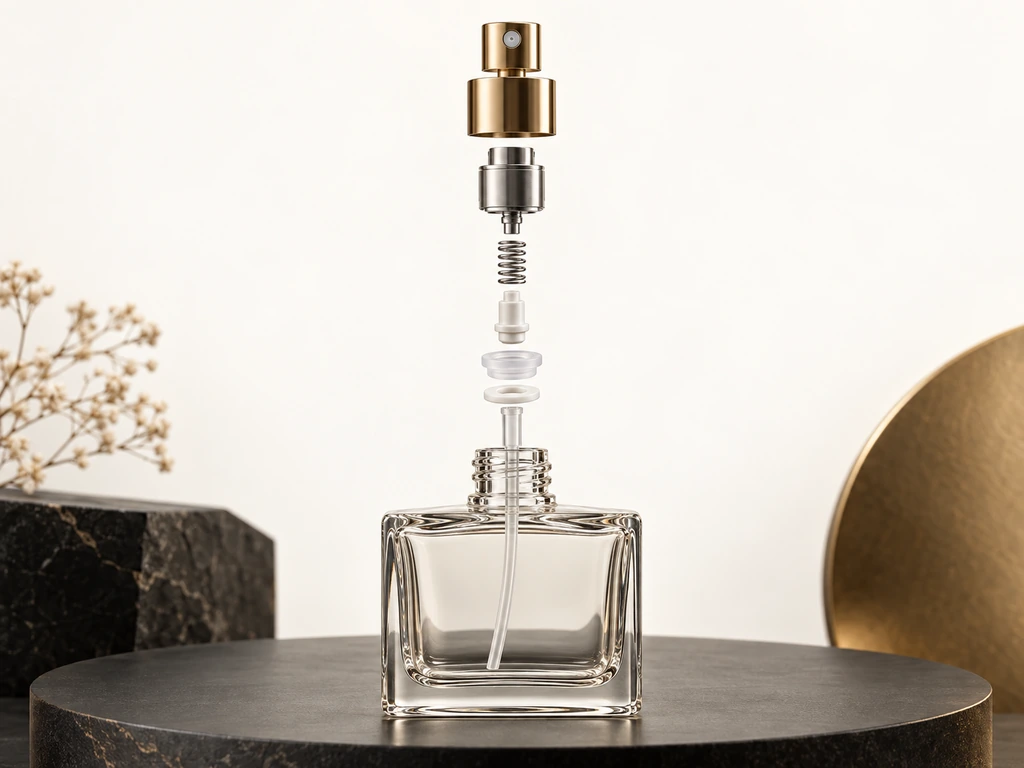
| Component | Quality material | What goes wrong cheap |
|---|---|---|
| Valve core | Ceramic micro-porous | Plastic inserts mist unevenly over time |
| Spring | 316L stainless | Ordinary steel corrodes, loses tension |
| Gaskets | Medical silicone / PTFE-type | Rubber swells in alcohol, then leaks |
| Assembly | Crimp vs screw collar on standard neck | Bad crimp = first-week leakage |
The other non-negotiable is compatibility testing with your liquid. Alcohol-based perfumes suit standard systems, but oil-based fragrances can attack standard pump materials: dissolving seals, swelling cores, clogging orifices. Send a sample for compatibility testing before ordering volume; a supplier who refuses the test is telling you something.
Finishes That Stay: Decoration and Adhesion
Decoration is a materials question too: every finish is a layer that must stick to glass for the product’s whole life. The standard toolset is compact: spray/paint coating, silk screen, hot stamping, decals, and engraving. Engraving cuts into the glass and cannot peel; printed methods live or die by adhesion, a documented failure. Small brands repeatedly report prints and labels that never stick or peel after weeks of alcohol exposure. Glass needs the right surface treatment and ink-system match for a finish to bite, so ask for alcohol-wipe and aging tests on your decorated sample before the production run.
Sustainability: Evaluate the Whole Packaging System
No perfume bottle material is sustainable in isolation. Glass is widely recyclable and can be reused, but heavy walls increase production and freight loads. Plastic cuts transport weight but depends on resin choice, local collection and whether pumps, labels and coatings can be separated. Metal is durable and recyclable, yet a lined or mixed-material construction may complicate recovery. The useful comparison is therefore the complete pack: material weight, recycled content, refill potential, decoration, component separation, secondary packaging and the real recycling routes in the target market.
Ask suppliers to document material identities and recycled content instead of relying on broad terms such as “eco-friendly.” For cartons, specify recycled or responsibly sourced paperboard where appropriate, minimize plastic lamination and use a right-sized paper or molded-pulp insert that still passes transit testing. A lighter bottle that arrives intact can be a better system choice than a nominally recyclable bottle that needs excessive protective material.
Stock, Customized or Custom-Molded: Where the MOQ Thresholds Sit
Finally, the route to production, and the honest MOQ picture: “low MOQ” marketing is loudest exactly where the truth is least flattering. There are three tiers. Stock bottles, bought as-is from a catalog, suit testing and micro-runs. Stock bottles with custom decoration (your silk screen, your hot stamp) cost more per piece but keep order sizes small, because the mold already exists. Full custom molding is a different world: independent fragrance makers consistently report custom-mold runs starting around 10,000 pieces. Custom-mold MOQ is also commonly scaled by bottle weight: heavier bottles cost more per unit, so required quantities drop as weight rises. That is why the right question is not “what is your MOQ” but “what is your weight-based MOQ schedule, and where does stock-with-decoration start.”
For an emerging brand the rational order is stock, decorated stock, then mold: validate the formula and the market before paying for tooling. What changes that math is the supplier itself.
Nuvole Glass runs the same logic in the opposite direction. Our stock program keeps over 500 perfume bottle designs and more than 500 cap styles in-house, and the five decoration methods above (silk screen, hot stamping, spray coating, decal, engraving) run on our own lines, so a first order can start from an existing shape and still carry your color, logo and finish (perfume packaging range). Because the mold already exists, early runs stay far below the tooling-scale quantities above, and our 3–5 design concepts with 3D modeling come in 3–7 days, with production quoted at 30–35 days (custom-design process). Send us the five-check email from the next section, and you will get the same grade spec, seal class and weight-based schedule we use for every line we produce.
What Fails First — and Five Checks to Run Before You Commit
Now you can spec a bottle. The last skill is verification: telling a manufacturer that answers engineering questions from one that only sells a catalog.
The Failures That Show Up First
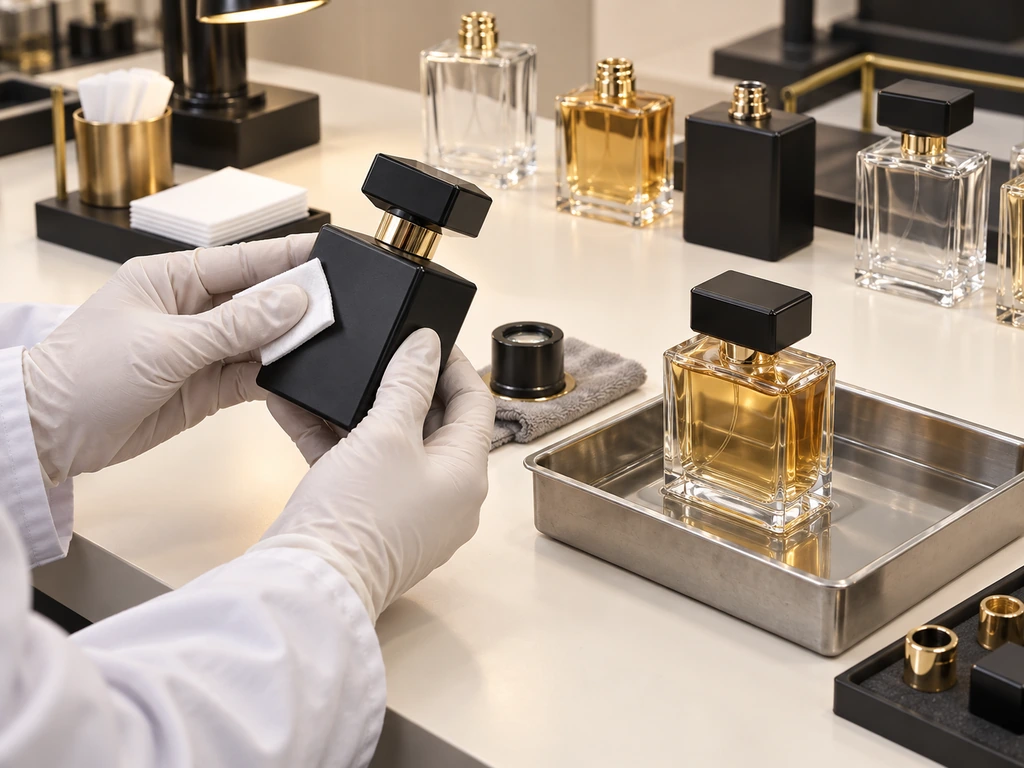
Four failure classes account for nearly every bad first order. Leaks and fast evaporation. A seal or crimp never tested as an assembly (small-brand makers comparing quality, leaks and spray performance before bulk orders). Peeling prints and labels. Decoration never tested against alcohol or time; the same thread’s makers report sample labels that simply would not stick. Soft solids that stop working. A push-up mechanism matched to a base too soft for it, which consumers freeze, scrape into jars, or return. Transit breakage. The difference between full inspection and random sampling, which you should treat as a negotiation item with a stated claim rate. All four are discoverable before you commit, if you ask in writing.
Five Checks That Fit in One Email
| Check | Why it matters for your formula | What to ask for |
|---|---|---|
| Seal & evaporation | Alcohol and long shelf life live or die here | Seal material class and rated evaporation in writing, plus leak-test protocol |
| Glass grade | A sprayed bottle hides its blank | Written grade spec (soda-lime / high-white / flint / crystal) + uncoated grade samples |
| Pump & compatibility | Oil-based formulas attack standard pumps | Pump material list and an oil-compatibility test on your sample |
| Decoration adhesion | Prints peel after months in alcohol | Surface treatment method and alcohol-wipe / aging test on your decorated sample |
| MOQ & route | Budget decides stock vs decoration vs mold | Weight-based MOQ schedule and where stock-with-decoration starts |
Use the table as your first email, literally. A supplier who answers all five with specs, samples and test protocols is a partner for the long run; one who answers “no problem, we can do anything” has failed in a single sentence. You are screening for the difference between a catalog and an engineering department, the entire game when your name is on the bottle.
Why Ordering Packaging “for Looks First” Costs More
Replay the failure lists as a business line and ordering stops being a taste question. For an established house, a peeling print is a quality incident; for an emerging brand it is the launch: no equity to absorb returns, no inventory buffer, no second chance with the retailer. One batch whose prints peel or seals weep can consume a quarter’s margin in replacements, freight and lost placement.
The order that avoids it is the one this article has built. Fix the formula’s requirements first (form, light, evaporation, temperature). Read the spec next (glass grade, seal class, pump materials, finish adhesion). Run the five checks against shortlisted suppliers, and only then talk decoration, price and minimums. Screening happens before quoting, so the residual risk is what no spec can answer: whether the market likes your scent.
The path can stay small while you learn that: a stock shape with your decoration is a full product test at a fraction of the tooling commitment, and the mold investment comes after the market votes. If you are sourcing perfume packaging materials for a first run, send your formula and target batch size to Nuvole Glass. We will reply with the glass grade, seal class and weight-based MOQ that match it, plus a decorated sample before you commit.
Get a Bottle Spec That Matches Your Formula
Send your formula and target batch size. We reply with the glass grade, seal class and weight-based MOQ that fit, plus a decorated sample before you commit.
Send Your Formula BriefReferences
- Reddit, r/DIYfragrance. “Custom Fragrance Packaging from Alibaba.” 2026. https://www.reddit.com/r/DIYfragrance/comments/1snynt7/custom_fragrance_packaging_from_alibaba/