The Anatomy of a Perfume Bottle: 6 Essential Parts Every Brand Must Know
Think about spending 18 months in fragrance development, to open up your first commercial order and there are wet boxes and loose labels. The culprit? A micro-millimeter discrepancy between the neck of the glass and the metal collar that spilled half your inventory during the shipping. This is a heart-breaking fact that is extremely widespread among young brands. A perfume bottle is much more than a drawing of a nice figure, it is a high stakes micro-engineering problem. Knowing its anatomy is your final weapon against disastrous leaks. This guide will also help strip away the layers of the top cap to the heavy glass base, so that you will be able to talk to factory engineers like a professional and guarantee your packaging to be as perfect as the fragrance in it.
The Crown Jewel: Perfume Cap (Overcap) and First Impressions
The top is the actual and metaphorical top of your product. Physically in store, it is the first touch that your customer will have with your brand. They sense the weight, temperature, and feel of the overcap long before they perceive the taste, smell, or the juice. Materials tell a lot in the luxury packaging world.
Shatterproof; exceptionally resistant to harsh perfume chemicals.
High-End Designer Brands
Sustainably Sourced Wood (Ash, Beech, Walnut)
Warm, natural texture with unique wood grains.
Classic eco-friendly appeal with a premium, organic feel. (⚠️ Requires inner plastic lacing)
Contemporary Eco-Friendly
Bamboo (Fast-Renewable Grass)
Earthy, organic aesthetic with distinctive bamboo nodes.
The ultimate sustainability story (grows rapidly). (⚠️ Susceptible to mold/cracking during ocean freight if moisture isn’t strictly controlled. Inner liner mandatory)
Clean Beauty / Indie Eco-Brands
Aluminum (over ABS core)
Metallic look but surprisingly lightweight.
Cost-effective metal illusion. Doesn’t tarnish easily but lacks the premium “heavy” feel.
The mass-market champion. Lightweight and cheap. (⚠️ Prone to scratching, peeling, and chemical clouding over time)
Mass Market / Fast Fashion Fragrances
But beyond the material aesthetics, there is a hidden mechanical metric that separates a cheap bottle from a masterpiece: Pull Force.
Expert Tip: A premium perfume cap must have a calibrated pull force (the effort required to pull the cap off) between1.5kg and 3.0kg. Why is this so crucial? If the friction between the cap and the inner collar is too tight, a customer trying to open the perfume might accidentally rip the entire spray pump off the glass bottle, causing a catastrophic spill. If it’s too loose, a customer picking up the bottle by its cap will watch in horror as the heavy glass body slips out, crashing onto the bathroom floor. That satisfying, magnetic “click” or smooth glide you feel on a $300 perfume? That isn’t an accident; it is ruthless precision engineering.
The Critical Interface: Collar, Neck Finish, and the Leak-Proof Gasket
When you take off the cap and the spray button, you see the most important defense line of the whole product the interface. It is at this point that the glass and the metal touch, the liquid is closed and 90 percent of all leakage catastrophes begin.
Collar Types and Neck Finishes (The FEA Standard)
What type of collar (ring of metal or plastic) and pump you may have is entirely determined by the neck finish of the glass bottle. You do not want to recreate the wheel in the international fragrance business. The standard of gold is the FEA 15 standard (a neck outer diameter of 15mm).
When you instruct your designer to design you a beautiful but full custom 14.3mm neck finish, you will be ready to pay astronomical prices on custom molds of the pump, the collar and the cap, and will maximize the chances of leaks. By adhering to FEA 13, FEA 15 or FEA 20, compatibility with thousands of suppliers is guaranteed. When your neck finish is in place, you will need to decide on the way to cap the bottle. Here is the breakdown:
Sealing Method
How It Works & Manufacturing Reality
Ideal Brand Application
Crimped (The Industry Standard)
Requires a specialized pneumatic crimping machine on the assembly line to permanently crush and fold the aluminum collar around the glass neck lip. It provides unbeatable leak protection and is tamper-proof.
The glass neck has threads, and the pump simply twists on. It requires no heavy machinery to assemble, making it great for start-ups doing manual filling.
Eco-conscious brands offering refillable perfume programs, or indie brands bottling in small, manual batches.
Crimpless / Snap-On
The collar is pushed down over the glass neck until internal plastic teeth “click” and lock it into place. It speeds up the assembly line significantly.
Mid-market brands needing high-speed, automated production without the investment in expensive crimping tools.
The Gasket (O-ring): The Unsung Hero of Leak Prevention
Buried deep within the metal collar and wedged between the rim of the glass is a very small ring known as the gasket, which is very cheap. It may only cost you a fraction of a cent but it will hold the fortunes of your whole business.
Perfumes are harsh chemical compounds that usually have as much as 80% of high-proof ethanol (alcohol) and strong essential oils. When a factory attempts to cut on cost with the help of a typical, low price plastic or rubber used as this gasket, it will gradually be chewed up by the alcohol. In a matter of weeks, the gasket will swell, distort or be lost. The seal cracks and your costly perfume only flies into the air. You will have to state clearly that your supplier should apply very chemical resistant materials such as Silicone or NBR (Nitrile Butadiene Rubber) as the gasket. Do not do away with this unseen hero.
The Delivery Engine: Actuator, Pump, and Dip Tube
We have now breached the defense line. Next, we pull out the dynamic heart of the bottle: the delivery system. This complex mechanical assembly is responsible for taking the dormant liquid and transforming it into a sensory, tactile experience.
The Actuator (Sprayer): Shaping the Mist
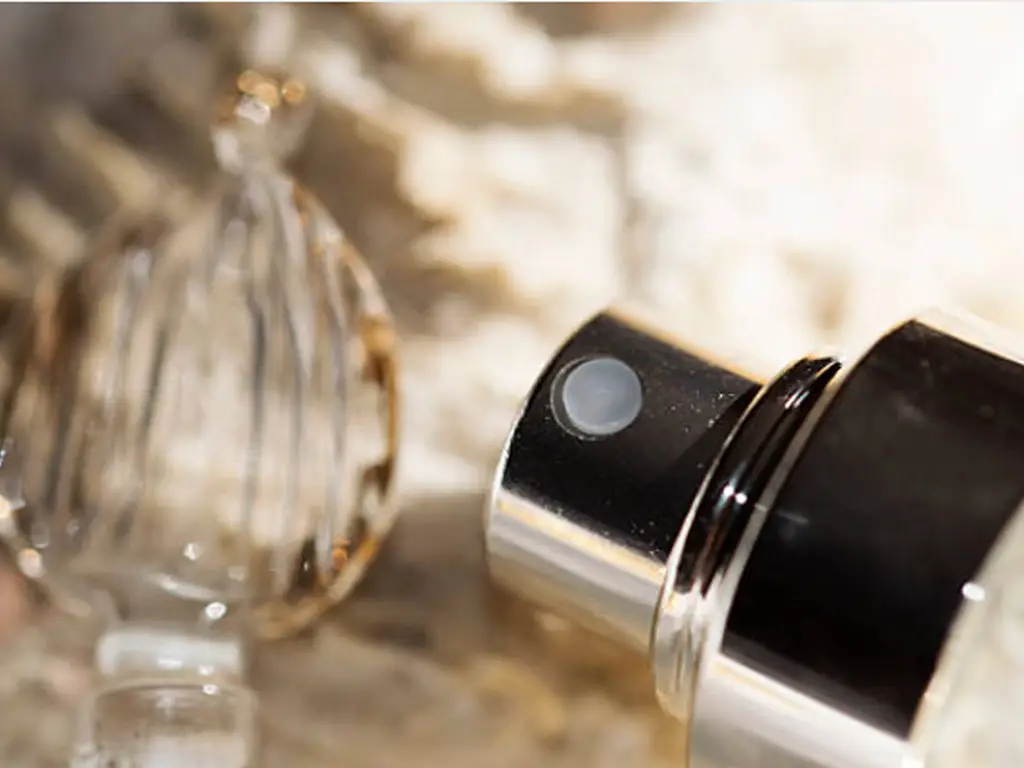
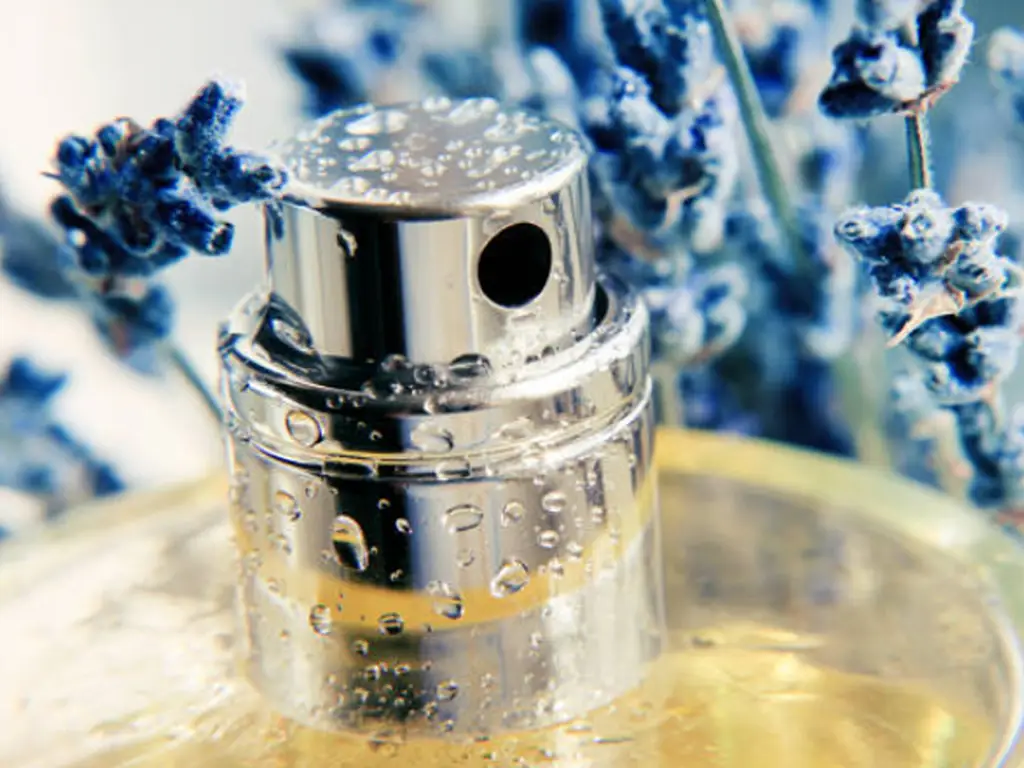
The physical button that is pressed by the index finger of your customer is referred to as the actuator. Although the outer is engraved with logos or made in classy metallic finishes, the magic is conducted within the microscopic nozzle, referred to as the insert.
The shape of this small insert determines the shape of the spray pattern, the cone angle, and the size of the droplets. When the tooling tolerance of the factory is only a hair out of place your well-crafted top notes are not going into the air. Rather they will burst out in a jagged, highly-intensive wet jet that riches back the skin. A high quality actuator produces a longer mist that looks in the form of clouds since this helps in flash off the alcohol in a short period of time leaving behind the pure fragrance profile on the skin.
The Atomizer Pump: The Heart of the Dispenser
Beneath the actuator lies the atomizer pump, a micro-engine containing a tiny stainless steel spring, a glass ball valve, and a plastic piston. When pressed, it creates a vacuum that pulls the liquid up.
A high-quality pump is meticulously calibrated to deliver a precise dosage—typically between 0.08ml and 0.12ml per press. It must also have a smooth, linear resistance. If the spring is made from cheap, uncoated metal, the fragrance oils will eventually cause it to rust, turning your beautiful golden perfume into a murky, brown liquid.
The Dip Tube: The Invisible Luxury
Go to one of the up-end department stores and observe the high priced niche perfumes of say 400 dollars closely. Notice anything missing? The plastic tube in the liquid is not normally visible.
There is no way to mar the appearance of a beautiful glass bottle of crystal clarity more effectively than to place down the middle of it a cloudy, thick, white, tube of plastic. Whereas the standard PE or PP plastic tubes are used in the mass-market brands, luxury brands demand the use of invisible dip tube. These are manufactured using special Fluoropolymers (such as Teflon). The trick is optics: the refractive index of this material is the exact one of the refractive index of the perfume liquid. When the tube is submerged, it deflects the light just as the liquid does and becomes practically invisible to the naked eye. It is an insignificant fact, but it makes a bottle no longer an ordinary package but a perfect, jewel-like image.
The Foundation: Perfume Glass Bottle and Puddling
Finally, our journey brings us to the vessel itself. In the B2B world, purchasing glass isn’t just about picking a beautiful silhouette from a catalog. It is about understanding material grades, overcoming manufacturing limits, and mastering the psychology of weight.
When a consumer picks up a fragrance, their brain instantly associates physical weight with financial value. To achieve this, luxury brands utilize a design technique called Puddling (or the Glass Base)—designing the mold so that a thick, solid block of heavy glass sits at the bottom before the liquid cavity begins. Furthermore, this requires Super Flint Glass. Unlike standard glass with its slight greenish tint, Super Flint is highly purified, offering a crystal-clear, diamond-like transmission that makes your perfume color pop.
However, luxury comes with severe manufacturing hurdles. Pushing molten glass to form a massively thick, heavy base often causes uneven cooling. If a factory lacks masterful temperature control, you end up with disastrous visual defects: ugly “cold spots,” wavy watermarks, or trapped air bubbles inside that expensive thick base.
Overcoming Defects: The 5-Stage Quality Control Protocol
Achieving a flawless glass base requires uncompromising quality control. To prevent these defects, forward-thinking brands partner with specialized manufacturers like Nuvole. Their production begins with rigorous Glass Material & Process Control, where high-purity glass and optimized molding ensure consistent quality right from the furnace. To specifically tackle the issue of watermarks and trapped air in a thick base, they execute a strict Surface Treatment Inspection (3 Stages), meticulously checking for scratches, bubbles, and coating uniformity to guarantee perfect aesthetics.
Beyond visual clarity, the physical bottle must flawlessly support the pumps and collars discussed earlier. Nuvole conducts dedicated Vacuum Testing to ensure leak-proof seals, which is absolutely critical for fragrance preservation. They also perform rigorous Structural Integrity Testing to evaluate bottle strength and prevent breakage during international transport or daily use. Finally, rather than relying on random batch sampling, they enforce a Full Bottle Inspection, where every single unit undergoes dual human-machine checks for zero defects. By adhering to these exact manufacturing protocols, your brand secures the heavyweight luxury feel it deserves, completely free from backend defect headaches.
Now that you understand the anatomy, you must understand the business risk. The biggest mistake new brands make is trying to save a few pennies by sourcing the glass bottle from Factory A, the pump from Factory B, and the cap from Factory C.
In manufacturing, every single component has an acceptable margin of error, known as a tolerance. If Factory A’s glass neck is manufactured at the maximum allowed size (+0.2mm), and Factory B’s metal collar is manufactured at its minimum allowed size (-0.2mm), they will not fit together. This is called a “Tolerance Stack-up Disaster.” When the crimping machine presses down, the glass neck will shatter into pieces on the assembly line.
Before you wire a 30% deposit for mass production, you must execute this strict compatibility checklist:
Demand 2D/3D Technical Drawings: Never guess based on a physical sample alone. Request the engineering blueprints for the bottle neck, the collar, and the cap. Ensure the measurements and tolerance ranges overlap perfectly.
The Pull Force Audit: Request pre-production samples of the fully assembled pump, collar, and cap. Test the friction. If the cap pulls the pump off the bottle, reject the design immediately and ask the factory to adjust the mold fitment.
The 0.06Mpa Vacuum Leak Test (Non-Negotiable): This is your ultimate insurance policy. Have the factory assemble 50 empty sample bottles with the chosen pump and gasket, filled only with tinted water or alcohol. Place them inside a vacuum testing chamber at a negative pressure of -0.06Mpa for 5 minutes. If a single bubble escapes from the collar area, the sealing mechanism has failed. Reject the batch. Do not proceed until they fix the gasket or the crimping dimensions.
Conclusion: Mastering Your Perfume Packaging Strategy
The in-depth knowledge of the inner parts of a perfume bottle can accomplish far more than just widen your industry vocabulary. It gives you the leash of quality assurance and financial security. When you enter a supplier conference that you have to use NBR as your gasket material, Teflon as your dip tube and the pull force of your cap must not exceed 3kg then the dynamic changes.
You cease to be a weak customer who can be easily sacked with ready, off-the-shelf solutions. Rather, you are an awsome brand builder. With its attention to detail and adherence to the engineering tolerances that lie behind the glass, the pump, and the seal, your packaging will accomplish just one thing: it will bring your beautiful fragrance out of a scented liquid and into an unforgettable perfect luxury experience.