
Every B2B merchant, manufacturer, and e-commerce brand faces a precarious balancing act when shipping glassware. On one side of the spectrum lies the crippling cost of product replacement, customer acquisition loss, and damaged brand reputation. On the other side is the profit-draining trap of excessive dimensional weight (DIM weight) shipping fees caused by over-packaging.
The solution to this dilemma is not blindly adding more layers of cheap bubble wrap. Instead, it requires a calculated, engineering-based approach to packaging dynamics. You must understand the physical stress your products will endure and choose materials that neutralize those specific forces.
This comprehensive guide provides an industrial-grade Standard Operating Procedure (SOP). It is meticulously designed to help supply chain managers and fulfillment teams compress breakage rates to the absolute statistical baseline, all while strictly controlling volumetric logistics costs.
Fundamentals of Glass Packaging: Physics and Industry Standards
Before selecting packing materials or designing a box layout, supply chain professionals must fundamentally understand the physical forces at play during transit. Glass does not simply break because a box is dropped. It fractures due to localized stress concentration and high-frequency resonance.
When an external impact occurs, shockwaves travel violently through the packaging materials. If the glass surface is sitting flush against a rigid exterior box, or if its internal cavity is completely empty, these vibrations amplify. This amplification leads to micro-fractures, which rapidly propagate into catastrophic failure.
To navigate these physical vulnerabilities and establish a baseline for safety, modern B2B packaging strategies are governed by critical industry benchmarks:
- The ISTA 3A (D2C) and ISTA 3E (B2B) Standards: Created by the International Safe Transit Association (ISTA), these testing protocols mathematically simulate the brutal realities of transit. It is vital to separate your use cases. D2C parcel networks (UPS/FedEx) are governed by ISTA 3A, requiring the parcel to survive controlled free-fall drops from specific heights onto its corners, edges, and flat faces. Conversely, B2B bulk palletized freight must adhere to ISTA 3E, which focuses on entirely different physical threats: surviving severe pallet compression, forklift impacts, and sustained vehicle resonance.
- The Dimensional Weight (DIM Weight) Formula: Logistics carriers calculate shipping costs based on the volumetric space a package occupies, not just its actual scale weight. The standard formula used is (Length × Width × Height) / DIM Divisor.
The Financial Impact of DIM Weight: Consider a glass vase that weighs only 3 lbs. If packed efficiently in a 10″ x 10″ x 10″ box (using a 139 divisor), the billable weight is 8 lbs. If an untrained packer uses a 14″ x 14″ x 14″ box “just to be safe,” the billable weight skyrockets to 20 lbs. That fraction of an inch in over-packaging can bump your box into a pricing tier that instantly erases your entire product margin.

The Ultimate Glassware Packing Materials Matrix
Procuring the right void fill and cushioning materials is a strict financial calculation. Below is a comprehensive analysis of industrial packing materials, evaluating shock absorption capabilities, cost-effectiveness at scale, and the increasingly critical factor of global plastic tax compliance for international exporters.
| Material Type | Primary Function | Shock Absorption | Est. Cost (Per Unit) | Best For (Use Case) | Storage Efficiency | Plastic Tax / EPR Compliance & Limitations |
|---|---|---|---|---|---|---|
| Heavy-Duty Bubble Wrap | Surface protection & base cushioning | Medium | Low | Low-volume D2C sellers with highly variable SKUs. | Poor (occupies massive warehouse space) | High Risk. Subject to Plastic Packaging Tax (PPT) in UK/EU. Non-biodegradable. |
| Honeycomb Kraft Paper | Surface tension & interlocking protection | Medium | Low-Medium | Eco-conscious brands, independent studios with limited space. | Excellent (stores flat on rolls) | Exempt. 100% recyclable. Limitation: Insufficient for heavy glassware drop tests (>3 lbs) without secondary outer cushioning. |
| Air Columns | External shock isolation | High | Medium | Wine/liquor e-commerce, standardized cylinder shippers. | Excellent (inflated on demand) | High Risk. Subject to EPR fees. 🚨 Boyle’s Law Risk: Do not use for air freight or high-altitude transport; decreasing atmospheric pressure causes columns to over-expand, crushing thin glass or bursting. |
| Custom Corrugated Inserts | Cavity immobilization & impact distribution | High | Medium-High | B2B manufacturers, Amazon FBA sellers with fixed bottle designs. | Good (ships flat, folds into 3D shapes) | Exempt. Limitation: Requires upfront tooling costs and die-cut fees. |
| Molded Pulp | Total suspension & custom fit contouring | Ultimate | Low at Scale | Enterprise brands, high-volume wholesalers requiring near-zero breakage thresholds. | Fair (nests together, requires dedicated pallet space) | Exempt. Limitation: Requires massive Minimum Order Quantities (MOQ) to offset steel mold costs. |
Step-by-Step SOP: Packing Glassware for D2C and B2B Shipping
Implementing a standardized, repeatable packing workflow is the only way to scale fulfillment operations without proportionately scaling your breakage rate. The following SOP is structured sequentially, separating the internal preparation of the glass body from the macro-level outer defense strategy.
Step 1: Cavity Filling and Surface Protection
The most common amateur mistake in fulfillment centers is wrapping the outside of a glass vessel heavily while leaving its internal structure empty. Hollow items like stemware, large vases, and intricate perfume bottles act as acoustic chambers that trap and amplify vibrations during transit.
Phase A: The Inner Layer (Surface Protection). Begin by wrapping the exterior of the item with a single layer of high-quality, acid-free tissue paper. This material is incredibly thin and offers zero structural support. Its exclusive purpose is to prevent chemical tarnishing, oxidation, and micro-scratches on premium glass finishes.
Phase B: The Core Support (Cavity Immobilization). You must systematically address the hollow spaces. Tightly stuff the internal cavities of the glassware with high-density, heavy-duty Kraft paper or use pre-molded flexible inserts. Critically important: Never use injected custom foam (polyurethane) inside a glass cavity. The exothermic reaction and uncontrollable volumetric expansion will instantly create massive internal stress, shattering the glass from the inside out before it ever leaves your facility.
Step 2: Conformable Wrapping (The Zero-Tension Technique)
Applying traditional packing tape tightly around wrapped glassware is a fatal warehouse error. Pulling tape tight introduces “Tension” into the packaging matrix, transferring external pressure directly onto the surface of the glass. This creates invisible “Static Stress.” When a tightly bound glass item experiences sudden temperature drops (thermal contraction) or minor transit shocks, the static stress causes the item to spontaneously shatter.
Material Selection & Validation: Always use Conformable Wrapping. Rely on cohesive corrugated wrap or self-adhering honeycomb paper. These materials securely encase the glass and hold their shape without applying squeezing pressure. Finally, perform the Shake Test: gently shake the wrapped item near your ear. You should hear zero movement or sliding, confirming it is securely nested without being choked by adhesive tension.
Step 3: Outer Defense (D2C vs. B2B Bulk Dispatch)
The final boxing strategy diverges completely depending on your fulfillment business model. Applying a D2C packing method to a B2B wholesale shipment will quickly bankrupt your company in DIM weight fees.
Branch A: D2C Single-Item Fulfillment (The Double-Boxing Method)
For high-value items shipped directly to consumers via ground networks, the Double-Boxing method is non-negotiable. Place the individually wrapped item inside a snug inner corrugated box. Next, select a heavy-duty outer box that is exactly 6 inches larger in all dimensions. This creates a mandatory 2-to-3 inch Suspension Zone on all six sides. Fill this suspension zone entirely with dense molded pulp inserts or tightly crumpled heavy-duty kraft paper. Seal the outer box using the H-Tape Method.
Branch B: B2B Bulk Dispatch & FBA Freight (Master Carton Matrix)
If you are shipping 50 to 100 perfume bottles on pallets, individual double-boxing is mathematically impossible. You must utilize a highly rated, double-wall corrugated Master Carton (minimum 44 ECT rating).
Inside this carton, install rigid Corrugated Cell Partitions (grid dividers). The intersecting grid structure vertically disperses the crushing weight of pallet stacking. However, this grid alone creates a fatal lateral blind spot. You must install Perimeter Liners (Side Wall Cushions)—thick double-wall corrugated sheets placed between the outer grid edge and the master carton’s interior walls. Without this perimeter defense, the outermost ring of glass will instantly shatter from minor forklift nudges or pallet sway. Finally, to complete the vertical defense, ensure a thick corrugated pad is inserted at both the very top and the bottom of the carton.
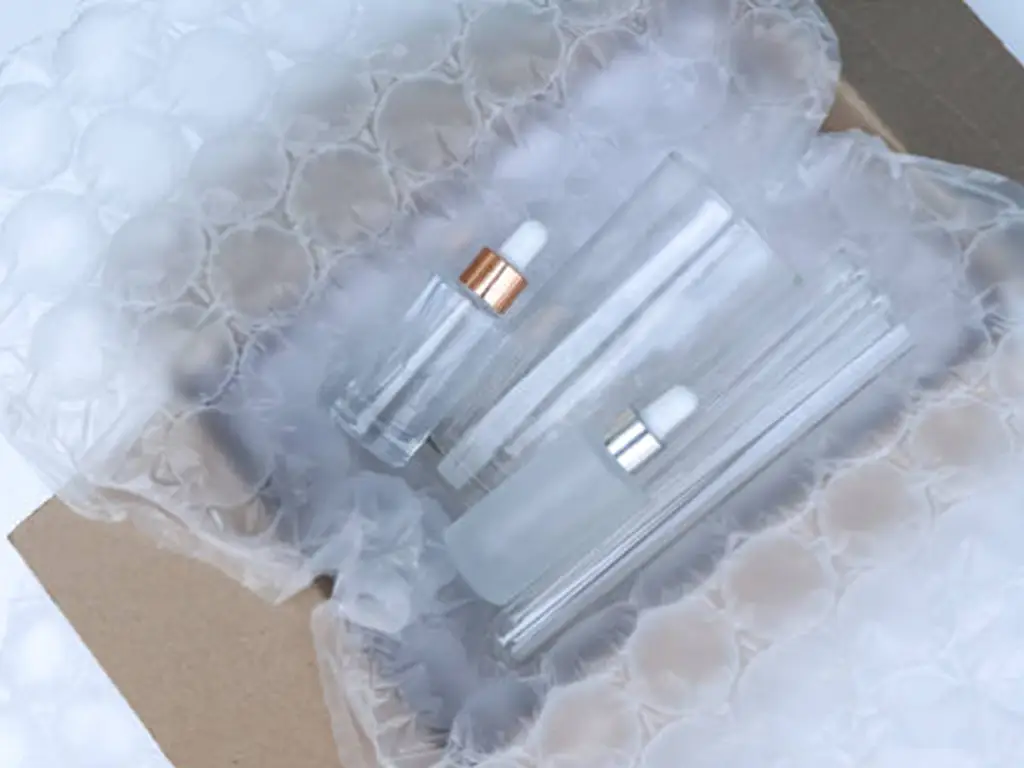
Costly Pitfalls to Avoid in B2B Glassware Shipping
Even with a robust SOP in place, supply chains leak capital through unseen logistical traps. Eliminating these pitfalls is the final step in auditing your logistics.
The Danger of Settling Void Fills
Filling your outer carton with cheap expanded polystyrene (EPS) packing peanuts offers a false sense of security. Because of the constant, low-frequency vibration generated by long-haul trucking, these loose particles undergo a physical phenomenon known as Settling. Over hundreds of miles, the peanuts sift downward. By the time the parcel reaches the regional sorting facility, the heavy glass is resting directly against the unpadded cardboard wall, resulting in guaranteed breakage upon impact.
The Ultimate Blind Spot: Optimizing TCO from the Manufacturing Source
However, while securing your current inventory with premium void fills is a necessary immediate fix, relying on heavy packaging to compensate for weak glass permanently drains your margins. The ultimate strategy to lower your Total Cost of Ownership (TCO) is upgrading the product at its source. By partnering with Nuvole, you leverage over 20 years of B2B manufacturing expertise to engineer inherently stronger vessels. Rather than over-packing fragile generic glassware, our bespoke custom design capabilities optimize the structural integrity and glass distribution of your specific bottles, making them naturally resistant to transit shocks. Combined with our factory-direct pricing, you acquire a highly durable, custom-branded product at a fraction of standard market costs. Your supply chain becomes intrinsically resilient, dramatically slashing both your upfront procurement costs and your downstream packaging expenses before the item ever enters a cardboard box.
Conclusion
Mastering the shipment of complex glassware requires a definitive pivot from reactive packing to proactive, physics-based engineering. By understanding the mechanics of high-frequency resonance, utilizing zero-tension wrapping techniques, and strictly adhering to operational segregation between B2B palletized freight and D2C fulfillment models, logistics managers can confidently protect their products.
Furthermore, by making tax-compliant material choices and sourcing structurally superior glass directly from experienced manufacturers, you secure your profit margins at both ends of the supply chain. Standardize these advanced steps into your warehouse protocols today to ensure that every shipment prioritizes structural safety while ruthlessly protecting your bottom line from inflated volumetric shipping costs.