
Have you ever wondered why luxury perfume bottles or premium XO cognac decanters capture and refract light with an almost diamond-like brilliance, while standard glass packaging looks flat and lifeless? The secret lies deeply within the atomic structure of the material itself. Welcome to the definitive guide on flint glass. In this comprehensive breakdown, we will demystify what flint glass actually is, explore its historical evolution, and systematically dissect the five core differences that separate it from crown glass and regular soda-lime glass.
- History & Composition ➤ Jump to: Lead vs. Lead-free evolution and trace elements
- The 5 Core Differences ➤ Jump to: Physics, optics, and thermal dynamics compared
- Super Flint Applications ➤ Jump to: Matrix of luxury containers (Spirits, Perfume, Cosmetics)
- Commercial Value & Safety ➤ Jump to: FDA compliance, ROI, and brand premium strategies
- Lifecycle & Automation ➤ Jump to: Machining, filling lines, and transit durability
- Future Trends ➤ Jump to: The conclusion and future of glass manufacturing
What is Flint Glass: Composition Evolution and History
Before diving into the complex physical and optical properties, we must first clear up a pervasive industry misconception: the assumption that all highly refractive glass must contain toxic lead. The history of this material is a fascinating journey of continuous chemical refinement, driven by the pursuit of aesthetic perfection and global health compliance.
The Classic Lead Crystal Era vs Modern Alternatives
The story of flint glass begins in 17th-century England with the pioneering glassmaker George Ravenscroft. Seeking a way to rival the clarity of Venetian glass while lowering the melting temperature of raw materials, Ravenscroft discovered that adding lead oxide (PbO) to the glass melt produced remarkable results. This classic “lead crystal” formulation—often containing anywhere from 24% to 30% lead oxide—resulted in a highly refractive material that revolutionized optics and decorative arts for centuries.
However, as global awareness regarding heavy metal toxicity grew, the traditional formulation faced severe regulatory hurdles. Today, driven by stringent international regulations such as the European Union’s RoHS (Restriction of Hazardous Substances) Directive and strict FDA food contact standards, the modern B2B supply chain has completely pivoted. The industry transitioned to “eco-flint” or lead-free flint glass. By utilizing advanced metal oxides such as titanium dioxide and zirconium dioxide, scientists engineered a material that perfectly mimics the brilliant refractive index and high density of traditional lead crystal while remaining entirely compliant with environmental and health safety standards.
Unpacking the Chemical Anatomy for Buyers
To truly understand the value of this material, one must look closely at its modern chemical anatomy. Standard soda-lime glass has a relatively loose recipe. Super flint glass, however, requires a level of chemical purity that borders on pharmaceutical standards.
The critical differentiator is trace element control, specifically regarding Iron Oxide (Fe2O3). Iron naturally occurs in silica sand and is the primary culprit behind the cheap “green tint” visible on the edges of standard glass. To achieve true optical clarity, a premium manufacturer must execute the following:
- Ultra-Pure Silica Sand: Standard glass can tolerate up to 1000 ppm of iron. Top-tier flint glass requires specially mined and purified silica sand where the iron content is strictly capped below 100 to 120 ppm.
- Electric Melting & Temperature Control: Traditional gas-fired furnaces introduce impurities and carbon residue. High-grade flint is often processed in advanced electric furnaces to maintain absolute atmospheric purity during the melt.
- Optical Complementary Decolorization: Even at 100 ppm, a microscopic green tint can remain. Master glassmakers introduce highly calibrated amounts of selenium or cobalt to create a complementary wavelength absorption that neutralizes the green, resulting in the coveted “invisible” crystal-clear finish.
The 5 Core Differences: Flint vs. Crown & Soda-Lime Glass
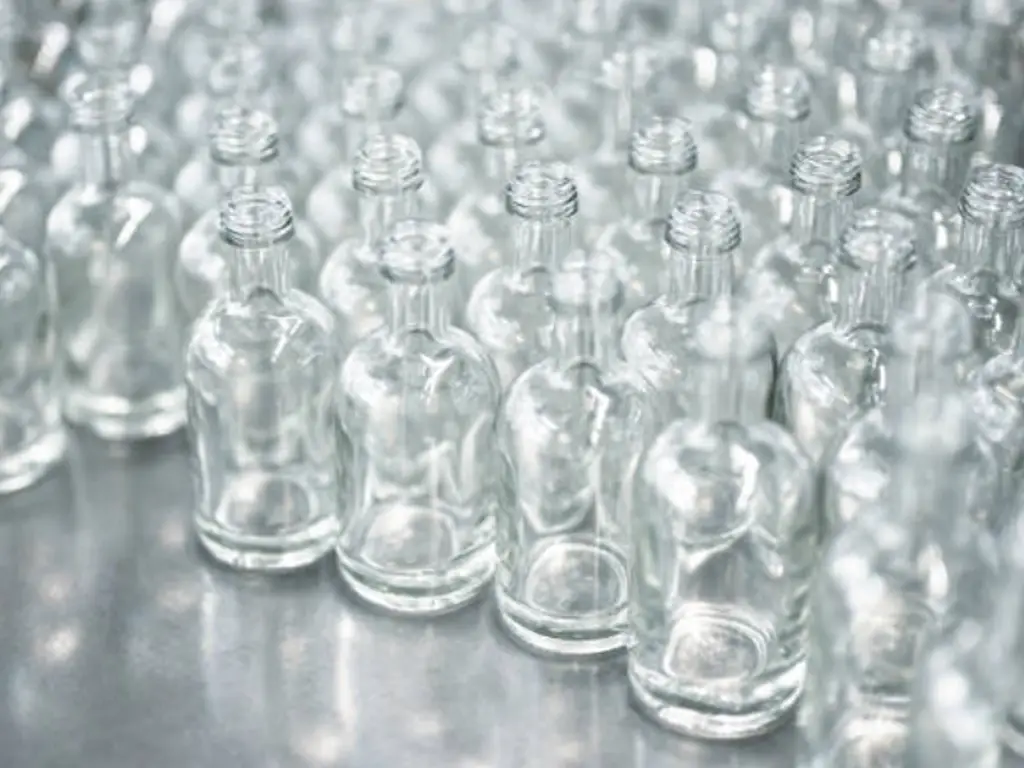
When selecting materials for precision engineering or high-end retail packaging, relying on vague terms like “extra clear” is risky. We must quantify the differences. Here are the five core engineering and physical parameters that segregate flint glass from standard packaging glass and crown optical glass.
Difference 1 & 2: Refractive Index (nd) and Abbe Number (νd)
These two optical properties are the most critical parameters for engineers and are forever linked. The Refractive Index measures how much a material bends or slows down light. Flint glass boasts an exceptionally high refractive index, typically ranging from 1.45 to an impressive 2.00. This is what gives luxury bottles their brilliant sparkle—light is trapped and refracted internally, creating a dazzling display.
However, this high refractive index comes with a trade-off measured by the Abbe Number, which calculates optical dispersion (the ability to split white light into its component colors). Flint glass has a notoriously low Abbe number (under 50), meaning it has very high dispersion. In optics, this causes Chromatic Aberration. To solve this, engineers created the Achromatic Doublet: by pairing a high-Abbe (low dispersion) Crown glass convex lens with a low-Abbe (high dispersion) Flint glass concave lens, the flint’s negative refractive power acts as a precise corrective mechanism. It pulls the divergent color wavelengths back into perfect alignment, eliminating the color fringe.
Difference 3: Chemical Purity and Trace Element Control
The third core difference is the absolute intolerance for trace impurities. Standard soda-lime glass manufacturing focuses on volume and cost-efficiency; thus, utilizing lower-grade silica with higher iron, sulfur, and chromium content is entirely acceptable. Flint glass production demands laboratory-grade chemical purity. This relentless control over trace elements—keeping iron below the critical 100 ppm threshold—is the first major economic dividing line. It dictates why true super flint cannot be manufactured cheaply, as the raw materials require complex purification supply chains.
Difference 4: Specific Gravity and Macroscopic Density
Moving to macroscopic physics, the fourth major difference lies in the material’s Specific Gravity (density). Because modern formulations rely on heavy metal oxides like titanium and barium as structural baselines, the atomic mass of the resulting glass matrix is substantially higher than standard packaging glass.
This density translates directly to tactile feedback. When a consumer picks up a premium bottle of XO Cognac featuring a thick glass base, a standard soda-lime bottle will feel relatively light and look muddy or distorted. Conversely, a flint glass bottle will feel surprisingly heavy, solid, and luxurious in the hand, while maintaining absolute transparency through inches of solid glass. In luxury packaging, tactile weight strongly influences psychological value.
Difference 5: Thermal Dynamics and The Annealing Point
The final core difference, driving the premium cost, is its thermal dynamics. The addition of density-increasing oxides significantly raises the glass’s Annealing Point (the temperature at which internal stresses are relieved in a controlled manner).
Because the annealing window for this highly pure glass is exceptionally narrow compared to regular glass, the manufacturing facility’s cooling curve must be drastically extended and controlled down to single-digit degree variances. If standard rapid cooling speeds are applied, the high-density material retains massive amounts of residual thermal stress. This invisible stress leads to catastrophic spontaneous breakage later on the filling line or during transport. The immense energy and time costs associated with this extended, micro-managed annealing process primarily dictate the premium price tag.

Industry Applications: The Super Flint Container Portfolio
To visualize how these core differences translate into real-world commercial dominance, we have constructed a matrix detailing the primary high-end applications of Super Flint glass in the B2B packaging sector.
| Container Type / Industry | Critical Packaging Requirement | The Super Flint Advantage |
|---|---|---|
| Premium Spirits & XO Cognac | Extreme heavy-base distribution and highly complex custom mold engravings. | High specific gravity provides a luxurious tactile feel; superior refractive index flawlessly presents the liquor’s amber color without distortion. |
| Niche & Luxury Perfumes | “Invisible border” illusion, absolute clarity, and zero color interference. | Trace element control (< 100ppm iron) eliminates the cheap green tint, allowing the pure essence and color of the fragrance to shine brightly. |
| High-End Cosmetics Jars | Perfectly uniform wall thickness, high structural reliability, and absolute chemical inertness. | Provides a visual texture akin to natural quartz crystal; exceptional melt homogeneity ensures uniform thickness and zero active ingredient degradation. |

Maximizing Commercial Value and Safety in B2B Packaging
For B2B procurement directors and brand managers, choosing the right packaging material is a delicate balancing act between defending the absolute baseline of consumer safety and pushing the upper limits of brand profitability.
Compliance Bottom Line: FDA Standards and Hydrolytic Resistance
When dealing with high-proof alcohol or highly active chemical compounds, safety is the non-negotiable baseline. Standard, low-quality glass can suffer from poor Hydrolytic Resistance, meaning the internal matrix of the glass can break down over time when exposed to aggressive liquids. This leads to “leaching,” where trace heavy metals or alkalis dissolve into the product. Utilizing a highly stable, lead-free flint glass formulation ensures compliance with rigorous USP Type III glass classifications and FDA GRAS (Generally Recognized as Safe) standards. By investing in premium raw materials, brands purchase an insurance policy against product recalls, altered flavor profiles, and catastrophic brand trust erosion.
Unlocking Brand Premium: The ROI of Super Flint Glass
Once safety is guaranteed, we must evaluate the Total Cost of Ownership (TCO). Procuring custom super flint bottles can cost 30% to 50% more per unit than standard soda-lime alternatives. However, for a luxury perfume or a vintage whiskey retailing at $150 or more, the physical packaging cost represents less than 5% of the total margin. If a brand attempts to save pennies using standard glass, the resulting micro-bubbles and green tint will broadcast a cheap signal to the consumer under retail lighting. Upgrading to flawless glass elevates the entire perceived value of the product, justifying a 20% or higher retail premium. That marginal increase in packaging cost is the most effective investment a luxury brand can make to defend its market position.
For brands looking to secure this crucial premium, sourcing from a manufacturer capable of true optical-grade purity is paramount. Nuvole Glass provides global brands with unparalleled Super Flint packaging solutions, ranging from heavy-based liquor decanters to flawless 30ml perfume bottles designed for the luxury niche market. To achieve absolute crystal clarity, we utilize ultra-low iron silica sand paired…
Lifecycle Control: Machining, Automation, and Transit Durability
A B2B buyer’s journey does not end at procurement. The true test of high-end packaging lies in how the material behaves in the grueling realities of industrial mass production and global logistics. It is here that the uniform properties of premium materials demonstrate their operational value.
Mitigating Defect Rates on Automated Filling Lines
Modern bottling facilities operate at staggering speeds, processing hundreds of units per minute. In these high-speed environments, bottles are subjected to immense lateral pressure and impact from starwheels and automated capping machinery. What prevents shattering on the filling line is the elimination of microscopic structural flaws. Because premium flint glass requires an exceptionally rigorous melting and refining process, it boasts incredible Melt Homogeneity. This highly uniform internal structure dramatically reduces the presence of micro-bubbles (seeds), un-melted silica particles (stones), and microscopic surface flaws. These defects act as critical stress concentrators; when a bottle is bumped, stress accumulates around these flaws, causing explosive shattering. By utilizing highly homogenous glass, factories drastically reduce their hidden downtime costs, ensuring smooth production runs without cleaning up glass shards from machinery.
Abrasion Resistance During Global Transit
Finally, the pristine product must survive the trans-oceanic journey to the consumer. Inside a shipping container, high-frequency vibrations over thousands of miles cause bottles to rub against each other and their cardboard partitions. This constant friction can cause severe scuffing, turning a beautiful crystal-clear bottle into a frosted, damaged mess before it even reaches the retail shelf. While the dense nature of flint glass provides a robust structural foundation against crushing forces, its flawless surface must be protected. Procurement teams must match their premium glass investments with equally high-specification secondary packaging—utilizing flocked plastic inserts, high-density EVA foam, or specialized anti-abrasion coatings—to guarantee that the meticulous engineering of the glass is flawlessly preserved upon arrival.
Conclusion and Future Trends in Glass Manufacturing
Flint glass remains an irreplaceable marvel of materials science, bridging the absolute precision of atomic chemistry with the tangible aesthetic demands of the luxury commercial market. By understanding the strict control of trace elements, refractive dispersion, and demanding thermal dynamics, buyers are empowered to make highly strategic procurement decisions. As the industry advances toward sustainable production ecosystems, the commitment to extreme purity will only deepen. The next time you admire a premium whiskey through a heavy-based decanter, you will understand the rigorous engineering that makes such a breathtaking visual experience possible.
Elevate Your Brand’s Visual Identity
Don’t let subpar packaging dilute the luxury of your product. Partner with Nuvole Glass to secure absolute optical purity, FDA-compliant safety, and the heavy tactile feel your consumers demand. Build your brand’s physical fortress today.
Contact Us for a Sample