50ml vs 100ml Perfume: Which Size Is Actually Right for You?
The 50ml vs 100ml perfume question looks like a math problem: which bottle gives you more for your money? It isn’t. If you’ve ever finished a 100ml bottle you loved, or watched a 100ml bottle you didn’t love gather dust for three years, you already know the real question is different. It’s about how you actually wear fragrance: how often, how many bottles you rotate, and whether you’ll still love this scent in nine months.
This guide translates the label numbers into real usage, walks through the trade-off between the two sizes, and then pulls back the curtain on something most guides never mention: how brands choose between 30ml, 50ml, and 100ml when they design their own product lines. Read the consumer sections to pick your next bottle; read the brand section to understand why the shelf looks the way it does.
What Do 30ml, 50ml, and 100ml Actually Mean? The Numbers Behind the Label
Before comparing sizes, translate the numbers on the label into something you can use: sprays, months, and ounces.
| Capacity | US Size | Sprays (est.) | Light Use (2–3 sprays/day) | Daily Use (4–5 sprays/day) | Typical Role |
|---|---|---|---|---|---|
| 30ml | 1.0 fl oz | 300–450 | 3–5 months | 2–3 months | Entry, travel, testing |
| 50ml | 1.7 fl oz | 500–750 | 6–9 months | 3–5 months | Standard full bottle |
| 100ml | 3.4 fl oz | 1,000–1,400 | About 12 months | 6–8 months | Value and signature size |
One conversion worth memorizing: one US fluid ounce is 29.57ml, which is why the industry rounds 30ml to 1 oz, 50ml to 1.7 oz, and 100ml to 3.4 oz. If you shop from US retailers that list sizes in ounces, 1.7 oz and 3.4 oz are the two bottles you’re actually comparing.
Notice that spray counts are ranges, not promises. The reason is the pump: a typical atomizer delivers 0.08–0.12ml per spray, so two different 50ml bottles can produce meaningfully different spray counts. A fine-mist pump stretches the juice; a heavier-spraying pump empties the bottle faster. When a brand claims “about 700 sprays,” they’re describing their pump, not the glass. Keep this in mind for later; it matters more than most buyers expect.
50ml vs 100ml Perfume: The Real Trade-Off Nobody Explains
Here is the part most guides skip: price per ml is the second question. The first question is use-up risk.
How often you wear a scent (occasionally to daily) and how many bottles you already own (0–5 to 10+) decide your size. Frequency low + collection large = 50ml. Frequency high + collection small = 100ml.
The 100ml is almost always the better deal per milliliter. Typical pricing sets a 50ml at roughly 60–70% of the 100ml price, which means the big bottle’s juice is 30–40% cheaper per ml. But those savings only materialize if you finish the bottle. Fragrance stays at its best for about three to five years once opened (Nota Perfumes, 2026). If a 100ml takes you four years to empty, the last third of the bottle is a souvenir, not a saving. That’s the trade-off: unit price versus the risk of paying for juice you’ll never wear.
When 50ml Wins: Rotation, Discovery, and Travel
If you own ten or more bottles, the math is brutal. One 100ml bottle holds roughly a year of daily wear. Ten of them is a decade of juice. Perfume is not wine. It doesn’t improve in the cabinet. For rotation-heavy collectors, 50ml keeps a collection realistic and finishable.
Ten 100ml bottles ≈ a decade of daily wear. Perfume is not wine — it doesn’t improve in the cabinet.
For a scent you’ve never worn, 50ml is the smart ceiling. It’s generous enough to test across seasons and occasions, but small enough that walking away costs little. Buy 50ml first, upgrade to 100ml only on repurchase. That sequencing is how experienced buyers describe their own habits, and it consistently saves them money even though the small bottle costs more per ml.
And for travel, 50ml (or 30ml) is simply easier. Airport rules cap each carry-on container at 100ml, or 3.4 fl oz, with all liquids fitting in one quart-size bag (TSA, 2026). A 100ml bottle is exactly at the ceiling, eating your entire liquids allowance in one item; a 50ml leaves room for everything else.
When 100ml Wins: Signature Scents and Daily Wear
If you wear the same scent four or more days a week, the 100ml is the rational choice. The math is simple: four to five sprays a day is roughly 1,500–1,800 sprays a year, about 100–150ml of juice. A daily wearer on 50ml restocks two or three times a year, paying packaging and shipping each round and gambling that the brand hasn’t reformulated in between. One 100ml purchase is one decision, done.
Cost-per-spray only matters when you’ll actually spray them all. Daily wearers will. That’s the entire test: if this scent is part of your routine, buy big; if it’s a maybe, buy small.
The Wildcards: Discontinuation, Odd Pricing, and Counterfeit Risk
Three situations break the normal rules, and they’re the kind of thing you usually only learn from fragrance forums:
- Discontinuation rumors or limited releases. When a scent you love may disappear, buying the 100ml isn’t hoarding. It’s hedging. This is the one case where collectors rationally buy big.
- Odd pricing at checkout. Promotions occasionally invert the usual curve: a discounted 100ml can end up cheaper per ml than a full-price 50ml, and in rare cases cheaper overall. Before you buy, compute both the total price and the price per ml, not just the one you saw in the ad.
- Counterfeit risk. Counterfeiters concentrate on large bottles: faking a 100ml maximizes profit per unit, while 50ml fakes are rare, especially for designer fragrances. If you buy online from third-party sellers, the small bottle carries an unadvertised safety benefit.
Where 30ml Fits In: The Entry-Size Economy
Thirty milliliters is the entry ticket, and it’s becoming more common as niche brands launch with 30ml or 50ml as their only sizes, particularly for high-concentration extraits. When you’re choosing between 30ml and 50ml on the same scent, here’s the practical view:
| Dimension | 30ml | 50ml | Which to Pick |
|---|---|---|---|
| Trial cost | Lowest | Moderate | 30ml for untested scents |
| Portability | Fits a pocket or clutch | Fits a handbag | 30ml for carry-everywhere |
| Price per ml | Highest | Mid-range | 50ml if you’ll wear it regularly |
| Gifting | Cute but modest | Generous default | 50ml for most gifts |
If the scent is already proven for you, the 50ml is usually the better value. The per-ml premium on 30ml is the steepest of any size step. If the scent is new, the 30ml is the smarter bet: it’s the cheapest way to find out whether a fragrance earns a place in your rotation, and it’s the size most suited to travel, gifts, and blind-buy hesitation.
The 30ml is also quietly becoming the fashionable size. Niche houses increasingly launch with 30ml as their only format, a deliberate move to keep entry prices accessible when a brand has no name recognition yet. Some established niche lines go the opposite way and sell only 100ml, which annoys exactly the rotation-minded buyers who’d happily pay for less. And in the sample-and-decant economy, 30ml is the bridge product: big enough to be a real purchase, small enough that buying it feels like an experiment rather than a marriage. If a brand offers 30ml, it’s usually the lowest-risk way to buy that brand’s story.
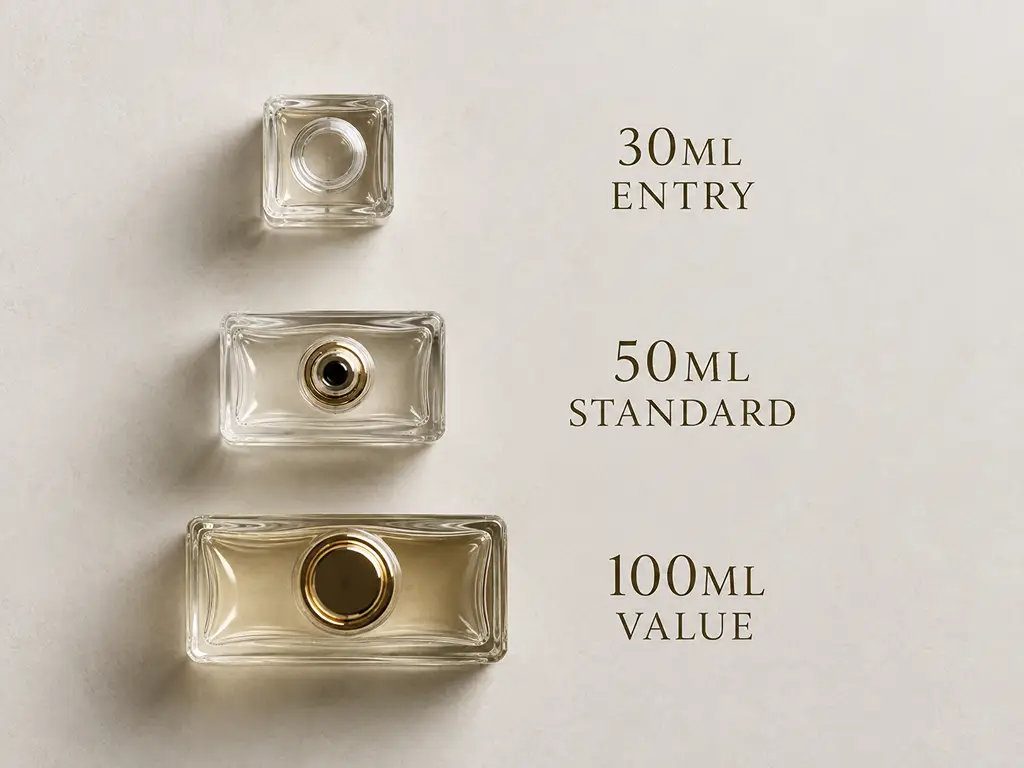
How Big Is Each Bottle, Really?
The most-asked question that almost no guide answers: what does each size actually look and feel like in your hand?
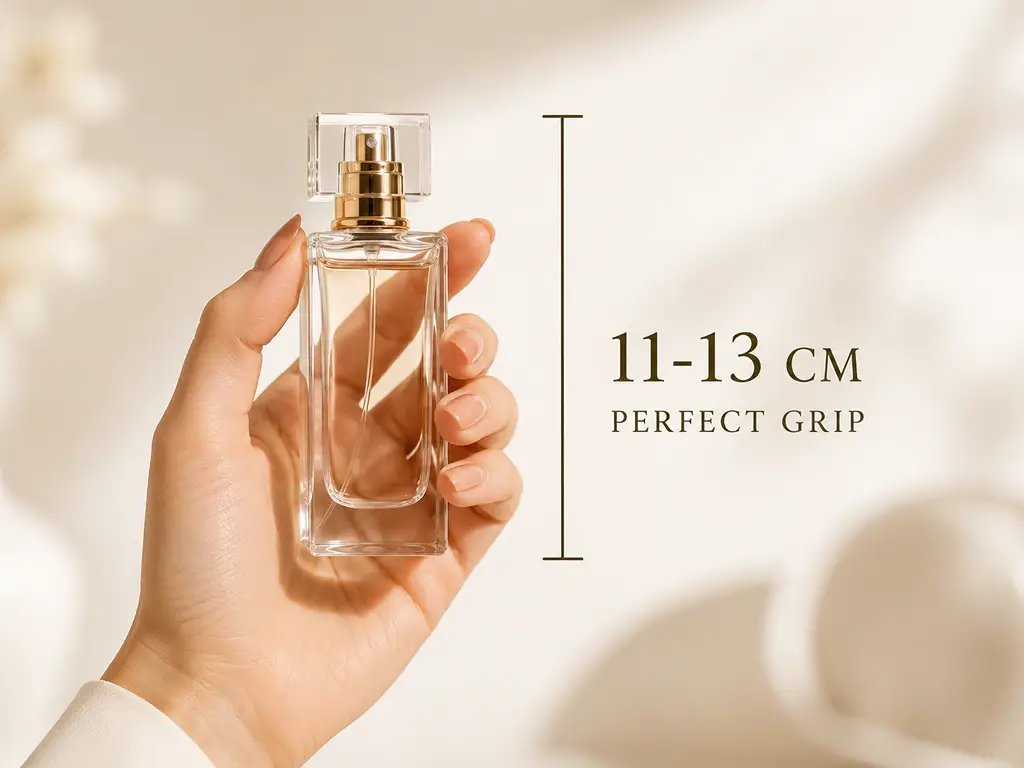
Height is only half the story. Weight is the other. A 100ml glass bottle can weigh roughly three times what a 30ml bottle weighs (Packamor, 2026). That heft looks like luxury on a vanity, but it’s the same mass you’ll be carrying in a bag or paying to ship. For daily carry, the difference between 30ml and 100ml is not marginal. It’s the difference between “I’ll bring it” and “it stays home.”
Shape confuses size, too. Long-time collectors notice that bottle design warps perception: a tall, slim 75ml can look larger than a squat 100ml sitting next to it. The capacity is what the label says; the silhouette is what your eye reports. When size matters to you (travel, a shelf that fits, a gift that looks right), compare heights and widths in the specs, not the thumbnail photos.
One practical tip for online shopping: don’t trust a lone product photo. Check the listed bottle height in the specs, and look for a shot of the bottle in a model’s hand. Proportions in standalone images are routinely misleading.
And remember the travel ceiling from earlier: a 100ml bottle is the exact maximum allowed in a carry-on, so it’s fine to pack but leaves zero margin, while 50ml and 30ml slide through with room to spare (TSA, 2026).
Fragrance Type Changes the Answer: Why Concentration Decides Your Bottle Size
Here’s a variable most size guides ignore: the same 50ml is a different length of time depending on what’s inside it. Concentration sets your spray count, and your spray count sets your ideal bottle size.
| Fragrance Type | Oil Concentration | Longevity | Typical Sprays per Day | Size That Makes Sense |
|---|---|---|---|---|
| Eau de Cologne (EDC) | 2–5% | 2–4 hours | 6+ with reapplication | 100ml if it’s your daily |
| Eau de Toilette (EDT) | 5–15% | 4–6 hours | 4–6 | 50ml or 100ml |
| Eau de Parfum (EDP) | 15–20% | 6–8 hours | 3–4 | 50ml is the sweet spot |
| Parfum / Extrait | 20–30% | 8–12+ hours | 1–2 | 30ml is plenty |
These concentration bands are the industry’s standard reference points (Ulta Beauty, 2026). The logic flows straight from them: a heavy extrait worn at one to two sprays a day turns a 30ml bottle into half a year of fragrance, while a light eau de toilette that you reapply at lunch can burn through 100ml in a year.
There’s one counterintuitive exception the forums know well: citrus and other short-lived scent families. Because they fade fast, wearers reapply aggressively. The people who need the biggest bottles are often buying the lightest fragrances. If you’re a re-sprayer, invert the table above: buy up a size.
Sizing a Product Line, Not Just a Bottle
If you’re the one deciding which sizes a fragrance will come in, the same math applies — plus bottles, pumps, and MOQs.
Buying for a Brand? How Launch Sizes Are Really Chosen
Everything above doubles as a market report. The habits you just read about: use-up risk, rotation, the pull of per-ml math, pump output, concentration. They are not just shopping quirks. They are the exact data a brand, distributor, or wholesaler uses to plan a product line. Read each one from the other side of the counter and it becomes a business decision. Consumers fear unfinished 100ml bottles, so 50ml became the retail default. Collectors and rotation buyers demanded a smaller entry format, so niche brands launched 30ml. The per-ml math pulls buyers toward the big bottle, so brands price the 100ml at 1.4–1.5× the 50ml to harvest that pull. And the pump, not the glass, decides spray counts. That makes the pump a specification you buy, not an afterthought. The 30/50/100 ladder is not a menu of preferences. It’s a pricing strategy built directly on consumer behavior: an entry size to lower the first-purchase barrier, a main size that carries the line, and a big size that harvests repeat customers with per-ml value.
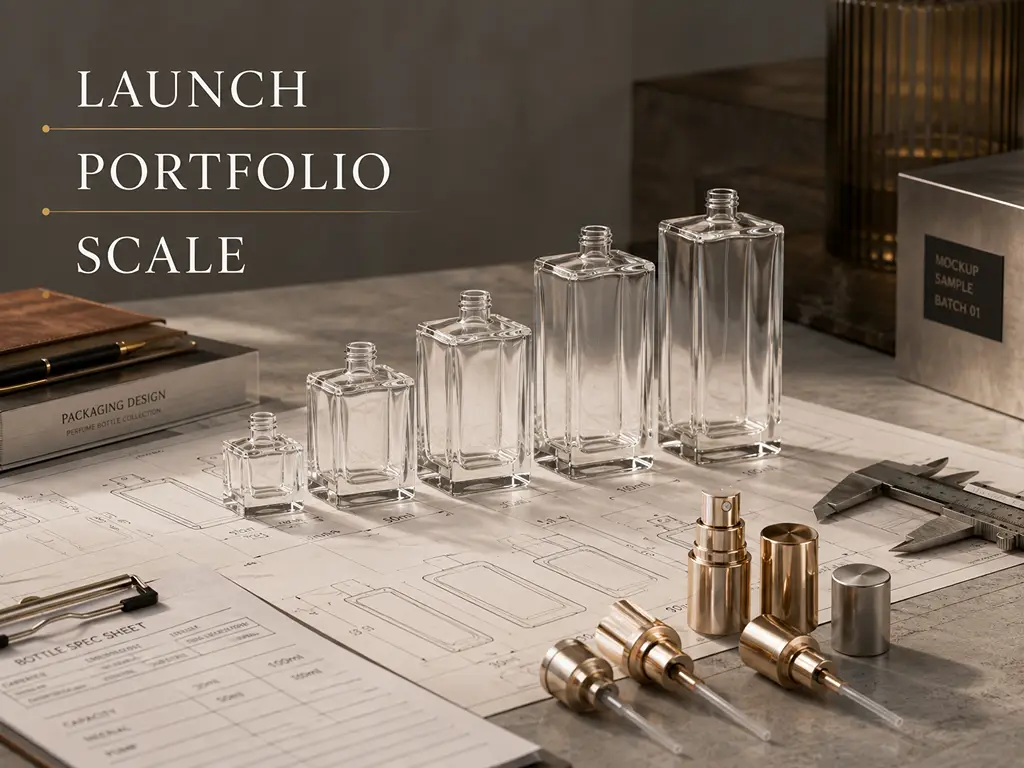
The 30/50/100 Ladder at Every Scale: Launch, Portfolio, and Channel Strategy
The same ladder plays a different role depending on where you sit in the market. At launch, it’s a launch plan. At scale, it’s portfolio architecture. In distribution, it’s channel math.
For most new brands, 50ml is the default. The reason is the use-up risk you calculated for your own shelf. Consumers treat an unfinished 100ml as a mistake, so the size they commit to is the one they can actually finish. It looks like a “complete” bottle to customers, it sits in the $55–100 comfort zone for indie fragrance, and it offers enough label surface for a full, uncrowded design. It also photographs well: substantial without looking like a prop.
30ml is the low-risk play, and it monetizes the rotation and blind-buy habits from earlier. A smaller sticker price converts hesitant first-time buyers (who can’t smell your product through a screen), lets the same budget launch more scents, and ties up less capital in liquid. Its downside is margin. Per unit, the bottle, pump, label, and filling cost nearly as much as a 50ml’s, so your percentage margin is thinnest here.
100ml is the later move. It works because the per-ml deal is real: consumers who finish a scent happily pay up for the big bottle. And because the bottle, pump, crimp, and label costs don’t double with capacity, the 100ml’s margin percentage is usually the highest of the three, but only once demand is proven. Launching 100ml on an unproven scent means betting your cash on juice nobody has smelled yet.
One warning for new brands: resist launching all three sizes at once. Every size multiplies your inventory, SKUs, label layouts, and product photography. The pattern that works is one hero size at launch, additional sizes only for proven sellers.
The typical retail ladder tells the whole story: around $45–65 for 30ml, $75–95 for 50ml, and $120–140 for 100ml. Notice the 100ml is priced at roughly 1.4–1.5× the 50ml, not 2×. That gap is deliberate. It’s what makes the big bottle feel like a deal, and it’s why consumers feel the pull toward the largest size even when a smaller one fits their habits better (ScenTO, 2026; Packamor, 2026).
Run the margin math once and you’ll see why brands love the big bottle: the glass, pump, crimp, and label on a 100ml cost only modestly more than on a 50ml, while the juice roughly doubles. Since packaging is the flat part of the cost and fragrance oil is the variable part, the 100ml’s gross margin percentage beats the 50ml’s at that 1.4–1.5× price. The trade is inventory: every unsold 100ml ties up twice the liquid. That’s the whole 100ml strategy in one sentence: higher margin, higher risk, correct only after the scent proves itself.
For an established brand, the same three sizes are portfolio architecture.
The 30ml is a doorway, not a discount. It brings in travel buyers, gift buyers, and price-sensitive newcomers without touching the core price of the 50ml. At the luxury end the math inverts entirely: houses sell 30ml extraits at per-ml prices far above their 100ml lines, and the small bottle looks like privilege, not thrift. A well-priced 30ml protects a brand’s price architecture from below.
The 100ml is the margin engine and the gift format. Because its per-unit costs barely exceed the 50ml’s, the big bottle funds the line. Multi-size families reinforce each other on the shelf: a shopper recognizes the 30ml, the 50ml, and the 100ml as one brand. And promotions follow the architecture. Brands discount the 100ml, not the 50ml, because the per-ml math makes the big-bottle markdown feel generous while the entry price stays protected.
For a distributor or wholesaler, the ladder is channel and inventory math.
Channels map to sizes. The 50ml is the retail-shelf format: mid-price, fits planograms, turns fast. The 30ml feeds travel retail, gift sets, and sampling programs. The 100ml carries e-commerce value positioning and duty-free volume. A distributor who stocks all three the same way leaves margin on the table in every channel.
Inventory math punishes the big bottle. A 100ml ties up twice the liquid and roughly three times the shipping weight of a 30ml, so turnover matters as much as unit margin. And ladders are readable documents: a competitor’s size-to-price structure tells you exactly which customer they’re hunting and where their margin lives. That’s far more useful than their press releases.
The Bottle-Supply Checklist Most Brands Skip
The liquid is only half the product. Here are the five supply-side checks that separate smooth launches from expensive corrections:
Fill volume vs. labeled volume. Fill is typically 80–85% of the bottle’s brim capacity (headspace prevents expansion problems); a “50ml” bottle’s total capacity is larger than 50ml.
Label area. A 30ml face must still fit the full INCI ingredient list; small-bottle labels are a compliance design problem, not an afterthought.
Glass weight. A 100ml bottle can weigh 3× a 30ml; weight drives both sea freight and air costs, and perfume ships as a Class 3 flammable liquid by air (IATA, 2022).
MOQ structure. Bottle minimums usually tier by bottle weight: light bottles in the tens of thousands, heavy bottles in the low ten-thousands; align them with your first batch size.
Pump output. Standard pumps deliver 0.08–0.12ml per spray, premium pumps 1.0ml or more; the pump, not the bottle, determines how long your “50ml” actually lasts in customers’ hands.
If that checklist sounds like a lot to source, it is. The strongest supplier partnerships cover most of it in one place. Nuvole Glass, for example, carries 500+ stock bottle shapes across 30ml, 50ml, and 100ml with 500+ matching caps, turns around sample prototyping in 3–7 days, and structures MOQs by bottle weight, from 10,000 to 50,000 pieces. Their custom perfume bottle designs page spells out exactly what’s configurable before you commit to a mold.
The 60-Second Decision Checklist
By now you have every variable. Here’s the compressed version. Run through it next time you’re stuck at the size selector:
Have you worn this scent before? No = 50ml or smaller. Yes = keep going.
How many days a week will you wear it? Four or more = lean 100ml. Fewer = 50ml.
How many bottles do you already own? Ten or more = 50ml. Under five = 100ml can pay off.
Is this your signature scent? Yes = 100ml. Not sure = 50ml.
Do you travel with fragrance? Yes = 50ml or 30ml.
What’s the concentration? Extrait or parfum = 30ml is plenty. EDT or cologne = 100ml if you reapply.
Have you done the promo math? Recompute total price and per-ml price today, not the price you remember.
When in doubt, buy the smaller bottle. A finished 50ml becomes a happy repurchase. An unfinished 100ml becomes guilt. The brands count on you choosing by unit price; the people who actually finish their bottles choose by habit.
Frequently Asked Questions
Is 50ml of perfume too small?
No. At light-to-regular use it lasts 3–9 months. The only wearers who outgrow 50ml are people who wear one scent daily — and they know who they are.
Is 100ml of perfume too much?
For rotation and collectors, usually yes — a decade of juice across a ten-bottle shelf. For a daily signature wearer, it’s about one year of 4–5 sprays a day: perfectly sized.
How long does 30ml of perfume last?
Roughly 2–5 months depending on concentration and pump output — up to half a year for a two-spray-a-day extrait.
Are 30ml perfumes worth it?
Yes for testing, travel, gifting, and high-concentration fragrances. It’s the worst per-ml value, so avoid it for a scent you’ll wear every day.
Which perfume size is best for gifting?
50ml — generous without presuming. 30ml works for colleagues or guessed scents; 100ml only when you know it’s their signature.
Spec Your 30/50/100ml Bottles With a Glassmaker That Answers the Checklist
500+ stock shapes, 3–7 day sampling, MOQs structured by bottle weight — start the conversation with a spec, not a guess.
References
- U.S. Transportation Security Administration. “Liquids Rule.” 2026. https://www.tsa.gov/travel/security-screening/liquids-rule
- International Air Transport Association. “What You Need to Know About the Transport of Dangerous Goods by Air.” 2022. https://www.iata.org/en/publications/newsletters/iata-knowledge-hub/what-you-need-to-know-about-the-transport-of-dangerous-goods-by-air/
- Ulta Beauty. “Fragrance Concentration Guide: Eau de Toilette vs Parfum.” 2026. https://www.ulta.com/discover/beauty-education/eau-de-toilette-vs-parfum
- Packamor. “Perfume Bottle Sizes: 30ml vs 50ml vs 100ml.” 2026. https://www.packamor.com/blogs/knowledge-hub/perfume-bottle-sizes-explained
- ScenTO. “Perfume Bottle Sizes 2026: 30ml vs 50ml vs 100ml Compared.” 2026. https://www.scento.com/blog/perfume-bottle-sizes-30ml-vs-50ml-vs-100ml-compared
- Nota Perfumes. “50ml vs 100ml: Which Size Is Right for You?” 2026. https://nota-perfumes.com/blogs/fragrance-journal/50ml-vs-100ml-which-size-is-right-for-you
- Nuvole Glass. “Custom Design.” https://www.nuvole-glass.com/custom-design/
- Nuvole Glass. “Home.” https://www.nuvole-glass.com/