How Big Is a 100ml Bottle of Perfume? Size, Sprays, and Dimensions Explained
A 100ml bottle of perfume is the bottle most people picture when they hear “full-size”. It is also the bottle almost nobody has actually measured. It stands roughly 12 to 15 centimeters tall, about the height of a smartphone. It carries 3.4 fluid ounces and delivers somewhere around 1,000 sprays. But those three numbers only begin to answer “how big is a 100ml bottle of perfume?”
This guide goes further: exact dimensions and weight, plus how the bottle feels in your hand. You will learn how long the fragrance actually lasts, the travel rule that makes 100ml a magic number, and what 100ml costs on the shelf. The guide also covers what the size means for a brand at any scale. Behind the glass, it details the specifications and costs that brands and buyers deal with when they order 100ml bottles by the thousand. Along the way, every answer carries a business side. Each fact a wearer checks is a line someone negotiated.
What “100ml” Means: Volume, Ounces, and the Size Ladder
100ml equals 3.4 US fluid ounces. In the retail fragrance world, that number occupies a very specific seat: it is the largest volume most brands offer in a standard line. Bigger sizes exist (125ml, 150ml, even 200ml), but they are limited-edition territory. 100ml is the “signature” size. It is the bottle a brand expects you to keep on a shelf for a year, not in a handbag for a weekend.
| Volume | US fl oz | Typical retail position |
|---|---|---|
| 30ml | 1.0 fl oz | Travel and entry size |
| 50ml | 1.7 fl oz | The standard daily driver |
| 75ml | 2.5 fl oz | Premium midpoint |
| 100ml | 3.4 fl oz | Standard large / signature size |
| 150ml | 5.0 fl oz | Extra-large, rare in retail |
There is a second reason 100ml became the default: it is the universal airline carry-on ceiling. The largest container you may take through airport security holds exactly 100ml. One number, two identities — and it explains why the size ladder so often stops there.
For the business: a size that doubles as the airline ceiling is a compliance-safe SKU. Brands pour their launch budget into the 100ml because one bottle works on the shelf, in the duty-free bag, and in every market. That is exactly why 100ml became the volume the whole supply chain optimizes for.
The Real Dimensions of a 100ml Bottle (and Why They Vary)
Here is the anchor number first. A typical 100ml perfume bottle stands 12–15 cm tall, spans 4–6 cm across, and weighs 200–250 grams. If you are holding a smartphone right now, you are holding something the same height as most 100ml bottles. The bottle is only about half as wide, and noticeably heavier.
The Numbers: Height, Width, Depth, and Weight
No two 100ml bottles are identical, but the ranges below hold for the vast majority of commercial designs:
| Dimension | Typical range | What it means in practice |
|---|---|---|
| Height | 10–15 cm (4–6 in) | Most designs sit between 12 and 15 cm |
| Width / diameter | 4–8 cm (1.6–3.1 in) | Square bottles run wider than round ones |
| Depth | 3–5 cm (1.2–2 in) | The profile thickness of the bottle |
| Weight | 200–250 g (7–8.8 oz) | Glass plus cap, excluding packaging |
| Neck finish | 13 / 15 / 20 mm | 15 mm is the industry standard |
For a concrete reference: one widely sold 100ml glass bottle weighs 235 grams. It measures 12 cm tall, 6 cm long, and 2.5 cm wide (Scent-DNA, 2025). That is a little over half a pound of glass in your hand.
The weight number matters more than most shoppers realize. In the supply chain, a bottle’s glass weight is the single biggest driver of its unit cost, followed closely by freight. We will come back to that in the buyer’s section below.
Why “100ml” Bottles Look So Different
Search “how big is 100ml perfume bottle” and you will see towers, bricks, spheres, and everything between. Same volume, wildly different silhouettes. Four design variables explain it:
- Proportions. A tall, slim bottle and a squat one can hold identical volume. Tall bottles read as larger, a favorite trick of brands selling luxury at 100ml.
- Thick bases. Perfume bottles are deliberately heavy-bottomed. The extra glass adds stability and makes light travel through the bottle. But it eats visual volume: a thick base can make a 100ml bottle look smaller or larger than it really is.
- Decoration. Spray coatings, silk-screening, and hot-stamping add visual bulk and weight without changing capacity.
- Headspace. This is the part almost nobody knows: a bottle labeled 100ml is not filled to the brim. The fill capacity is typically 10–15% higher, around 115ml, with the liquid line sitting below the shoulder. That headspace protects the juice from pressure changes and makes the pump work properly. So when a bottle looks “almost full but not quite,” it is engineered that way.
How Big Is It in Your Hand? Everyday Object Anchors
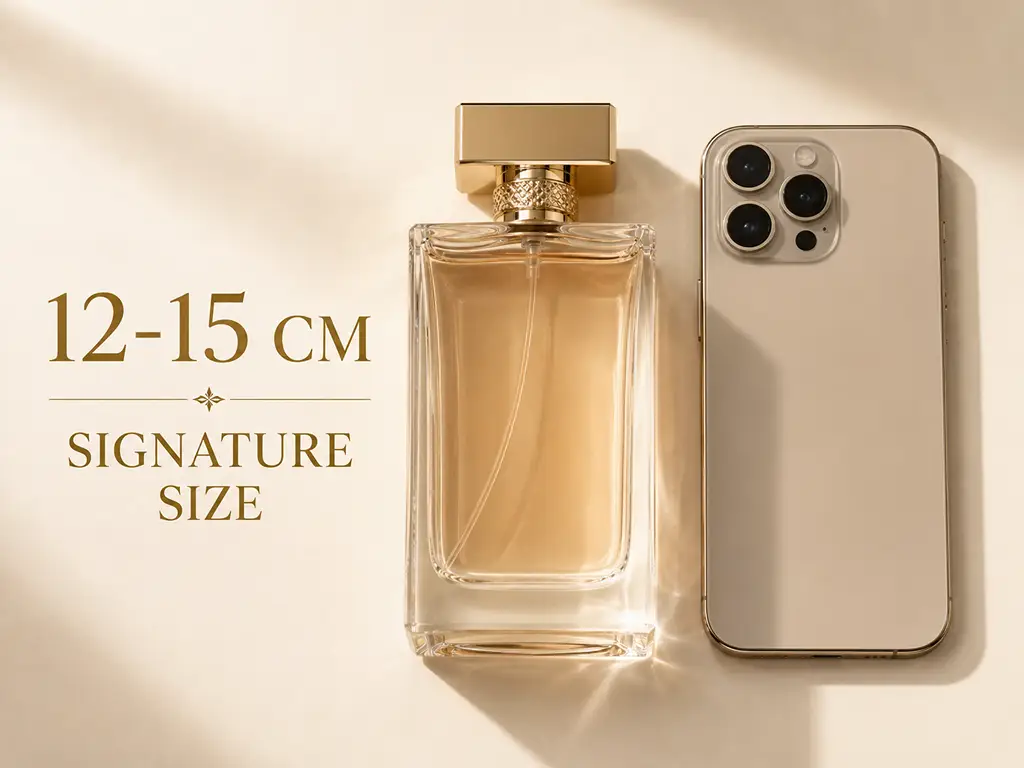
Dimensions are useful; anchors are memorable. Here is how a 100ml bottle sits against objects you already know:
| Object | How the bottle compares | The feel it conveys |
|---|---|---|
| Smartphone | Same height, half the width, twice the thickness | A phone with a heavy case |
| Baseball | Slightly less volume, but taller and boxier | A solid handful |
| Deck of cards | Similar footprint for square bottles | Familiar desk-object scale |
| Open palm | The base sits comfortably inside your palm | One-hand grip, but not hidden |
| Soda can | Can is about 12 cm tall but much wider | The bottle is slimmer and denser |
The bottom line: a 100ml perfume bottle is a confident one-hand object. It sits stably in the palm, disappears into any bag, and is just too large for most pockets. If 50ml is the bottle you forget you are carrying, 100ml is the bottle you feel.
For the business: that half-pound of glass is not an accident. It is purchased. Brands buy heft on purpose, and every extra 50 grams raises the bottle’s cost and its shipping weight. It is one reason budget perfumes so often feel light in the hand: in this business, weight is a line item.
How Long Does 100ml Last? Sprays, Days, and the Honest Math
Anchor answer: at roughly 0.1ml per spray, 100ml delivers about 1,000 sprays. That is roughly 8 months of daily wear at 4 sprays a day. But the honest math has two moving parts.
The Spray Math (and Why Everyone Quotes Different Numbers)
You have probably seen “1,000 sprays,” “1,350 sprays,” and “1,500 sprays” quoted for the same 100ml bottle. Nobody is lying. Pumps differ.
A standard atomizer delivers 0.06–0.08ml per spray. A high-output atomizer delivers 0.10–0.13ml per spray. Same bottle, different pump: a 60% swing in total spray count.
| Pump type | Per spray | Per 10 sprays | Sprays per 100ml | Days at 4 sprays/day |
|---|---|---|---|---|
| Standard atomizer | 0.06–0.08 ml | 0.6–0.8 ml | 1,250–1,650 | 10–14 months |
| High-output atomizer | 0.10–0.13 ml | 1.0–1.3 ml | 770–1,000 | 6–8 months |
| Typical average | ~0.1 ml | ~1 ml | ~1,000 | ~8 months |
This also matches the community rule of thumb that one milliliter of perfume equals roughly 9–12 sprays. The spray count is not a fixed property of the bottle. It is a conversation between the pump and your finger.
The Cost Question: Retail Prices and the 50ml vs 100ml Account
“How much is 100 ml perfume?” On the shelf, a 100ml bottle typically costs $50 to $200 or more, depending on brand, concentration, and demand (Be Layered, 2024). Most of that price is brand, fragrance oil, and marketing, not glass.
The value math everyone does: per milliliter, the 100ml is usually 20–40% cheaper than the 50ml of the same fragrance. That is why 100ml wins the “smart buy” argument in every comparison article.
But here is the account those articles skip, and it comes straight from fragrance collectors. If you rotate five or more perfumes, you may never finish a 100ml bottle. The per-ml saving only materializes if the last drop gets sprayed.
The bigger bottle is not a deal. It is a commitment.
For the business: the same pump question that decides your spray count is a spec line on a purchase order. Buyers choose the dose tier: a 0.06–0.08ml standard pump or a 1.0–1.3ml-per-10-sprays high-output. That choice writes the customer experience, the brand’s spray-count marketing, and its long-term leak reputation. Consumers feel the pump; buyers sign for it.
Travel Rules: The 100ml Carry-On Line
Remember the second identity of 100ml? It is the exact carry-on ceiling. The U.S. Transportation Security Administration’s 3-1-1 rule breaks down like this:
- 3.4 oz (100ml) per container. A 100ml perfume bottle passes exactly at the line. A 150ml bottle fails, even if it is only a quarter full. The rule reads the container’s printed capacity, not the remaining liquid (TSA, 2026).
- One quart-sized (about 1 liter) clear zip bag must hold all your liquids, gels, and aerosols.
- One bag per passenger. A full 100ml bottle eats most of that bag on its own, so pack it first, then negotiate space for toothpaste.
Anything larger goes in checked baggage, ideally wrapped in clothing and cushioned against impact. The rule itself is about cabin safety; the glass bottle’s opinion on rough handling is another matter entirely.
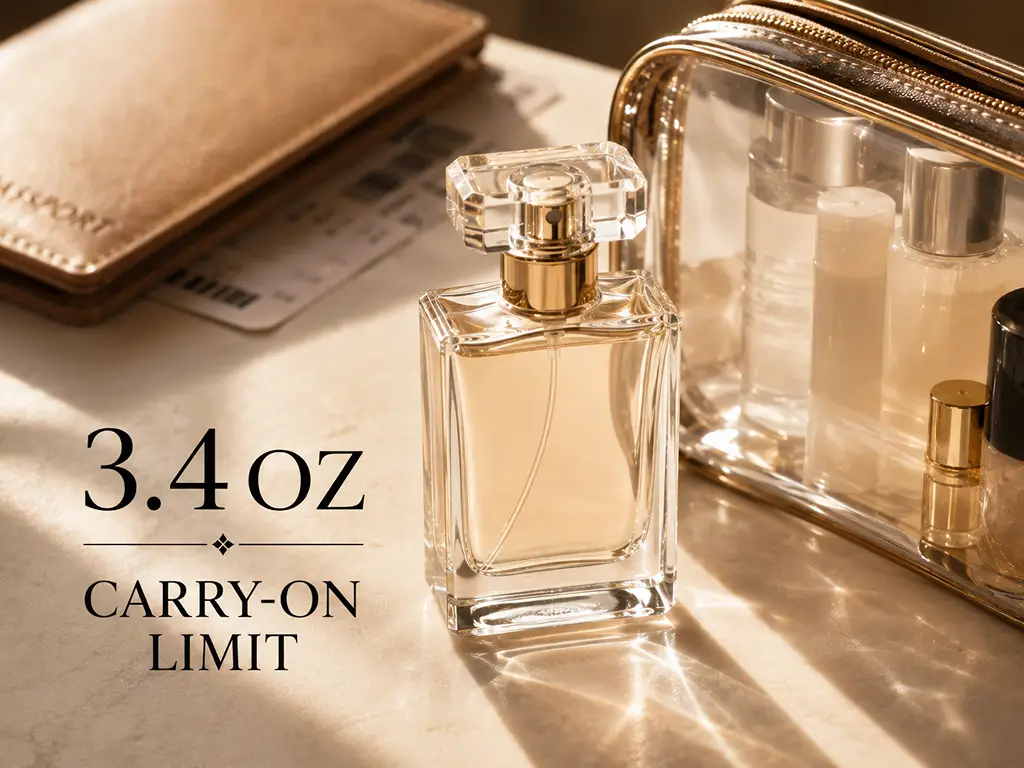
For the business: regulators read the printed capacity, not the juice left, so the 100ml is the only size that is travel-safe everywhere. That is why brands plan product lines around it. A 30ml travel size and a 100ml flagship are compliance decisions before they are aesthetic ones. It is also why 100ml molds are the deepest stock in every bottle factory.
What the 100ml Means for a Brand at Any Size
For a brand, a 100ml bottle is three decisions stacked on top of each other: a capital decision, a margin decision, and a compliance decision. The size you launch with is the size of your bet.
| Brand stage | What the 100ml means | The strategic move |
|---|---|---|
| Startup / indie | A capital lockup: 10,000–50,000 units at $2.60–3.15 a bottle ties up $30,000–150,000 before the first sale | Launch at 30ml or 50ml on stock molds; plan the 100ml as a second-year flagship |
| Mid-size / growing | A margin engine and an expansion passport: the 100ml carries the best per-ml economics, and its travel compliance opens duty-free and international retail | Make the 100ml the hero SKU once distribution can absorb it; lead marketing with per-ml value |
| Established / global | The market’s standard unit: pricing psychology, marketing ROI, and sustainability pressure all anchor on the 100ml | Lightweight the bottle (15–25% less glass) to cut freight and carbon; add refill formats to protect margin |
The startup math is worth spelling out. A custom 100ml bottle with tooling can cost a young brand five figures before a single drop of fragrance is filled. The same brand can launch a 30ml on a stock mold for a fraction of it. That is why so many indie fragrances debut small: the bottle size is the size of the bet.
At the other end, the 100ml is where sustainability pressure lands hardest. Glass is heavy and freight is expensive, so established brands are lightening their flagship bottles by 15–25%: every gram saved is margin and carbon saved together. Refillable 100ml formats run the same math: the expensive bottle is bought once, and the refill carries the margin.
Whatever your stage, the next step is the same. It is the spec sheet.
From the Wearer’s Questions to the Buyer’s Spec Sheet
Every question a wearer asks about a 100ml bottle is a line on a buyer’s spec sheet. The height fits a spec. The spray count fits a spec. The plane-safe size fits a spec. Here is the mapping:
| The wearer asks | The buyer specs |
|---|---|
| How big is it in my hand? | Bottle height, width, depth, and glass weight |
| How many sprays will I get? | Pump dose tier (0.06–0.08 vs 0.10–0.13 ml) |
| Why does it look bigger than it holds? | Nominal capacity vs fill capacity (±3ml tolerance) |
| Can I take it on the plane? | 100ml as the travel-compliant SKU |
| Is it worth the price? | Cost per unit: glass + pump + decoration + tooling |
The Four Lines of a 100ml Quote
Everything so far has been the wearer’s view. Flip the bottle around: for a brand owner, an independent perfumer, or a packaging buyer, a 100ml bottle is four line items: glass, pump, decoration, and tooling. Each one answers a question you have already met in this article.
- Glass. The weight a hand feels is the first number on the invoice. Weight comes first: it sets the unit cost and the freight cost. Mid-to-high-end perfumes use super flint (low-iron, extra-clear) glass for that crystal-bright look. Serious suppliers quote capacity tolerance of ±3ml and weight tolerance of ±5g per bottle.
- Pump. The dose tier that decides your spray count is chosen at the purchase order, not the perfume counter. From the 0.06–0.08ml standard spray to the 1.0–1.3ml-per-10-sprays high-output feel, the spec you sign decides the experience. The seal material decides whether the bottle stays leak-free for years. This is the part wearers feel but never see.
- Decoration. The coatings that make a bottle look premium are billed one process at a time. Spray coating, silk-screening, hot-stamping, and decals are each a separate cost line, applied after forming. More finishes, more cost, more lead time.
- Tooling. A bottle shape that does not exist yet starts with a mold: typically 20–35 days to make, with a working life of roughly 400,000–500,000 pieces. A stock shape skips this step entirely.
Cost, MOQ, and Lead Time: What to Expect
Here is the number that surprises everyone. The perfume on the shelf costs $100-plus. The empty 100ml bottle behind it wholesales for about $2.60 to $3.15 a unit. Orders start as small as 70 pieces, with factory-direct pricing from 1,000 units up (Packamor, 2026). The gap between those two numbers is fragrance oil, branding, and distribution, not glass.
Custom runs have their own logic. Minimum order quantities for perfume bottles typically scale inversely with glass weight. Heavier bottles carry more margin, so factories will accept smaller runs:
| Bottle weight | Typical minimum order |
|---|---|
| 40–50 g | ~50,000 units |
| 50–120 g | ~30,000 units |
| 120–200 g | ~20,000 units |
| 200–350 g | ~10,000 units |
Time is the other half of the quote. A custom 100ml bottle follows a predictable chain: 20–35 days for the mold, 30–35 days for production, roughly 45 days total to delivery. Each added decoration extends it. Suppliers with large stock-mold libraries (some keep 400–500 ready designs) can compress the whole timeline by skipping tooling. That is how brands launch a new fragrance in weeks instead of months.
Here is the practical version of this section: when you request a 100ml quote, all four lines should come back from one supplier. Nuvole Glass keeps 500+ stock bottle shapes and 500+ caps, so most projects can skip tooling entirely. They pour super flint (low-iron) glass with ±3ml capacity and ±5g weight tolerance, and supply both pump dose tiers with vacuum leak testing before every shipment. One inquiry returns the glass weight, the pump spec, the decoration options, and the mold question, answered together instead of across four vendors.
Nuvole Glass quotes the whole chain: design concepts in 3–7 days, molds in 20–35, delivery in about 45. All from one contact page.
References
- Transportation Security Administration. “Liquids, Aerosols, and Gels Rule.” 2026.
- Scent-DNA. “BT003 – 100 ML Glass Perfume Bottle.” 2025.
- Packamor. “100ml Perfume Bottles (3.4oz).” 2026.
- Be Layered. “How Big is 100ml Perfume? Understanding the Volume of Fragrance Bottles.” 2024.
- Nuvole Glass. “Contact Us.”
- Nuvole Glass. “Homepage.”