Here’s a scene almost every fragrance buyer knows: the 30ml bottle arrives, you unwrap it, and for a second you’re not sure you received the right size. It looked bigger in the photos. It feels heavy in the hand. And the box says 30ml, about one fluid ounce, which doesn’t feel like much of anything.
The short version: a 30ml perfume bottle typically stands 7–9 cm tall and 2–3 cm wide. It delivers somewhere between 250 and 500 sprays, and it lasts most people two to four months of daily use. But “how big is 30ml?” has two different answers: the amount of perfume inside, which never changes, and the physical bottle around it, which changes wildly between brands. This guide covers both, plus the spray math that no two websites agree on and the honest answer to “is it worth it?”
How Big Is a 30ml Perfume Bottle? The Numbers and the Mental Picture
Before anything else, separate the two things people mean by “big.” The volume of fragrance is fixed: 30 milliliters, every time. The bottle it comes in is a design choice. No two brands build it the same way. A 30ml fragrance can live in a slim 10-centimeter tower or a squat 5-centimeter cube. Same perfume inside, completely different footprint. Here’s the number side first, then the picture side.
From ml to oz: The Conversion That Never Changes
Thirty milliliters is 1.01 US fluid ounces, a ratio set by measurement standards, not by brand preference. Precisely, 1 fl oz equals 29.573 ml (NIST Handbook 44, Appendix C, 2026). That’s why American shelves label the same bottle “30ml / 1.0 fl oz” while European shelves simply print “30ml” — both mean the exact same fill.
In everyday terms, 30ml is about the volume of one espresso cup. It sounds tiny until you remember that each spray uses only about a tenth of a milliliter. That’s exactly why such a small amount can last for months.
Ml to oz at a glance
| Milliliters | US fluid ounces | What it’s called on shelves |
|---|---|---|
| 30ml | 1.0 fl oz | The entry size |
| 50ml | 1.7 fl oz | The standard full bottle |
| 100ml | 3.4 fl oz | The value size |
So the liquid is easy to picture. The bottle is where the confusion begins.
The Physical Size: 7–9cm Tall, 2–3cm Wide — and Why It Varies
Ask retailers how big a 30ml perfume bottle is and most will give you the same range: roughly 7 to 9 centimeters (2.8 to 3.5 inches) tall and 2 to 3 centimeters wide. But that range exists because three design choices stretch it constantly. A slim cylindrical bottle sits at the tall end; a square or oval bottle sits at the low, wide end; and a thick, heavy base adds height and weight without adding a single drop of capacity.
That last detail matters more than people realize. Two 30ml bottles can weigh 40g or 120g. The difference is entirely glass, not perfume. Most 30ml bottles also share one invisible spec: a 15mm neck opening, the industry’s standard size for fitting spray pumps. If two bottles look completely different yet both say 30ml, that’s usually all that’s happening: same cavity, different costume.
And that raises a question we’ll dig into properly later: why do some 30ml bottles look like they should hold 100ml?
Everyday Objects That Match a 30ml Bottle
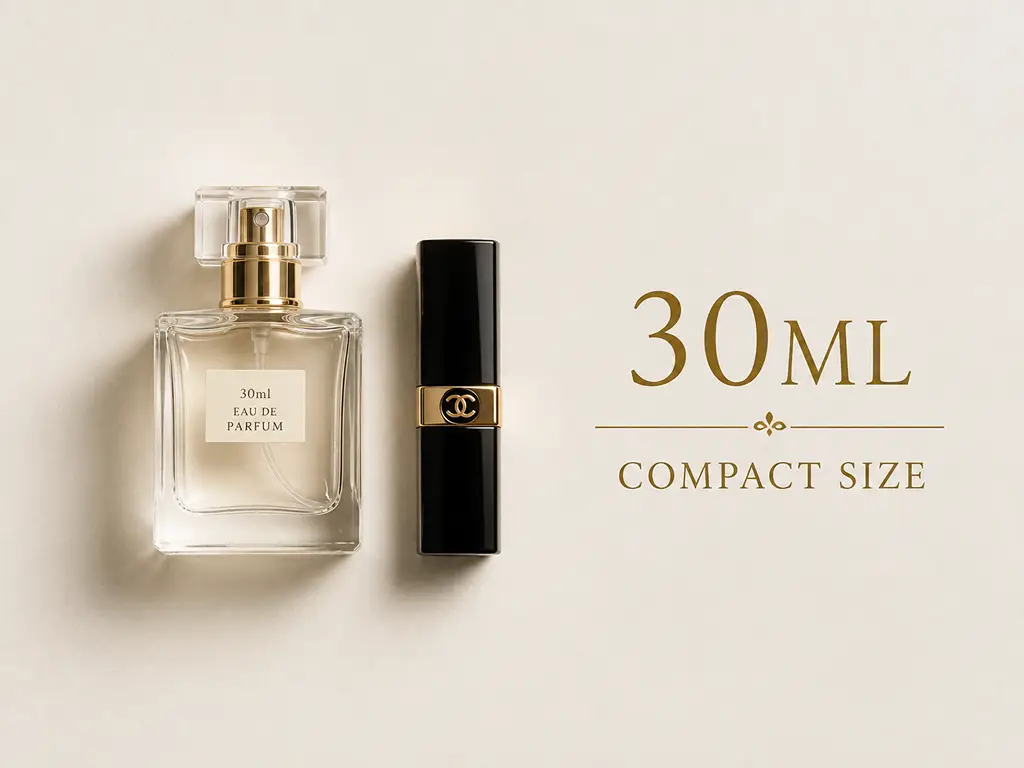
Numbers are fine, but the “size in hand” question people actually type into search engines deserves concrete objects:
- In your palm, a typical 30ml bottle is about half the width of your hand and stands as tall as your middle finger.
- Next to everyday items, it’s roughly the size of a lipstick box or a small lighter.
- By capacity, 30ml equals one standard shot glass (1 oz) or two tablespoons (volume equivalents, not shape equivalents).
- By footprint, it disappears into a jeans pocket or the smallest purse compartment, which is why travelers love it.
One caution while you picture this: a shot glass matches the capacity; a lipstick box matches the footprint. Mixing the two is how 30ml starts to feel confusing.
How Many Sprays and How Long Does 30ml Actually Last?
Search “how many sprays is 30ml” and you’ll get 300. Then 375. Then 450 to 600. All of them sound confident, none of them agree. The good news: there’s one hidden variable that explains every number at once — and once you see it, you’ll never need to memorize another estimate.
The Pump-Dose Math Behind Conflicting Spray Counts

Every spray count on the internet is just the same division problem solved with different inputs:
Sprays = 30ml ÷ dose per spray
The dose per spray is set by the pump, not the bottle. Most perfume atomizers release between 0.08 and 0.12 ml per press, with 0.1 ml as the most common spec used for estimation (Packamor, 2026). Plug the numbers in and the mystery dissolves:
- Find the pump’s dose. Typical perfume pumps: 0.08–0.12 ml per spray; 0.1 ml is the standard reference point.
- Divide. 30 ÷ 0.1 = about 300 sprays.
- Adjust for the pump you actually have. A fine-mist pump at 0.08 ml gives roughly 375 sprays; a high-output pump at 0.12 ml gives about 250.
So 300 is the sensible default, 375 and 450 belong to finer mist pumps, and the “600” claims assume an unusually small dose. Nobody is lying; they’re just quoting different hardware.
Same 30ml, different pumps
| Pump output | Sprays per 30ml | What it feels like |
|---|---|---|
| 0.08 ml (fine mist) | ~375 | Lighter cloud, bottle lasts longer |
| 0.10 ml (standard) | ~300 | The reference point most brands build on |
| 0.12 ml (high output) | ~250 | Generous dose, richer scent per press |
Spray quality changes this math more than anything else. A weak pump that spits a watery stream wastes perfume unevenly; a well-built one releases a fine, even cloud that covers skin without soaking it.
From Sprays to Months: Real-World Usage Timelines
Translating sprays into months depends almost entirely on your daily habit:
How long 30ml lasts in real life
| Usage pattern | Sprays per day | A 30ml bottle lasts |
|---|---|---|
| Light (special occasions) | 1–2 | 5–8 months |
| Daily signature (2–4) | 2–4 | 2–4 months |
| Heavy application (5+) | 5+ | About a month |
One more variable: concentration. An eau de parfum carries 15–20% fragrance oil, while an eau de toilette sits at 5–15% (Ulta Beauty). Higher concentration usually means fewer sprays per application. A 30ml EDP often outlasts a 30ml EDT in practice, even though both hold the same volume.
If you’re reading this as someone who sells fragrance rather than sprays it, here’s the trade takeaway: those three pump standards are your incoming-quality checklist, not just a counter tip. The pump is the one component your customer tests every single day, and it decides whether a 30ml gets repurchased or quietly abandoned. When two suppliers quote the same bottle, they are rarely quoting the same pump.
Why a 30ml Bottle Can Look Much Bigger Than It Holds
Here’s the real answer to the confusion that opened this article. Volume lives in the cavity inside the glass — not in the silhouette. A traveler on a forum described it perfectly: their oddly shaped 30ml bottle “visually looks about the size of my 100ml travel bottles.” They weren’t being fooled by their eyes; the glass really was hiding the difference.
Where the Glass Hides the Volume: Thick Bases and Walls
Perfume bottles are engineered to feel substantial (it’s how luxury is communicated), and that substance comes from glass in three specific places:
- The base. Perfume bottles are famously thick-bottomed; a base of 10–20 mm is common, sometimes a fifth of the entire bottle height. All of it is solid glass, occupying space where liquid could have been.
- The walls and facets. Multi-faceted “crystal cut” bottles and chunky square shoulders wrap the cavity in extra glass on every side.
- The silhouette. An hourglass or sculpted shape creates large external dimensions around a surprisingly small interior.
Glass weighs 2.4–2.6 grams per cubic centimeter. That’s why a 30ml bottle frequently weighs more than the perfume inside it, and why “it felt heavy” tells you nothing about capacity.
How to Judge Real Capacity at a Glance
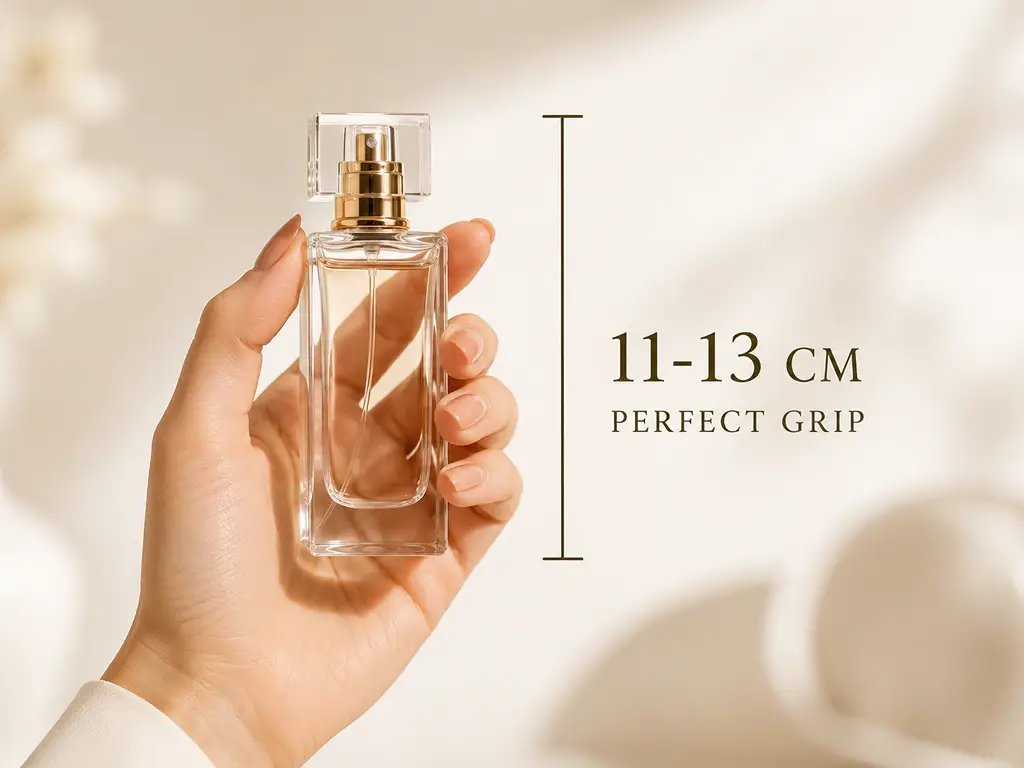
Since photos can’t be trusted, learn to read the bottle itself. Three quick checks, in order:
Better than all three: the net content printed on the box and the bottle is the only legally binding answer. Everything else, including this guide, is just estimation.
For a brand, that thick base is a deliberate choice. The 10–20mm slab of solid glass is why a 30ml feels like a luxury object in the hand, and it is engineered perceived value you pay for by the gram. Every bottle design splits the glass between two jobs: container and jewelry. The production numbers that follow from that split are coming up next.
Is a 30ml Perfume Worth It? Size, Price, and How It Compares
Now the question behind the question. Here’s the landscape in one view:
30ml vs 50ml vs 100ml
| Size | Typical sprays | Months of daily use | Price per ml | Best for |
|---|---|---|---|---|
| 30ml (1.0 oz) | ~300 | 2–4 | Highest | Trying new scents, travel, gifting |
| 50ml (1.7 oz) | ~550 | 4–6 | Middle | The everyday signature |
| 100ml (3.4 oz) | ~1,100 | 8–12 | Lowest | Committed favorites |
The price math deserves a straight answer. A 30ml bottle usually retails for 50–60% of the 100ml price of the same fragrance, which means you pay significantly more per milliliter when you buy small. That’s not greed: the glass bottle, pump, and filling line cost roughly the same whether they hold 30 or 100 milliliters, and the fragrance liquid itself is only a small slice of the retail price. The fixed costs get spread thinner as the size grows.
So “is it worth it” has two honest answers. By the math, the 100ml always wins on value per ml. By psychology, the 30ml wins on variety. A smaller commitment means more scents in your collection, a bottle that actually gets finished, and one that travels anywhere. On the travel front, 30ml (≈1 fl oz) sits comfortably under the 100 ml / 3.4 oz carry-on limit for liquids (TSA), so it never has to ride in checked luggage.
Turn that consumer logic around and it becomes a fragrance brand’s SKU strategy. The 30ml is the acquisition size: the one a stranger will risk money on. The 50 and 100ml are the retention sizes, where the margins live. Houses know the per-ml math favors the big bottle. They keep the small one in the lineup precisely because it is the cheapest way a stranger becomes a customer.
For Brand Owners: What 30ml Really Means on the Production Side
Every insight above was watched from the buyer’s side of the shelf: the pump, the glass, the price math. Here is the same knowledge from the production side, for anyone filling, buying, or selling 30ml bottles. But before the numbers, the strategy: what this size means for a brand at any scale.
A startup treats 30ml as the cheapest experiment money can buy: a small first batch, samples in strangers’ hands, and three scents tested instead of one budget bet.
A growing brand treats it as channel currency. Travel retail shelves, discovery sets, gift boxes, and subscription boxes are all built on the small format. Wholesale buyers who stock your 30ml are stocking trial; the ones who reorder it are voting on the fragrance itself.
An established house treats it as the low-friction door into the flagship. An entry format of a bestseller captures the customer who would never blind-buy 100ml, and it defends the price ladder against decants and dupes.
Every one of those moves rests on production numbers. These four matter most.
- The fill is smaller than the bottle. “30ml” is the net content, not the cavity, and the thick base you read about earlier is only part of the story. A 30ml glass bottle’s interior typically holds 32–35 ml, with 10–15% headspace left on purpose to protect the liquid and the seal.
- The neck dictates everything. 15mm is the standard neck for 30ml bottles (13mm for small formats, 20mm for oversized ones). It decides which pumps fit: the same pump your customer judges on the three standards above. Changing it after tooling is expensive.
- Tolerance is a spec, not a hope. “The same visible dose on every press” only happens because professional manufacturers work to ±3 ml capacity and ±5 g weight tolerances, so every fill line and box fits the same bottle.
- Glass MOQs are nothing like plastic. Bottle minimums scale with bottle weight: roughly 50,000 pieces for 40–50 g bottles, 30,000 for 50–120 g, and 20,000 for 120–200 g. New molds take 20–35 days. The “MOQ 50–100 units” numbers floating around online are plastic-bottle territory. Glass is a different world.
30ml bottle production specs at a glance
| Spec | Typical value | Why it matters |
|---|---|---|
| Net fill vs cavity | 30ml in a 32–35ml cavity | Headspace protects seal and shipping |
| Neck size | 15mm standard (13/20mm variants) | Determines pump compatibility |
| Tolerances | ±3ml capacity, ±5g weight | Keeps filling lines and packaging consistent |
| MOQ by weight | 20k–50k pcs depending on bottle weight | Sets the real order size |
| Mold lead time | 20–35 days | Plans your launch timeline |
If you’d rather skip the education curve entirely, manufacturers like Nuvole run the whole 30ml process under one roof: a first set of design concepts in 3–7 days, 3D-printed prototypes for approval, and 500+ in-stock designs to start from. You can browse their 30ml perfume bottle collection or walk through a full customization workflow to see how a 30ml bottle goes from idea to fill-ready.
Get Your 30ml Bottle Right the First Time
From 500+ in-stock designs to a fully custom mold, Nuvole takes your bottle from concept to fill-ready — with samples in as little as 3–7 days.
References
- National Institute of Standards and Technology. “Handbook 44, Appendix C: General Tables of Units of Measurement.” 2026. https://www.nist.gov/document/2026-nist-handbook-44-appendix-c
- Ulta Beauty. “Fragrance Concentration Guide: Eau de Toilette vs Parfum.” https://www.ulta.com/discover/beauty-education/eau-de-toilette-vs-parfum
- Transportation Security Administration. “Liquids, Aerosols, and Gels Rule.” https://www.tsa.gov/travel/security-screening/liquids-aerosols-gels-rule