Fifty milliliters is the size you see most often behind the perfume counter — but if you have never held one, “50ml” tells you almost nothing. Is it palm-sized? Will it fit in your bag? Will it last three months or a year? Here are the answers: the real dimensions, the weight nobody talks about, the spray math, and why some 50ml bottles look twice as big as others.
What 50ml Actually Means: Volume, Not Size
First, the foundation that most size guides skip: 50ml is a measure of liquid volume, not bottle size. Fifty milliliters converts to 1.7 fluid ounces — the industry’s standard “full size” for a fragrance. A 30ml bottle is the entry-level retail size, and 100ml is the large format.
But here is the part that confuses people: two bottles can hold exactly 50ml and look completely different. A slim, tall flacon and a squat, chunky cube both deliver the same amount of perfume. Perfume is sold by volume, not by silhouette — like a 50ml sachet of shampoo and a 50ml serum vial share nothing visually yet carry the same quantity. Keep that in mind, because everything below is measured against it.
The Real Size of a 50ml Perfume Bottle: Height, Width, and Weight in Your Hand
A 50ml perfume bottle is not one size — it is a family of shapes. But the whole family can be pinned down by two numbers: how tall it stands and how much glass it carries. Here are both, in numbers you can verify against a ruler and a kitchen scale.
Height, Width, and Depth: Real Numbers
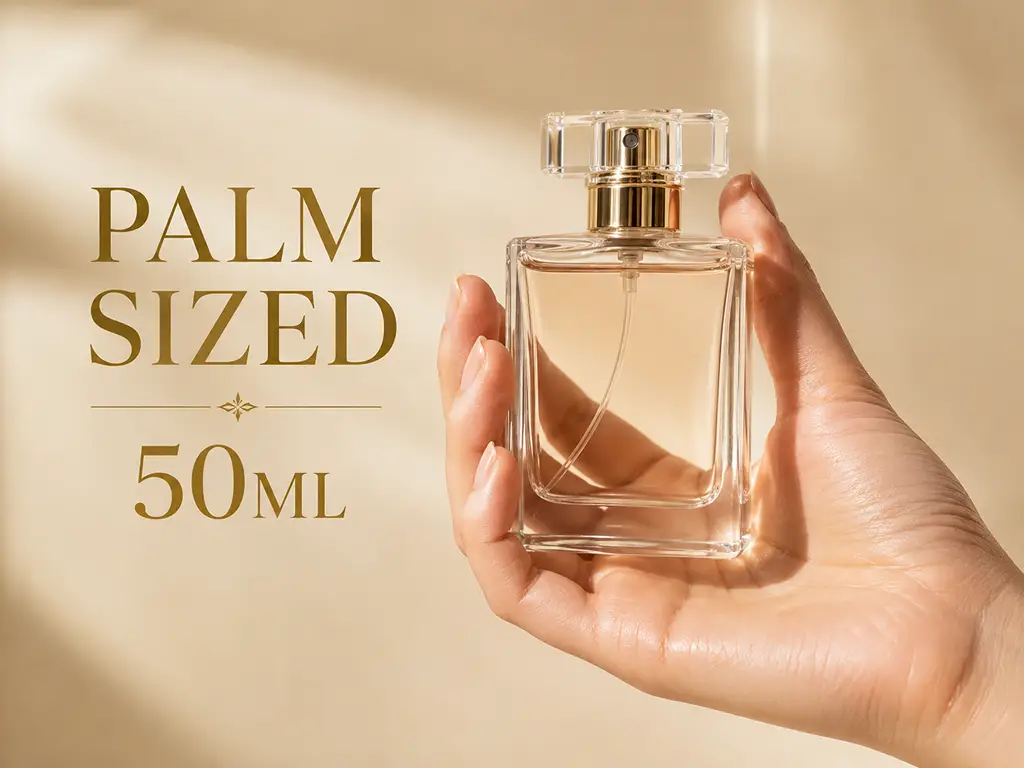
Most 50ml perfume bottles stand between 7.5 and 15 cm tall (about 3 to 6 inches), including the cap, with a diameter or side length of roughly 3 to 5 cm (Packamor, 2026). At the compact end sits something like a cube-shaped 50ml bottle measuring about 48.5 × 48.5 × 75.25 mm and weighing 147 g when filled (Packamor product specifications, 2026). At the elegant end, a slender cylinder may stretch 11 to 13 cm tall with a diameter of barely 3 cm.
The neck opening matters too, because it decides which pump and cap your bottle uses. Perfume bottles commonly come in 13 mm, 15 mm, and 20 mm finishes, with 15 mm as the everyday standard. Small and travel bottles lean toward 13 mm, while 20 mm is reserved for oversized statement flacons.
Glass Weight: The Number Nobody Quotes
Here is the data point almost every size guide misses: the glass itself. An empty 50ml perfume bottle typically weighs between 40 g and 200 g, depending on wall thickness and design. A minimalist, thin-walled bottle sits at the light end — around 40 to 80 g. A thick-bottomed, crystal-cut design can easily exceed 150 g before a single drop of perfume goes in. Add the liquid — 50ml of perfume weighs roughly 43 to 45 g, since alcohol-based fragrance is slightly lighter than water — and a filled 50ml bottle can land anywhere from about 90 g to nearly 250 g (Scento, 2026).
That weight difference is deliberate. A heavy glass base is one of the oldest tricks in luxury packaging: it makes the bottle sit lower and feel denser in the hand, which most people read as “more expensive.” Two 50ml bottles side by side — one 95 g, one 200 g — hold the same perfume, but your hand will swear they are different products.
How Many Sprays, How Many Months?
The question behind “how big is 50ml” is usually “how long will it last me?” That answer is built from one number: how much perfume your pump releases with each press.
The Spray Math: What Your Pump Actually Releases
A standard perfume pump dispenses between 0.08 and 0.15 ml per spray, with 0.1 ml as a working average (Packamor, 2026). Do the arithmetic: 50 ml ÷ 0.1 ml gives about 500 sprays, with a realistic range of roughly 330 to 625 sprays depending on your pump (Nota Perfumes, 2026; 121 Aroma). You can verify this at home in ten seconds: press the atomizer into the air a few times and watch the liquid level — the drop is visible, and it is small.
Two things do not change the math. Fragrance concentration — EDT, EDP, or extrait — affects how long the scent stays on your skin and how many sprays you choose to use, not how much liquid each press releases. And the brand name on the bottle changes nothing either; the pump is the variable, not the label.
Months of Use: A Realistic Timeline
Convert the sprays into months, and here is what a 50ml bottle looks like across real routines (Scento, 2026):
| Usage intensity | Sprays per day | Estimated lifespan | Typical wearer |
|---|---|---|---|
| Occasional | 1–2 | 8–12 months | Weekend or evening wearer |
| Daily office wear | 2–3 | 5–8 months | Commuter with a steady routine |
| Every-day full use | 4–5 | 3–5 months | Signature-scent daily wearer |
| Heavy application | 6–8 | 2–3 months | Frequent re-sprayer |
One distinction worth underlining, because forum threads constantly blur it: “how long a 50ml bottle lasts” (months of use) is not the same question as “how long the scent lasts on skin” (hours per application). An EDT typically projects for 3 to 6 hours and an EDP for 5 to 10 — but both come out of the same spray-count math above.
Why Some 50ml Bottles Look Bigger Than Others
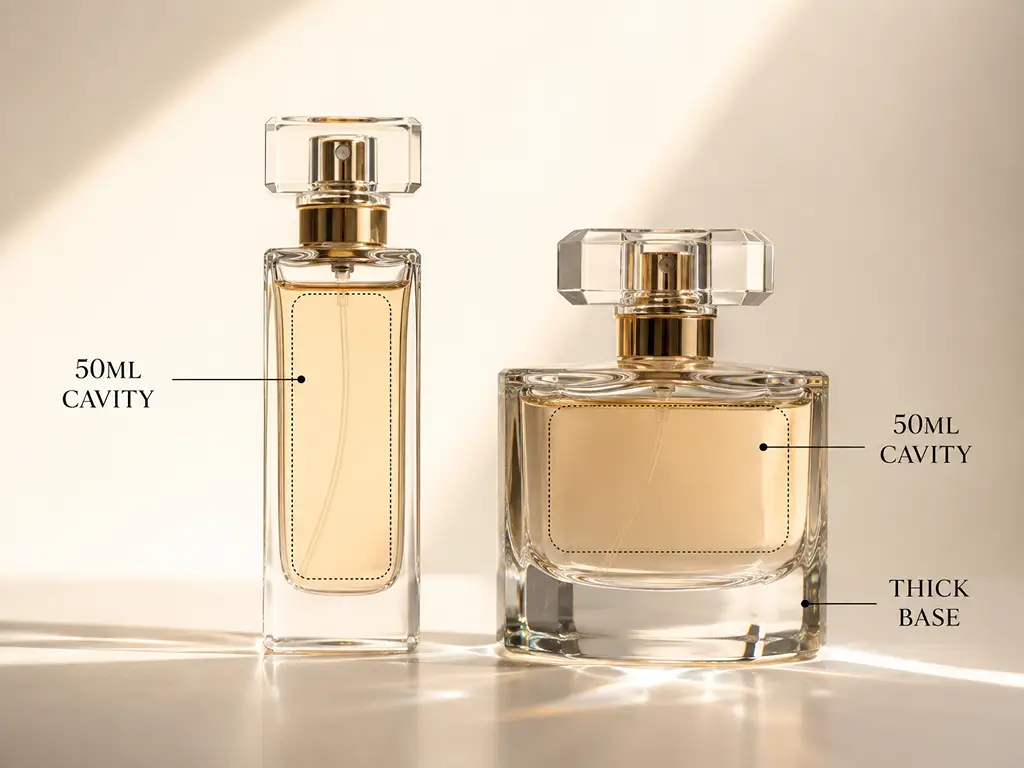
You have seen it on e-commerce pages: two perfumes, both 50ml, one looking generous and one looking stingy. That is not your eyes failing you — it is packaging engineering. Four factors create the illusion:
| Factor | How it changes the perceived size | Typical example |
|---|---|---|
| Glass wall thickness | A thick base and walls add 20%+ visual volume and make the bottle “sit” heavier | Crystal-cut heavy-bottom flacons |
| Bottle proportions | Wide shoulders and squat bodies read as larger; slim, tall cylinders read as smaller | Square vs. vertical rectangles |
| Surface finishing | Frosting, colored coating, and multi-facet cutting add visual density; clear thin glass reads airy | Matte spray-coated bottles |
| Fill level (headspace) | Bottles filled to the shoulder look fuller than those with 15–20% air on top — and perfume is usually filled to only 80–85% of total bottle capacity by design | Nearly every retail bottle |
That last row surprises most people. The headspace is not a manufacturer short-changing you — it is the engineering margin for thermal expansion and the pump mechanism (Packamor, 2026). It is also why product photography under counter lighting can flatter a bottle’s size: glass, light, and fill level work together like a stage set.
50ml vs 30ml vs 100ml: Which Size Fits Your Life
Now that you know what 50ml is, the practical question is whether it is your size. The comparison that actually matters:
| Size | Sprays | Typical lifespan | Portability | Price position | Cost per ml |
|---|---|---|---|---|---|
| 30ml (1 oz) | 300–450 | 2–5 months | Pocket-friendly | Lowest entry price | Highest |
| 50ml (1.7 oz) | 330–625 | 3–9 months | Handbag-friendly | Mid-range sweet spot | Middle |
| 100ml (3.4 oz) | ~1,000 | 6–12 months | Home or checked luggage | Highest | Lowest |
The decision rule is simple. Pick 30ml if you rotate scents or want to test something new without commitment. Pick 50ml if you wear fragrance most days and want the standard full-size experience without overbuying. Pick 100ml only for a proven signature scent you know you will finish (Scento, 2026). Collectors tend to arrive at the same place from a different route: several 50ml bottles beat one 100ml bottle, because a collection you actually finish is worth more than a shelf of half-empty giants.
Travel Rules and Gifting: The Practical Checkpoints
For travel, 50ml is comfortably inside every rule that matters. Airline security allows containers up to 100 ml (3.4 oz) each in carry-on luggage under the liquids rule, so a 50ml bottle clears the limit with room to spare (TSA). It is the largest perfume size you can pack without thinking twice about it — a 100ml bottle uses up the entire per-container allowance.
For gifting, 50ml sits in the same sweet spot it occupies everywhere else: generous enough to feel like a real present, modest enough that it stays thoughtful if the scent misses the mark. It is no accident that 50ml is the most common size in fragrance gift sets.
What Your Customers’ Size Questions Reveal About the Business
If you sell perfume rather than wear it — as a brand, a distributor, or a wholesaler — everything above is market research you did not have to commission. Each question this article answers on the consumer side has a second reading on the business side.
Start with the size question itself. “How big is 50ml?” is asked by shoppers one click away from abandoning the cart — and by retail buyers calculating shelf depth. A brand that publishes real dimensions and a hand reference removes the friction before it forms; a distributor uses the same numbers for planograms and box sizing.
The spray math is a repurchase engine in disguise. At 0.1 ml per press, a 50ml bottle holds about 500 sprays — five to eight months of daily wear. Spec a higher-dose pump and the same bottle empties faster, which improves the daily experience and shortens the repurchase cycle in the same stroke. The dose printed on no label is a loyalty decision made in the components catalogue.
The weight question is a positioning question. A 200 g bottle feels like luxury in the hand; the same 50ml at 60 g feels functional. But glass weight is also freight cost, and it is how suppliers tier minimum orders. What the customer reads as quality in their palm is a logistics line on a spreadsheet.
The “why does it look bigger” question is perceived-value engineering in plain language. Wall thickness, shoulder shape, frosting, and fill level change how large a bottle appears without adding a single drop of liquid — four levers a brand can pull at the design table at no cost in juice.
The travel and gifting checks mark out the channel logic. A 50ml that clears carry-on rules belongs in duty-free and travel retail; the size that dominates gift sets is the one gift wholesalers reorder all year.
Add it up and one conclusion falls out: the value a customer feels is manufactured upstream, in the bottle spec, the pump dose, and the glass weight. What follows is not a tangent — it is the same numbers read from the other side of the counter.
What 50ml Means to a Fragrance Brand at Any Scale
In fragrance, a size is never just a size. Fifty milliliters is the industry standard for a reason that has little to do with liquid: it is a positioning statement every market tier agrees on.
For an indie brand, 50ml is the entry ticket. It lands a launch in the $55–100 retail bracket — premium enough to signal quality, low enough for a first-time customer to take a chance (Packamor, 2026). It reaches the widest shelf of stock molds without a custom tool, and photographs like a real product rather than a sample. It is the smallest size that still reads as “a proper perfume brand.”
For a scaling brand, 50ml is the anchor of the ladder. The classic portfolio is 30ml as the trial, 50ml as the core, 100ml as the value. The middle rung does the heavy lifting: it carries the standard margin, it is the size reviewers show on camera, and it is the SKU retailers order without asking questions. Every other size borrows its credibility.
For an established house, 50ml is the accessible luxury rung. Luxury pricing runs on a ladder too — 50ml priced as the door into the house, 100ml as the better-value upgrade. That gap is what moves a hesitant buyer up. And because 50ml clears carry-on rules and fits gift sets, it travels through duty-free and holiday retail — channels where houses meet customers who never visit a boutique.
Why did 50ml win this position in the first place? Standards have gravity. Consumers trust the size they see most; shelves and cartons are dimensioned around it; suppliers keep hundreds of stock molds in it. Once an industry standardizes, deviating costs more than following — which is why new brands keep arriving at the same answer independently.
From the Brand’s Side: The Sourcing Reality Behind 50ml
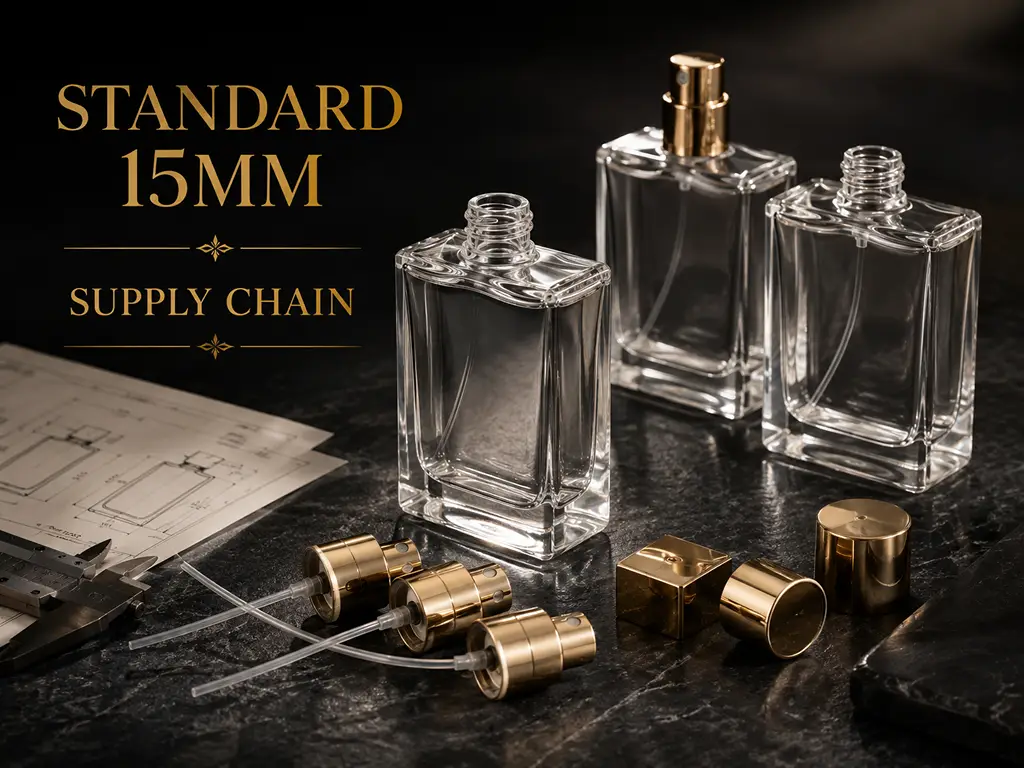
Strategy is the easy part; the bottle still has to exist. A 50ml bottle needs a fill of only 80–85% of capacity, a neck finish that matches a standard pump — usually 13, 15, or 20 mm — and a glass weight that controls both freight cost and perceived quality. Every gram matters when you are shipping flammable liquid as hazardous cargo across borders.
Then there is the sourcing reality. Minimum order quantities are usually tiered by bottle weight. Lighter bottles in the 40–50 g class carry higher minimums, often around 50,000 pieces; heavier 200 g designs can drop to 10,000.
For a brand launching its first 50ml, choosing the bottle supplier is quietly the most consequential decision of the launch — more than the label, the box, or the launch date. The glass decides the first impression; the pump decides every day after it.
If you are planning a 50ml launch, it helps to compare against a supplier that specializes in exactly this size. Nuvole Glass is a mid-to-high-end glass bottle manufacturer whose core category is the 50ml perfume bottle — super flint crystal-white glass that stays clearer and streak-free, high-dose fine-mist pumps tuned to Western usage habits, and more than 500 in-stock bottle shapes alongside a full custom design program. See the custom 50ml perfume bottle program for specifications and lead times.
References
- Scento. “Perfume Bottle Sizes 2026: 30ml vs 50ml vs 100ml Compared.” 2026. https://www.scento.com/blog/perfume-bottle-sizes-30ml-vs-50ml-vs-100ml-compared
- Nota Perfumes. “50ml vs 100ml: Which Size Is Right for You?” 2026. https://nota-perfumes.com/blogs/fragrance-journal/50ml-vs-100ml-which-size-is-right-for-you
- 121 Aroma. “How Big Is 50ml Perfume?” https://121aroma.co.uk/blogs/news/how-big-is-50ml-perfume
- Transportation Security Administration. “Liquids, Aerosols, and Gels Rule.” https://www.tsa.gov/travel/security-screening/liquids-aerosols-gels-rule