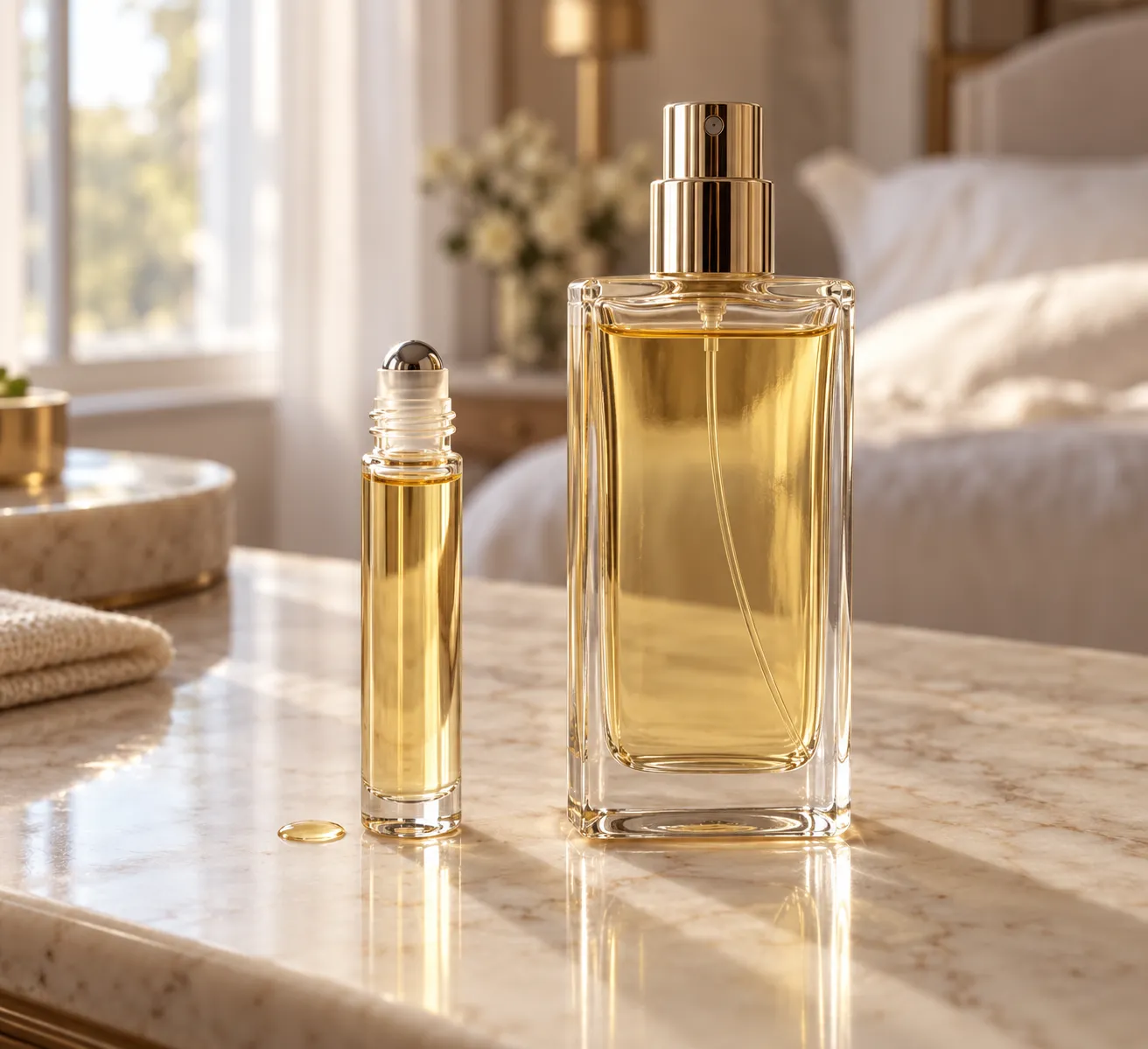
The same fragrance can arrive in two bottles that behave nothing alike. One is a 10ml roller you press onto your wrists. The other is a 50ml atomizer that fills a room with one pass. The juice inside may share the same scent brief. What separates them is the carrier, the base the fragrance compounds dissolve into. Alcohol-based sprays throw scent into the air and let it fade fast. Oil-based perfumes hold it against the skin and release it slowly. Nearly every practical difference you will read about below, from how long it lasts to which bottle it can legally live in, traces back to that one choice.
The root difference
Oil or alcohol is not a packaging detail. It is the one decision that sets wear time, throw, skin feel, cost per wear, and the container itself.
What Perfume Oil and Spray Actually Are
An alcohol spray suspends fragrance compounds in ethanol and a measured shot of water. When you press the pump, the alcohol flashes off, carrying the scent outward in a fine cloud. That flash is why a spray feels immediate and loud. It is also why a spray thins out: as the alcohol evaporates, some of the top notes go with it.
A perfume oil dissolves the same compounds into a carrier oil, usually jojoba or fractionated coconut oil. Oil does not evaporate the way alcohol does. Body heat warms it, and the scent unfolds slowly over half an hour to an hour (Onekind, 2026). Nothing flies away at first press, so what you get is quieter, closer, and longer.
One word of caution before going further, because the word oil gets reused across three different products. A wearable perfume oil is a formulated fragrance blend diluted to skin-safe strength in a carrier oil. A fragrance oil is a raw scent material made for candles, diffusers, and soap, and it is not meant to touch skin undiluted. An essential oil is a single botanical extract, like lavender or tea tree, that usually needs diluting too. If you are here because of candles or reed diffusers, that is a different shelf of the store. This article is about the stuff you wear.
One more bit of vocabulary, because the concentration ladder you may have seen lives inside the spray world: Parfum, Eau de Parfum, Eau de Toilette, Eau de Cologne. That scale measures how much fragrance sits in the alcohol. Oil-based perfumes do not share the ladder; they are usually sold as one concentrated strength.
How They Perform Head to Head
With the carrier fixed as the root difference, the practical questions sort into three groups. How does it smell, to you and to everyone else? How does it treat your skin? And what does it cost per actual wear?
Longevity and Projection: Slow Tail vs Loud Entrance
Alcohol sprays lead with projection. The initial cloud carries several feet, which is exactly what you want when the goal is to arrive announced. The trade is endurance: the same volatility that throws the scent out also burns it off. As concentration drops, the gap widens, and an Eau de Toilette can be gone by mid-afternoon.
Oils flip the order. Projection stays close, in the zone where someone has to lean in, and the scent keeps unfolding for hours after a spray would have faded. Formulation guides put oil wear at roughly six to ten hours on moisturized skin. Alcohol sprays run shorter as concentration drops: around four to eight hours for an EDP, three to five for an EDT (Onekind, 2026). Independent sellers who build their business on oil-based fragrances report five to eight hours. Same story, told with lighter formulas and drier skin (r/PerfumeOils, 2025).
The honest caveat cuts both ways. If your skin runs dry, it drinks the oil faster and the marathon shortens. A moisturized base extends wear in either format. And if the assignment is to be noticed across a room, no oil formulation genuinely competes with a spray. Projection is a property of the evaporating carrier, not of the juice.
Skin Feel and Application Technique
Alcohol is a common trigger for reactive skin. Right where most people spray, the neck and the wrists, it strips moisture and leaves tightness or stinging. Removing the alcohol removes that irritant, which is the honest core of the “oils are gentler” claim. The boundary matters just as much. The fragrance compounds themselves are the same allergens in both formats, so an oil is kinder to your skin barrier, not a guarantee against sensitivities (Onekind, 2026).
Technique differs too. A spray wants distance: three or four passes from arm’s length across the chest, neck, and hair. An oil wants dots: one to three drops on pulse points, pressed in but never rubbed, because friction breaks the top notes down before they open. Oils also layer well, since a close-wearing base under a brighter spray is how many people build a signature that does not turn into a cloud.
Cost Per Wear, and the Travel Math
The sticker comparison misleads. Oil retails at a higher price per milliliter, but it is dosed in drops, not bursts. A 10ml oil dosed at one to two drops per wearing delivers roughly 100 to 200 uses. A 50ml EDP spent at three to four sprays per wearing empties on a comparable count, at a noticeably higher total cost (Onekind, 2026). Per actual wear, the small bottle often wins.
Travel tilts the same way. The liquids rule caps carry-on containers at 3.4 ounces (100 milliliters) each in one quart-sized bag (TSA, 2026), which most full-size sprays clear. A roller or sample vial goes further: it slips into a pocket and survives baggage handling without a glass atomizer to snap off.
Oil vs Spray at a Glance
| Dimension | Perfume oil | Alcohol spray |
|---|---|---|
| Carrier | Jojoba or coconut oil, slow release | Ethanol, fast flash-off |
| First impression | Quiet, unfolds over 30-60 minutes | Loud, instant cloud |
| Typical wear | 5-10 hours depending on skin and formula | EDP 4-8h, EDT 3-5h |
| Projection | Close, arm’s length and in | Several feet |
| On reactive skin | No alcohol sting, same allergens | Alcohol can sting or dry |
| Application | 1-3 dots, never rub | 3-4 passes from distance |
| Cost per wear | Lower (100-200 wears from 10ml) | Higher at equal wear count |
| Travel | Pocket vial, nothing to snap | 100ml cap, glass to protect |
Which One Fits Your Day
The real question is rarely “which format is better” and usually “which one fits this part of my life.” Walk your own week through the matrix below; the point is to know when your default stops working.
Format Self-Check
| Your situation | Reach for | Switch when |
|---|---|---|
| Desk days and close meetings | Oil on pulse points | The room should notice you: add one spray layer |
| Commute with a midday re-up | Roller in the bag | Re-applying a spray needs a restroom and distance |
| Evening out or date | Spray over an oil base | Wearing a scarf or coat that traps scent: oil only |
| Fragrance-free office or clinic | Oil, one dot, judged by nose at 20cm | Any visible application: skip entirely and scent the wrists after hours |
| Gym and workouts | Skip or a single oil dot | Heat amplifies alcohol sprays into a cloud nobody asked for |
| Flights and travel | Roller or sample vial | Checking luggage: a full spray bottle is fine, protected |
Two habits cover most situations. The first is layering: an oil base in the morning, one spray pass before you walk out at night. That is the standard way to wear both instead of choosing. The second is testing placement. Oils can mark fabric, so on dark clothes press a dot on an inner hem or the skin under a sleeve first, and keep sprays off silk and light knits entirely.
The Container Follows the Carrier
Formulas do not float free; they ship in glass, and the carrier decides what the glass has to do. This is where the two formats really diverge, because a container that behaves perfectly with alcohol can fail with oil in weeks.
Tell Nuvole your carrier and target dose, and we will match the pump, the neck finish, and the bottle before you fill a single unit.
Send Your FormulaWhy Oil Clogs a Standard Spray Pump
A spray pump is a precision part built around tiny orifices and a spring valve, engineered for the low viscosity of an alcohol solution. Thicker oils or dried residue can obstruct those narrow passages, and a trapped air pocket can interrupt the spray. DIY makers hit the same wall. They decant homemade oil blends into reused spray bottles and watch the mist turn into a dribble, then nothing (r/ZeroWaste, 2025).
The failure is physics, not brand quality. Thicker oils move slower through the valve, and whatever the alcohol would have rinsed away stays behind and hardens. The way out is testing, not hope. A pump intended for oil service needs to be matched to the actual formula, with the real viscosity, before anyone fills a production run.
Buying a “perfume spray bottle” is not a spec. If your formula is oil-based, ask the supplier one question before ordering: has this pump been validated with oil-viscosity formulas? Water-thin alcohol blends and carrier-oil blends are different engineering problems.
Roller Bottles and Dab Vials: The Oil-Native Containers
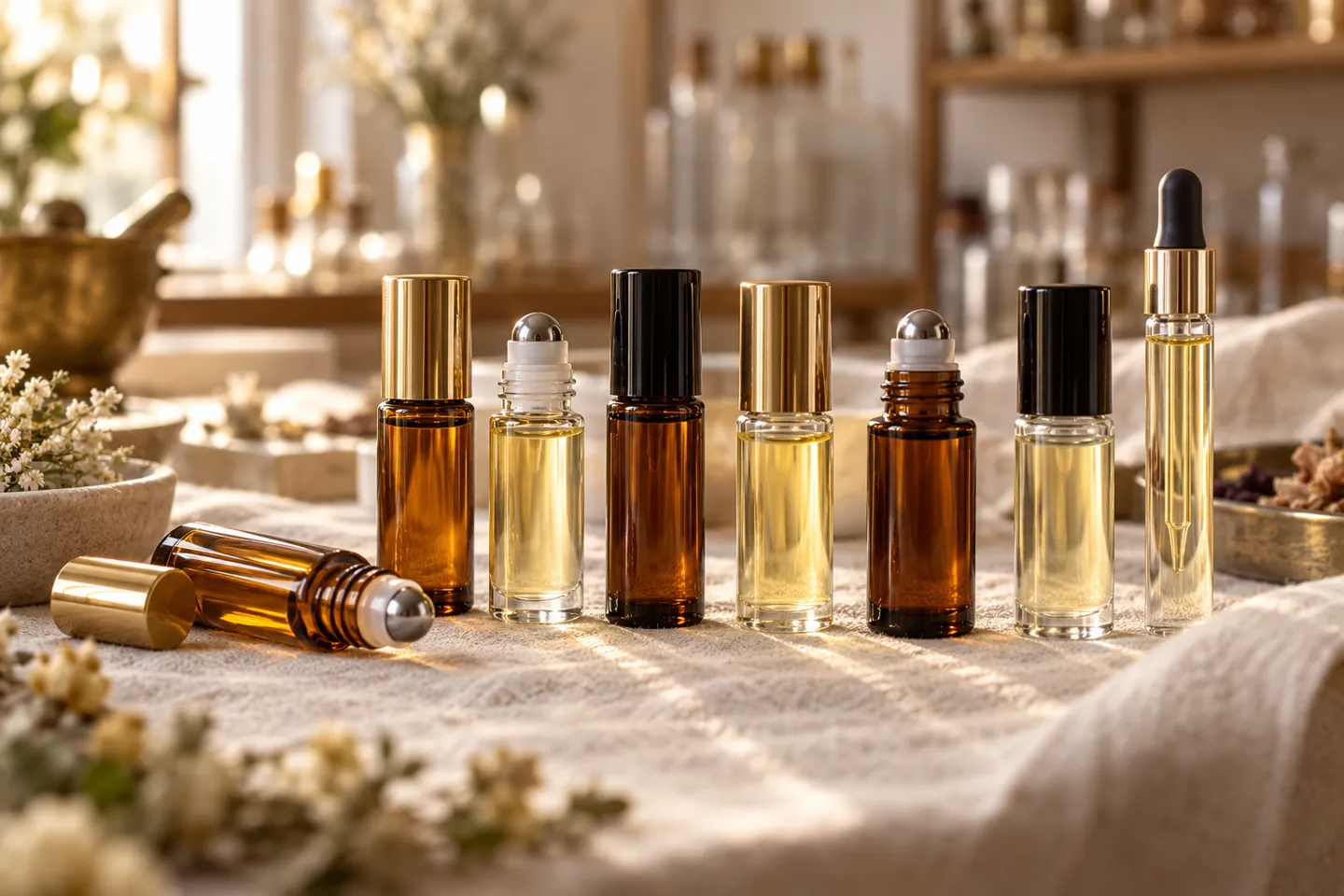
The containers oils prefer need no atomizer at all. A roller bottle feeds a controlled film through a steel or glass ball. The ball’s smoothness decides how the dose lands, and glass balls stay inert with sensitive formulas. A dab vial or dropper trades the ball for drop control, one to three drops at a time. That is the dosing most oil wearers actually use. Both formats are small by nature, and small helps a second way. Carrier oils oxidize, and amber or opaque glass in a slim volume slows that down.
Three Parameters That Decide the Right Container
Whether you are decanting for a gym bag or specifying a product line, the same three parameters sort the shelf. First, the neck. Perfume bottles standardize on 13mm, 15mm, and 20mm finishes. The 15mm finish carries most mainstream designs, 13mm shows up on minis, and 20mm is reserved for oversized flacons. Second, the closure. Screw caps seal and reopen for refilling. Crimp atomizers press-seal for tamper-evident retail. Magnetic caps add the weighted, satisfying close that luxury formats trade on. Third, the size tier. The 2, 3, 5, and 10ml vials exist for sampling and discovery. The 15ml size covers travel sets, and 30, 50, and 100ml make up the full-size commercial ladder.
Container Parameters by Format
| Container | Native carrier | What to check before buying |
|---|---|---|
| Spray bottle with crimp atomizer | Alcohol-based | Pump validated for your viscosity; neck matches the collar (13/15/20mm) |
| Roller bottle | Oil | Ball material (steel vs glass); secure collar; fill leaving no air gap |
| Dab vial or dropper | Oil | Drop control; light-proof glass for carrier oils |
| Sample and travel vials (2-15ml) | Either | Leak seal for bags; glass thickness for transit |
The container rule
An oil formula clogs a standard spray pump. Roller bottles and dab vials are an oil’s native containers.
When Things Go Wrong
Failures cluster into three recognizable groups, and each one has a repair-or-retire line.
The first is a pump that stops spraying. Check the nozzle for residue and press the pump repeatedly to clear a possible air lock. The limit is mechanical: if the valve or spring is deformed, cleaning will not restore it, and the pump gets replaced, not revived. A full bottle with a defective atomizer is a warranty claim, not a repair project.
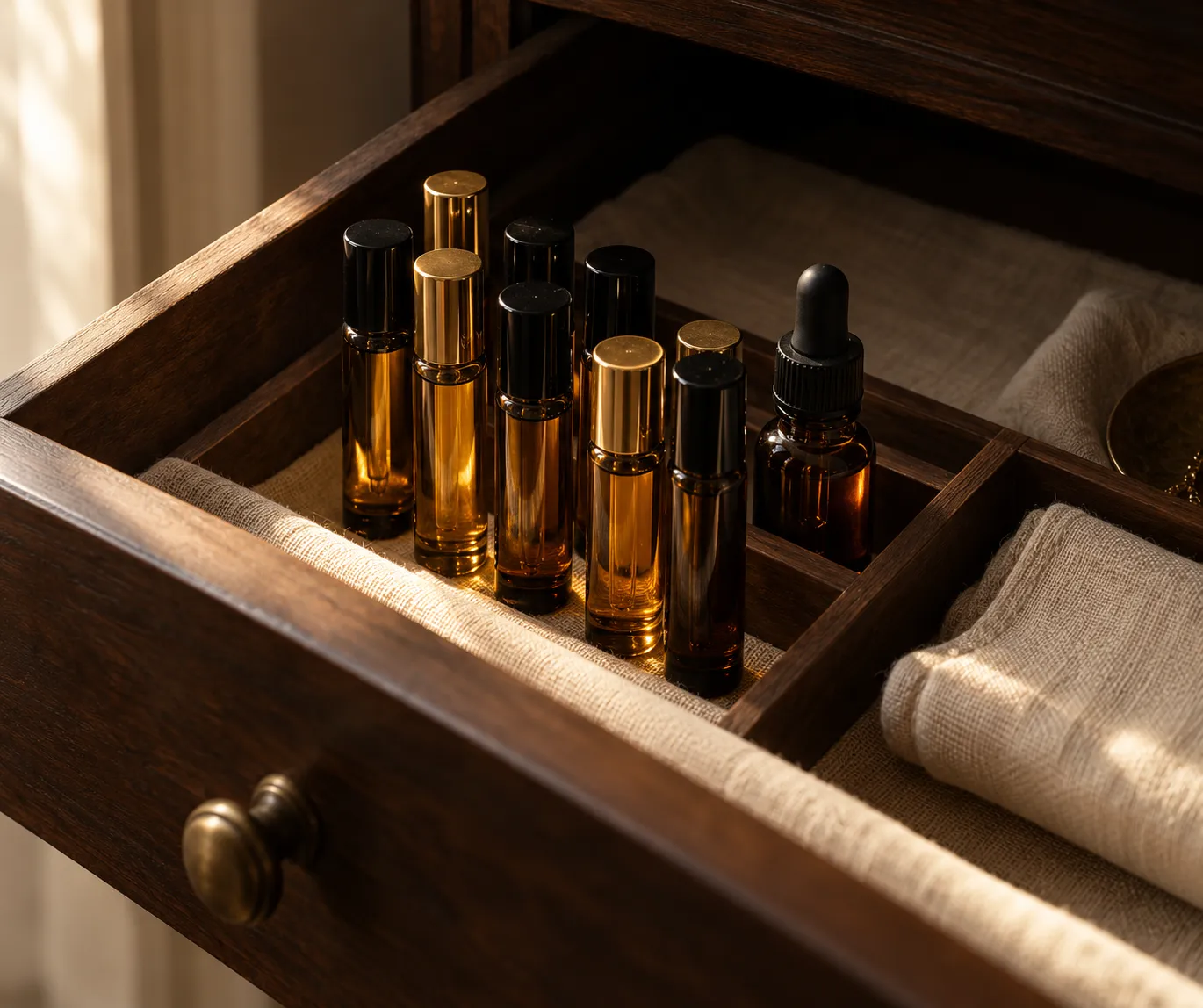
The second is the oil turning. Carrier oils oxidize, and a rancid batch smells waxy, like crayons, over the fragrance. Nothing reverses it. Prevention is the whole game: opaque or amber glass, cool storage away from sunlight, and small volumes decanted for daily use. And note the shelf-life date when you first open the bottle.
The third is staining. Oils can mark fabric, especially silks and light knits. The check is cheap: a dot on an inner hem before the garment ever sees a pulse point. On the spray side the risk is different: breakage and mis-spray rather than stains. That is why the bottle travels padded or stays home.
Retire the bottle when: the nozzle delivers liquid instead of mist after cleaning (worn valve), the oil smells waxy or flat (oxidized, irreversible), or the pump will not prime at all (broken spring). Rescue the bottle when: mist is weak or sputtering, which usually means a clog or air lock you can flush in minutes.
Every one of these failures is a nuisance at dresser scale. Multiplied by a production run, each one becomes a return truck. That shift in stakes is where this stops being a consumer question.
Reading This as a Brand Decision
For anyone packaging fragrance rather than wearing it, the comparison above rewrites itself into one sentence. The format decision is a packaging supply chain decision, not a juice decision. An oil line lives on rollers, dab vials, and sample sizes. It fills at low viscosity with no atomizer to validate, and it suits discovery programs, subscriptions, and gift sets. A spray line buys access to projection and the full-size retail ladder. It also inherits the engineering gate: every pump must be validated against the real formula’s viscosity before production. That is the clogged-nozzle failure mode described above.
The market context sharpens the choice. Eau de Parfum, the heart of the spray world, holds about 25% of the global perfume market as of 2025 and is forecast to keep growing (Global Market Insights, 2026). That is the incumbents’ arena. Founders building on oil formats and small-volume subscriptions are working a different door, one with lighter filling requirements and a repeat-purchase rhythm built in (r/PerfumeOils, 2026).
Two Lines, Two Supply Chains
| Oil sample line | Spray line | |
|---|---|---|
| Containers | Rollers, dab vials, 2-15ml sample vials | 30/50/100ml with validated atomizers |
| Gate before production | Formula stability and shelf-life check | Pump-vs-formula viscosity validation on live samples |
| Filling | Low viscosity, simple dosing | Atomizer assembly plus vacuum leak testing |
| Best for | Discovery, subscriptions, close-wear scents | Projection-led launches and full-size retail |
If you do run both, run them as two supply chains with one shared brand. The oil SKU and the spray SKU will never share a pump. And when an oil formula has to ship as a spray, treat the compatibility test as a gate. It runs on a sample of the actual juice, and it is not a line item to skip.
That gate is built into how we work at Nuvole. Our fine-mist sprayers are engineered for a 1.0-1.3ml dose per press, a cloud-pattern mist and 100,000+ presses. Every bottle passes a vacuum sealing test before it leaves the factory (fine-mist sprayer specs). For oil-based formulas we ask for a sample of the actual juice before production, because viscosity decides what the pump can deliver (roller and sample bottles).
Put Your Format on the Right Bottle
Send Nuvole your format plan and formula: we will quote rollers, sample vials, or validated sprayers, and test the pairing before your production run.
Start a Packaging ConsultReferences
- Onekind. “Perfume Oil vs. Spray: What Is the Difference?” 2026. https://onekind.us/blogs/skin-school/perfume-oil-vs-spray-whats-actually-different-and-which-one-is-right-for-you
- Global Market Insights. “Perfume Market Size & Share | Trends Report, 2026-2035.” 2026. https://www.gminsights.com/industry-analysis/perfume-market
- TSA. “Liquids, Aerosols, and Gels Rule.” 2026. https://www.tsa.gov/travel/security-screening/liquids-aerosols-gels-rule
- Reddit r/ZeroWaste. “Spray bottle jammed?” 2025. https://www.reddit.com/r/ZeroWaste/comments/1l7fm7s/spray_bottle_jammed/
- Reddit r/PerfumeOils. “Started my perfume oil business.” 2025. https://www.reddit.com/r/PerfumeOils/comments/1hh570s/started_my_perfume_oil_business/
- Reddit r/PerfumeOils. “Guys, starting a new perfume business, need advice.” 2026. https://www.reddit.com/r/PerfumeOils/comments/1sjpw00/guys_starting_a_new_perfume_business_need_advice/