Two fragrances can share almost the same scent and still sit at opposite ends of the price shelf, and the glass between them explains most of that gap. Perfume packaging design is usually treated as a visual discipline, a matter of mood boards and trend boards. It is closer to a manufacturing decision with a visual outcome. Every line you draw on a bottle sketch eventually reaches a mold maker, a glass furnace, and a packing line. Each of those stages either protects your idea or quietly charges you for it.

What Goes Into a Perfume Package
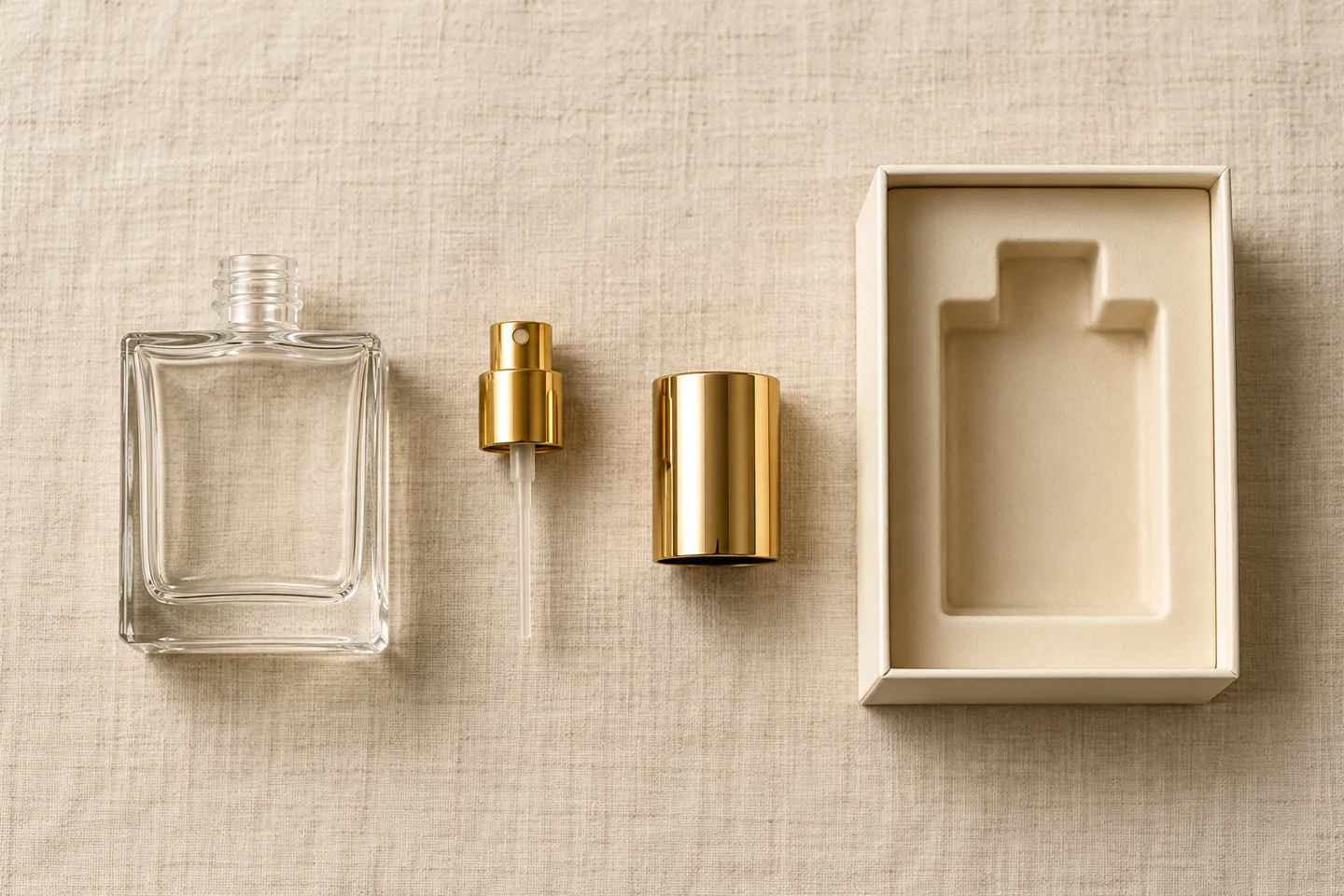
A complete package stacks five layers of decisions, and each layer belongs to a different specialist. The first layer is the bottle itself: its silhouette and its capacity. This is the part consumers photograph and designers argue about. The second layer is the neck and closure, the millimeter-precise interface between glass and pump or cap. Nobody sees it, and it is where leaks are born. The third layer is the glass grade itself, which decides whether the bottle reads as clear and weighty or greenish and thin. The fourth is surface decoration, from plating to printing, where most of the visible luxury actually lives. The fifth is the outer box and transit protection, the layer that decides whether all of the above arrives intact.
Trend lists will tell you that minimalism, natural textures, and sculptural forms are in this season, and they are. Treat those as styling choices made on top of the five layers, not replacements for them. Inspiration galleries are the right place to train your eye; physical samples are the only place to verify it. The rest of this article walks down the layers in order, because that is the order in which money gets committed.
Bottle Shapes and Sizes: The Design Choices With Manufacturing Consequences
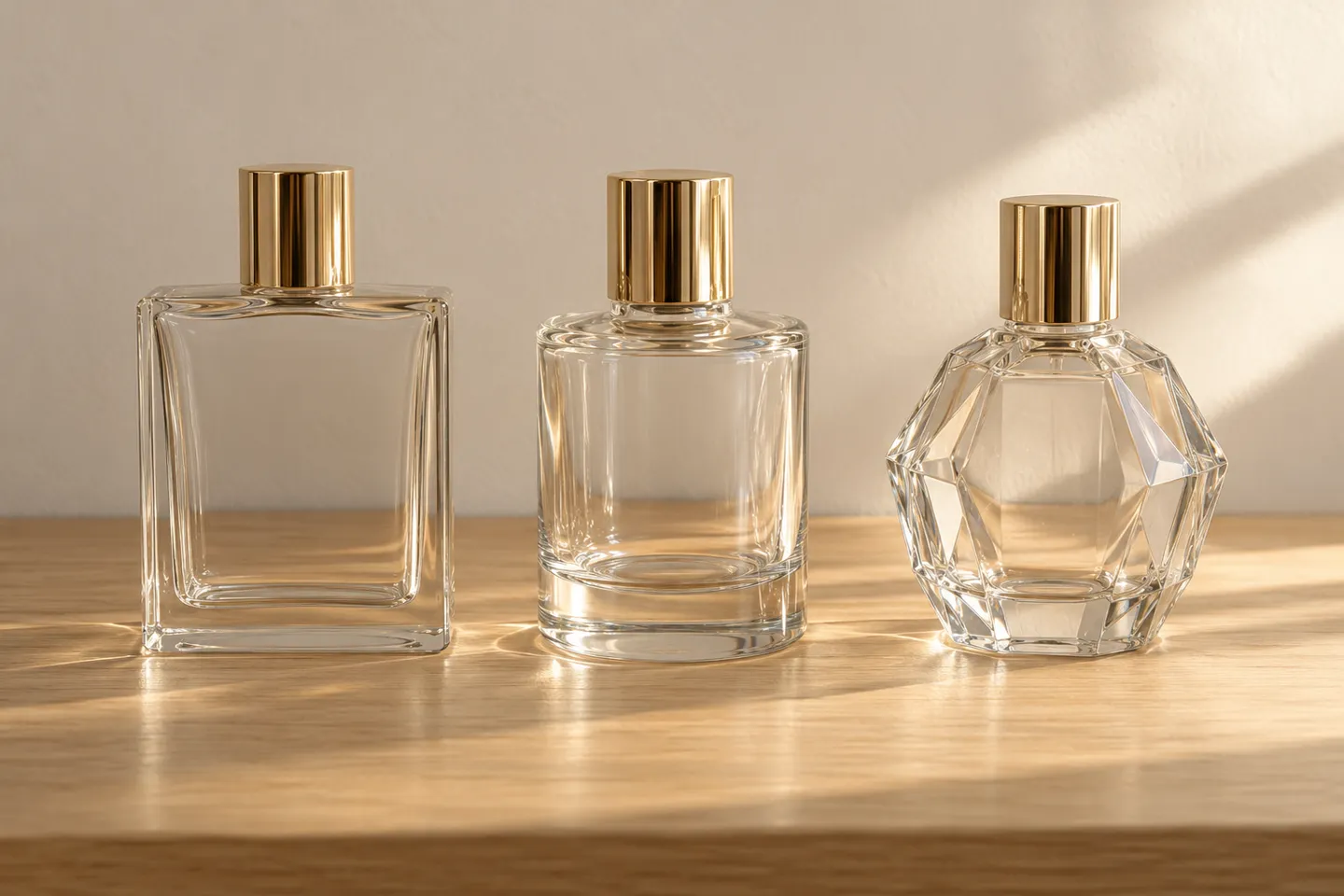
Shape families exist for practical reasons before aesthetic ones. Each family carries a different tooling cost, a different polishing burden, and a different risk of breaking in transit. Choosing a family is therefore the first real design decision, and it rewards you for knowing what happens downstream.
Three shape families at a glance
| Family | Design payoff | Manufacturing cost | Transit risk |
|---|---|---|---|
| Square / rectangular | Architectural look, calm canvas for labels and screen prints | Corners concentrate stress; panels need even wall thickness | Highest of the three: wants molded inserts, not loose paper |
| Round / cylindrical | Classic apothecary weight; decoration wraps without distortion | Easiest to mold, coat, and frost; friendliest cycle times | Lowest of the three; forgives a tight launch timeline |
| Polygonal / sculptural | Strongest shelf identity | Complex molds, multi-face polishing passes, walls thin as polish deepens | Needs engineered protection; thick walls to survive polishing |
Square and Rectangular Bottles
Flat panels read as architectural and modern, and they give labels and screen prints a calm canvas. That is why the 50 ml flat rectangle is the workhorse of the whole category. The trade sits in the corners: they concentrate stress during shipping, and flat panels demand even wall thickness to avoid visible distortion. A square bottle asks for better transit protection than a round one of the same volume, usually in the form of molded inserts rather than loose paper.
Round and Cylindrical Bottles
Cylinders distribute pressure evenly, which makes them the easiest shapes to mold, coat, and frost uniformly. Tooling is simpler, cycle times are friendlier, and decoration wraps without distortion. The apothecary look of a heavy round flacon is a classic for a reason. If your launch timeline is tight, this family forgives the most.
Polygonal and Sculptural Bottles
Faceted and sculptural bottles deliver the strongest shelf identity, and they are the family buyers reach for when a brand wants to look unlike anyone else. They are also the family that pays for it. Complex molds cost more and take longer, every polished facet adds passes, and deep polishing thins the glass itself. Multi-face polishing, the cut, rough grind, and fine grind sequence that gives facets a crystal-like finish, demands thick walls to survive the process. A sculptural bottle with thin walls cannot take that treatment at all, so the design and the finish must be chosen together, not in sequence.
Capacity is the quiet half of this decision. Lighter bottles sit lower on a manufacturer’s weight-based minimum order ladder. That ladder is one reason a 10 ml travel sprayer and a 100 ml flacon live in different commercial worlds, even when they share a silhouette.
Capacity, Weight, and MOQ Implications
| Bottle Size | Typical Empty Weight Class | MOQ Behavior at Typical Manufacturers | Common Role |
|---|---|---|---|
| 5-10 ml | Very light | Highest unit count per order ladder | Travel sprayers and discovery sets |
| 15-30 ml | Light | Moderate count | Entry and purse sizes |
| 50 ml | Mid | Standard ladder position | The core retail size |
| 100 ml | Heavy | Lowest count but highest unit value | Flagship and gift sizes |
Source: Industry practice summary based on manufacturer-published MOQ ladders
Custom Depth: Stock, Semi-Custom, or Full Mold
Once a shape family is chosen, the next decision is how custom to go, and it has exactly three levels. Stock means selecting an existing catalog shape and applying your decoration. Semi-custom keeps a stock bottle but commissions custom color, coating, caps, or finishing. Full custom commissions a new mold from a sculpt. Each level trades money and calendar time for distinction.
The minimum order question gathers more mythology than any other topic in this category. Suppliers marketing to new brands often promise “low MOQ” without giving numbers. Founders on forums tell the other side: quotes of 10,000 bottles, plus freight, plus mold fees, before selling a single unit (r/fragrance, 2022). Both things are true at once. The reason is physical: furnaces run in campaigns, and lighter bottles need more units to fill a production run. So the honest question is never “who has the lowest MOQ.” It is “what does this supplier’s ladder look like for my bottle’s weight class.”
Timeline carries the same kind of hidden depth. Standard sampling runs two to three weeks (Packamor, 2026), which feels manageable until you price a sculpted bottle. A custom mold alone adds six to sixteen weeks before production even starts (Packamor, 2026). That single line is the argument for treating full custom as a second-launch decision rather than a first one.
The timeline truth
Catalog bottle, samples, launch measured in one season
Stock glass, custom finish
New-mold tooling, before production even starts (Packamor, 2026)
The Two Hardware Decisions: Closure System and Glass Quality
Beneath decoration sit two decisions that no consumer can see and no brand can afford to guess at. They are the neck-and-pump interface and the glass grade. Get these wrong and the failure modes are unpleasant: leaking units, uneven sprays, and bottles that read cheap on a luxury shelf.
Neck Finish and the Closure System
Neck dimensions follow the FEA standards, with 13, 15, 18, and 20 mm as the common sizes. The 15 mm finish dominates fine fragrance; industry measurements put it at roughly 65 percent of the crimp-finish market (Cetie, 2021). Pump availability and pricing are friendliest there for exactly that reason. A leak is rarely one bad part. It is a chain: neck tolerance on the glass, fit between pump and finish, and the seal material’s resistance to alcohol. Weakness anywhere in that chain shows up as evaporation or weeping bottles in your customers’ drawers.
How to read a pump spec sheet
- Dose per spray. 0.6 to 0.8 ml on standard pumps; premium valves charge closer to 1.0 ml or more, which consumers read as generosity.
- Mist fineness. Decides whether the spray lands as a cloud or a wet splash.
- Actuation life. How the bottle feels after a month of daily use.
- Formula compatibility. Oil-based perfumes stress pumps differently than water-based ones; a pump that performs perfectly on one may need a compatibility test on the other.
- Leak proofing. Reputable suppliers vacuum-test assembled bottles; ask whether that test happens per batch and whether you can see the records.
Reading a pump spec sheet is a learnable skill. Dose per spray commonly falls between 0.6 and 0.8 ml on standard pumps. Premium valves deliver a fuller charge closer to 1.0 ml or more, which consumers read as generosity. Mist fineness decides whether the spray lands as a cloud or a wet splash. Actuation life decides how the bottle feels after a month of daily use. One boundary matters more than the rest. Oil-based perfumes stress pumps differently than water-based ones, and a pump that performs perfectly on one may need a compatibility test on the other. Reputable suppliers vacuum-test assembled bottles for leaks; ask whether that test happens per batch and whether you can see the records.
Glass Grades: What “Premium” Actually Means
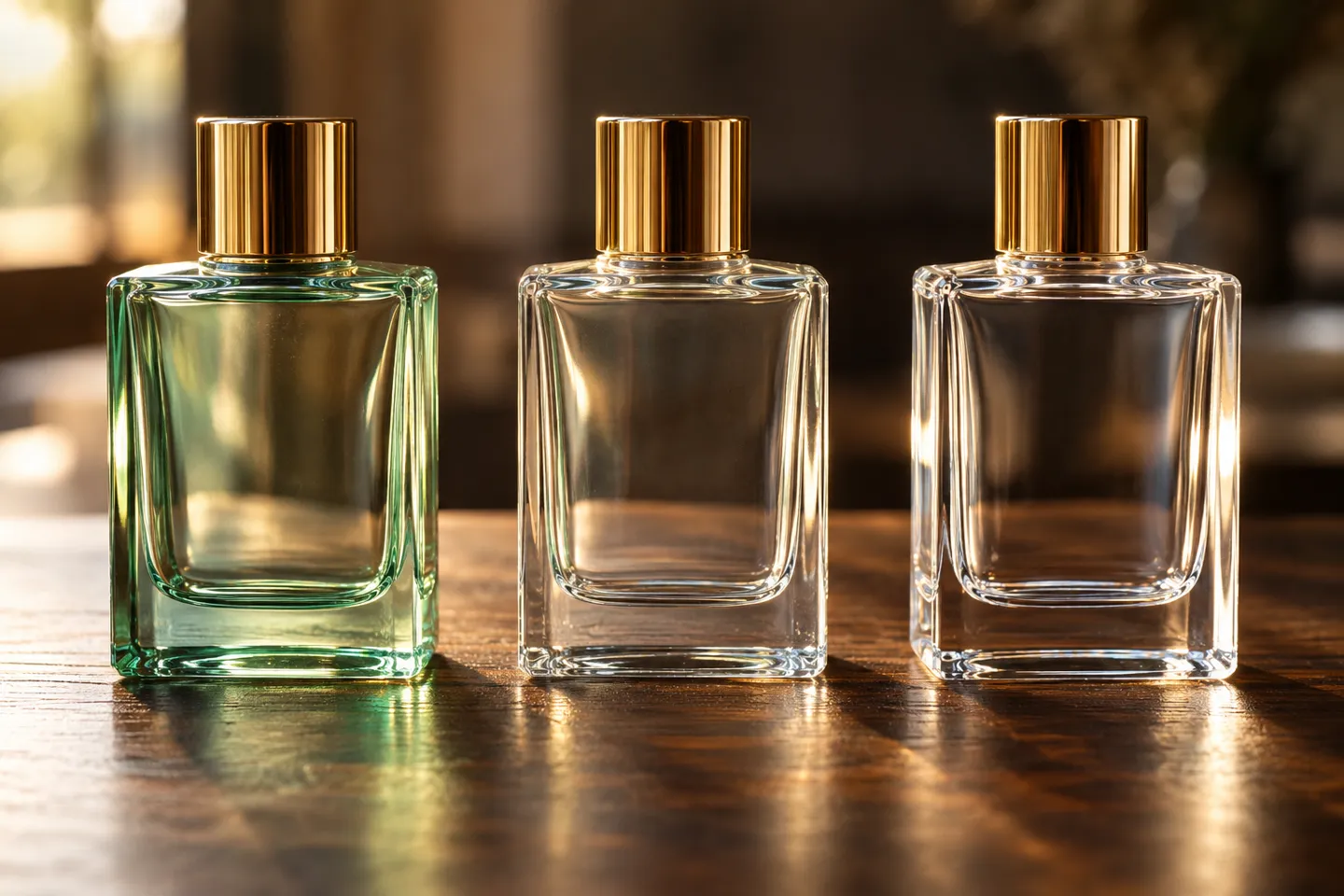
Glass grade is where “it looks expensive” becomes measurable. Standard soda-lime glass carries enough iron to cast a faint green tone. High-white glass reduces it. Extra flint removes it almost entirely, delivering very high transparency free of green or grey cast (Vetroelite, 2025). Crystal sits above all of them, trading weight, brilliance, and price for a flagship statement. What a luxury shopper perceives as richness is largely this ladder plus surface quality. Seeds, bubbles, or cord lines in the glass will undermine a premium position faster than any decoration can rescue it.
Glass Grades at a Glance
| Grade | What You See | Best Fit | Watch Out For |
|---|---|---|---|
| Standard soda-lime | Faint green cast | Value lines and colored finishes | May read thin on clear designs |
| High-white | Reduced tint | Mid-market clear bottles | Still visible at thick walls |
| Extra flint | Near-colorless high clarity | Premium clear and gradient work | Higher cost per unit |
| Crystal | Maximum weight and brilliance | Flagship and luxury editions | Price, fragility, heavier shipping |
Source: Glass grade definitions per Vetroelite (2025) and industry practice
Two boundaries deserve respect here. Frosted and coated finishes can hide minor surface flaws, but they also give up the clarity you paid a higher grade for, so decide which asset you are defending. And a lower grade behind a dark opaque coat is a legitimate engineering choice, not a compromise, as long as the visible surfaces are flawless.
Where Decoration and Delivery Fail
Decoration is where the money becomes visible, and it is also where most quality claims quietly expire. Every finish has a known failure mode, and every one of them can be checked before you wire a deposit. The matrix below is the checklist.
Decoration Processes: Effect, Failure Mode, and What to Verify
| Process | Effect It Delivers | Where It Fails | Check Before Ordering |
|---|---|---|---|
| Electroplating | Mirror-metallic luxury surface | Adhesion loss and flaking at edges | Adhesion and abrasion test reports |
| Gradient spraying | Modern color fades | Batch-to-batch color drift | Signed color plate plus per-batch retention samples |
| Screen printing | Crisp logos and text | Wear through handling | Rub-test count on the actual ink |
| Hot stamping | Metallic foil accents | Dulling and misregistration | Foil grade and stamp alignment sample |
| Engraving | Deep permanent branding | Chipping on thin walls | Wall thickness review at engraving depth |
| Multi-face polishing | Crystal-like facets | Wall thinning and distortion | Minimum wall spec confirmed in writing |
Source: Failure modes compiled from manufacturer QC practice and trade documentation
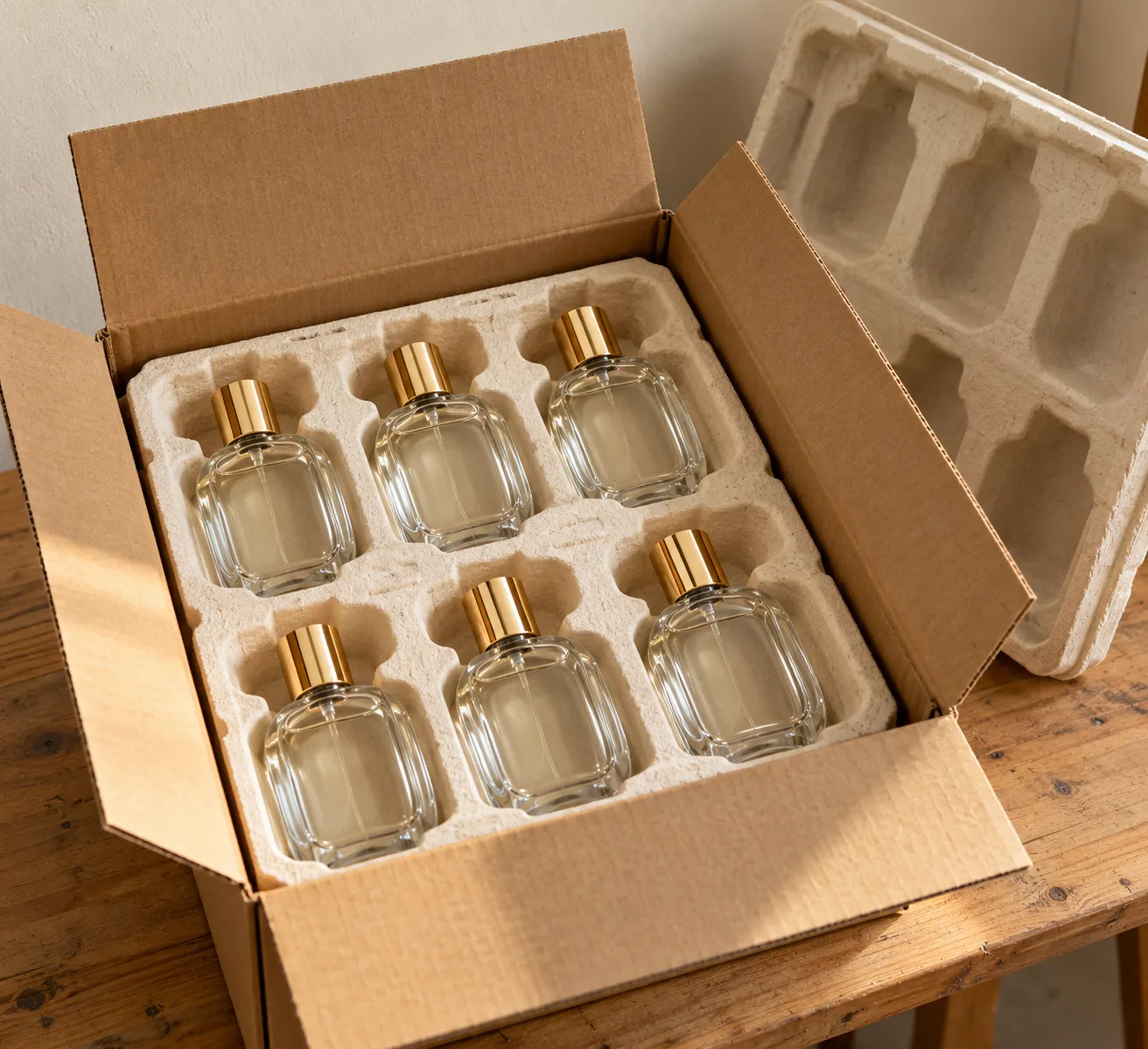
Transit is the second half of delivery risk. Sculptural and square bottles need engineered inserts, not optimistic amounts of paper, and parcel networks are rougher than most first-time brands expect. General simulation procedures such as ISTA 3A exist precisely to rehearse those parcel hazards on your package before a carrier does it for free (ISTA, n.d.). Standardized handling and fragile symbols on cartons are part of the same discipline. None of this is exotic; all of it is cheaper than a pallet of broken flacons.
How to Evaluate a Packaging Supplier
By this point you know what to ask for, so the remaining skill is telling a real manufacturer from a confident intermediary. Four steps cover most of it.
First, write your spec sheet before contacting anyone: neck finish, capacity, glass grade, decoration, target volume, and target landing cost. A supplier who receives a complete spec answers in specifics; one who receives a mood board answers in adjectives. Second, order samples and time them. Stock-bottle samples should be fast and often free, while custom prototypes take longer. A 3D-printed mockup validates a silhouette in days, but only a physical glass sample proves weight, clarity, and finish. Third, verify quality control directly. Ask which tests run per batch, whether assembled bottles get vacuum or leak testing, what tolerance the neck finish holds, and whether inspection is full or sampling. “Vacuum-tested” on a website is a claim; a test record per batch is a fact. Fourth, read the commercial terms with the same care: documentation availability such as COA and MSDS, breakage compensation policy, and how many months the quality guarantee actually covers.
Supplier evaluation in four moves
- Send a complete spec sheet and expect specific answers.
- Order both a fast mockup and a physical glass sample.
- Demand batch test records, not test adjectives.
- Confirm documents, breakage terms, and guarantee length in writing.
The common misjudgments are predictable. Comparing unit prices while ignoring tolerance and test records buys the cheapest leak. Treating a “low MOQ” slogan as a commitment invites a ladder surprise at contract time. Skipping the physical sample stage converts your launch into the sample stage.
The Budget Math for a First Launch
Assemble everything above and a straightforward allocation falls out. The recurring failure stories in this category cluster around closures and quality control: leaking seals, peeling plating, visible seeds, broken shipments. They rarely cluster around a shape being insufficiently sculptural. The truly irreversible costs, meanwhile, are tooling and minimum-order commitments, the two things a first launch is least equipped to carry. The conclusion follows without much ceremony: spend on the closure system and the glass grade, take the shape from a catalog, and make the decoration carry your identity. Full custom molds belong to the second or third release, when sales data argues for them.
If this math points at the stock-plus-custom path, Nuvole Glass answers a complete spec sheet with specific numbers, not adjectives.
Get a Spec-First QuoteThe supply side already supports this path, which is worth knowing before you assume custom means compromise. At Nuvole Glass, we run more than 500 stock bottle designs alongside roughly 500 cap options. Our catalog covers the standard capacity ladder from travel sizes to 100 ml flagships (perfume bottle catalog). Our design team turns a brief into three to five render concepts within about a week, and physical samples follow in days rather than weeks. First orders start from 5,000 pieces. On the hardware side, our pumps deliver a fuller 1.0 to 1.3 ml charge per spray against the common 0.6 to 0.8 ml. Every batch passes vacuum leak-testing after assembly. That is the stock-plus-custom path with premium hardware, and it exists because brands kept asking for exactly this trade.
The boundary deserves its own sentence. When a line has proven demand, a budget with slack, and a flagship that must own a silhouette no competitor can copy, full custom is the right call. That is a second-act decision, made with data. A first launch buys credibility with the budget it did not spend.
If you want to test this path on your own first fragrance, Nuvole Glass starts with free samples and three custom design directions before you commit (custom perfume bottle service). Your first check goes to the idea rather than the mold.
References
- Cetie. “From the FEA neck finish to the screw neck finish.” 2021. https://www.cetie.org/en/from-the-fea-neck-finish-to-the-screw-neck-finish_4_146.html
- Packamor. “How Long Does It Take to Launch a Perfume Brand?” 2026. https://www.packamor.com/blogs/knowledge-hub/how-long-launch-perfume-brand
- ISTA. “Test Procedure 3A: General Simulation for Parcel Delivery Systems.” n.d. https://www.ista.org/docs/3Aoverview.pdf
- Vetroelite. “Glass types: which ones to choose for exclusive packaging.” 2025. https://www.vetroelite.com/en/journal/news/types-of-glass/
- r/fragrance. “How on earth do new brands produce bottles?” 2022. https://www.reddit.com/r/fragrance/comments/vr5esp/how_on_earth_do_new_brands_produce_bottles/
Start Your First Bottle With Free Samples
Send your brief and Nuvole Glass returns three custom design directions plus physical glass samples before you commit a single dollar to tooling.
Request Free Samples