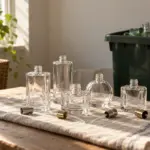
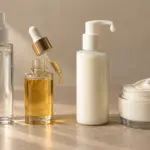
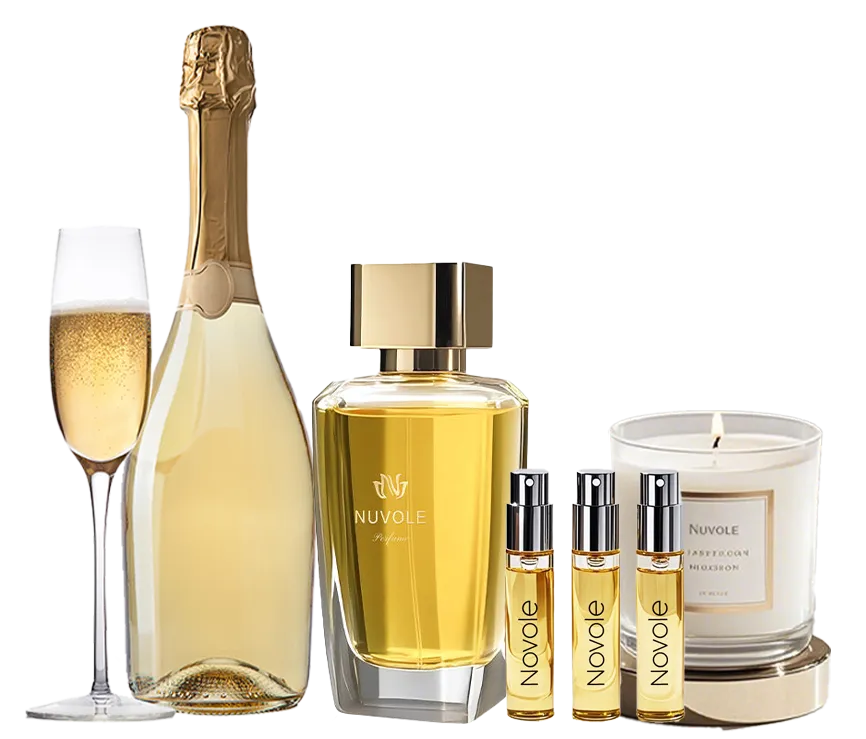
A glass jar can hold pickles, candles, or face cream, yet those products place very different demands on the vessel. Shape tells you how a container fills and closes; glass composition, processing, wall design, and intended use determine how it performs. A good specification starts with both.
This guide covers two practical meanings of “types of glass containers”: form families such as bottles, jars, vials, and food-storage vessels, and glass systems such as soda-lime and borosilicate. It also explains tempering, clarity grades, candle-vessel tests, and the separate pharmaceutical USP classification. Use the distinctions to shortlist a container and write a more useful supplier brief.
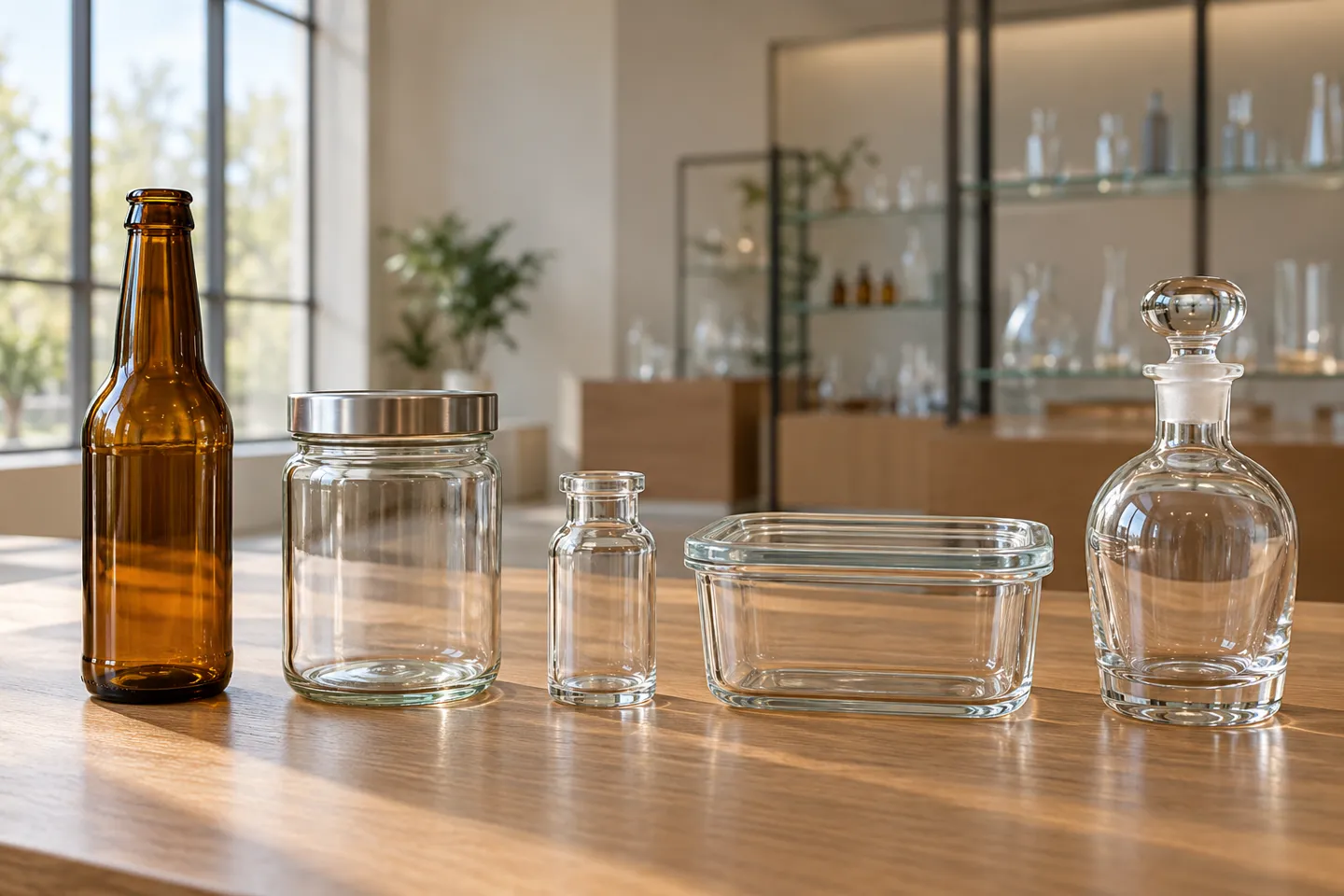
Four Glass Container Forms (Plus Closures)
- 1 Bottles: narrow-neck vessels for beverages, oils, spirits, and fragrance.
- 2 Jars: wide-mouth vessels for foods, creams, and selected candle applications.
- 3 Vials and ampoules: small-format vessels for pharmaceutical or specialty products.
- 4 Food-storage vessels: lidded dishes and tubs with use limits set by the product maker.
- 5 Closures and fitments: caps, stoppers, pumps, and liners that complete the package.
The closure is part of the packaging system rather than a glass-container form. It still belongs in the buying decision: a bottle that looks right can fail if its neck finish does not match the pump, cap, or seal. Likewise, two jars of similar shape may have different permitted heat exposures.
For example, a narrow-neck fragrance bottle needs a finish that fits its spray assembly and a glass surface compatible with decoration. A wide-mouth food jar needs an appropriate closure, contact assessment, and filling-temperature limit. A candle jar needs evaluation with its chosen wax and wick. The same silhouette can therefore lead to three different test plans.
Soda-Lime and Tempered Soda-Lime: The Everyday Glass and Its Thermal Limits
Soda-lime glass is common in bottles, jars, and drinking vessels because it can be formed at scale and offers a useful balance of cost, appearance, and performance. Those advantages do not make every soda-lime item suitable for every temperature path.
Why Soda-Lime Glass Is Everywhere
Soda-lime glass is made chiefly from silica, soda, and lime, with other ingredients varying by formulation. Soda helps reduce the processing temperature, while lime contributes chemical durability. The composition and established forming processes make it a practical choice for many food, beverage, fragrance, and cosmetic packages. A food jar, however, does not acquire a pharmaceutical “Type III” classification simply because its composition is soda-lime.
The form also affects manufacturing choices. A narrow-neck bottle may be made for a screw cap, cork, or crimped spray pump, and those finishes cannot be substituted casually. A wide-mouth jar needs a rim that seals consistently across production lots. For buyers, “glass type” therefore includes the drawing and closure interface, not just the melt composition. Request the finish standard or drawing before ordering pumps and caps from a separate vendor.
One important limit is thermal shock. Representative Corning data put the linear expansion coefficient of borosilicate lab glass near 3.25 × 10⁻⁶/K and soda-lime glass near 9 × 10⁻⁶/K. These are examples, not guaranteed values for every product. When one area of a vessel changes temperature faster than another, the resulting stress can crack glass; geometry, thickness, surface damage, and processing also matter.
Consider three situations that deserve separate evaluation:
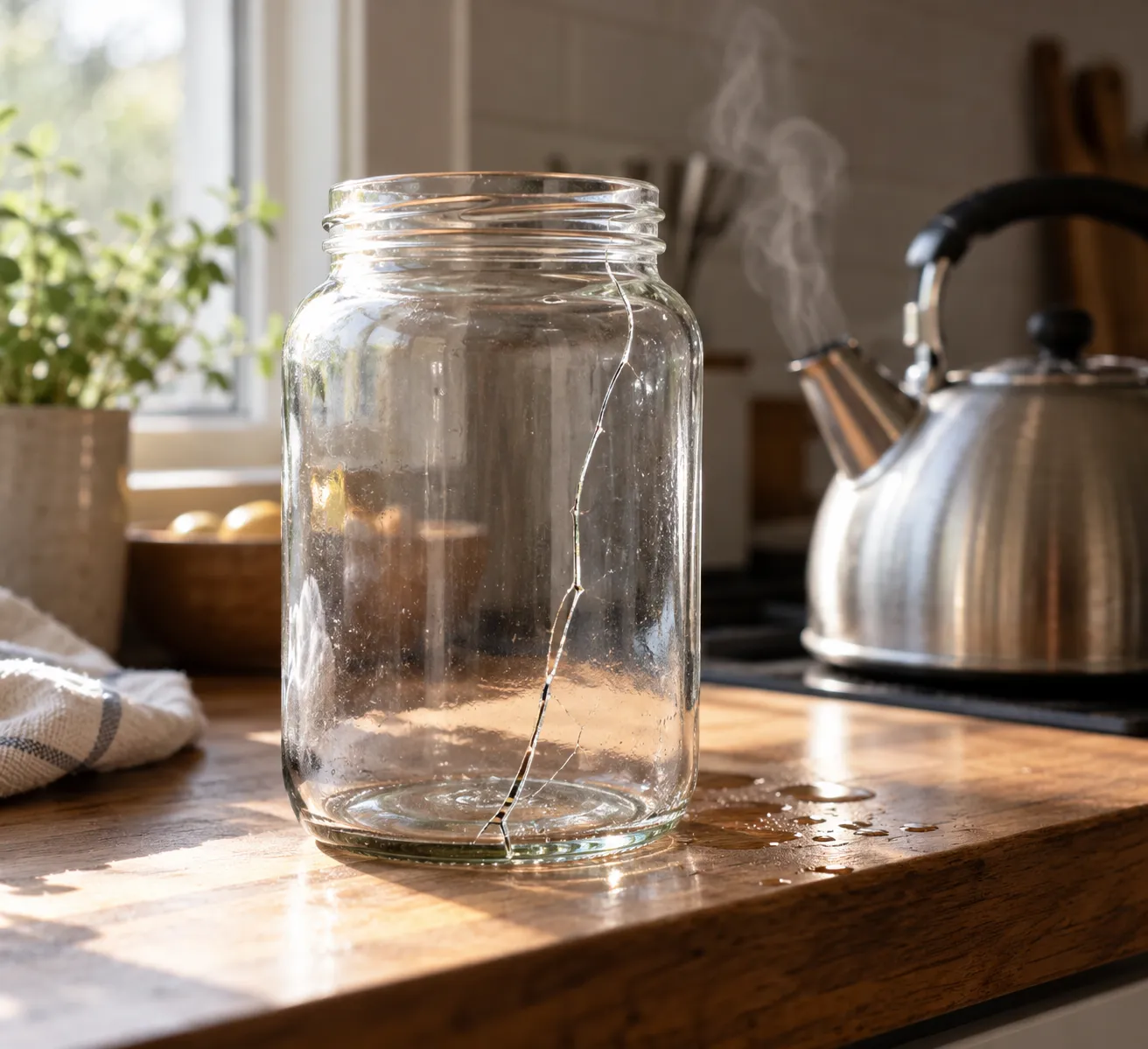
- A jar from the fridge filled with boiling water or hot preserves
- A drinking glass straight from the dishwasher getting ice-cold liquid
- A candle jar where the wick is too large, so one side of the base runs hot while the rest stays cool
A crack in one of these situations is not automatically a manufacturing defect or proof that all soda-lime glass is unsuitable. The temperature difference, vessel design, condition, and use instructions all need investigation.
Tempering, Care Instructions, and the “Candle Glass” Myth
Thermal tempering creates surface compression that can improve resistance to mechanical and thermal stresses. It does not turn soda-lime into borosilicate or change its underlying coefficient of expansion. The degree of improvement depends on the product and process, and scratches or damage can affect performance. Ask for a product-specific test result instead of treating “tempered” as a heat rating.
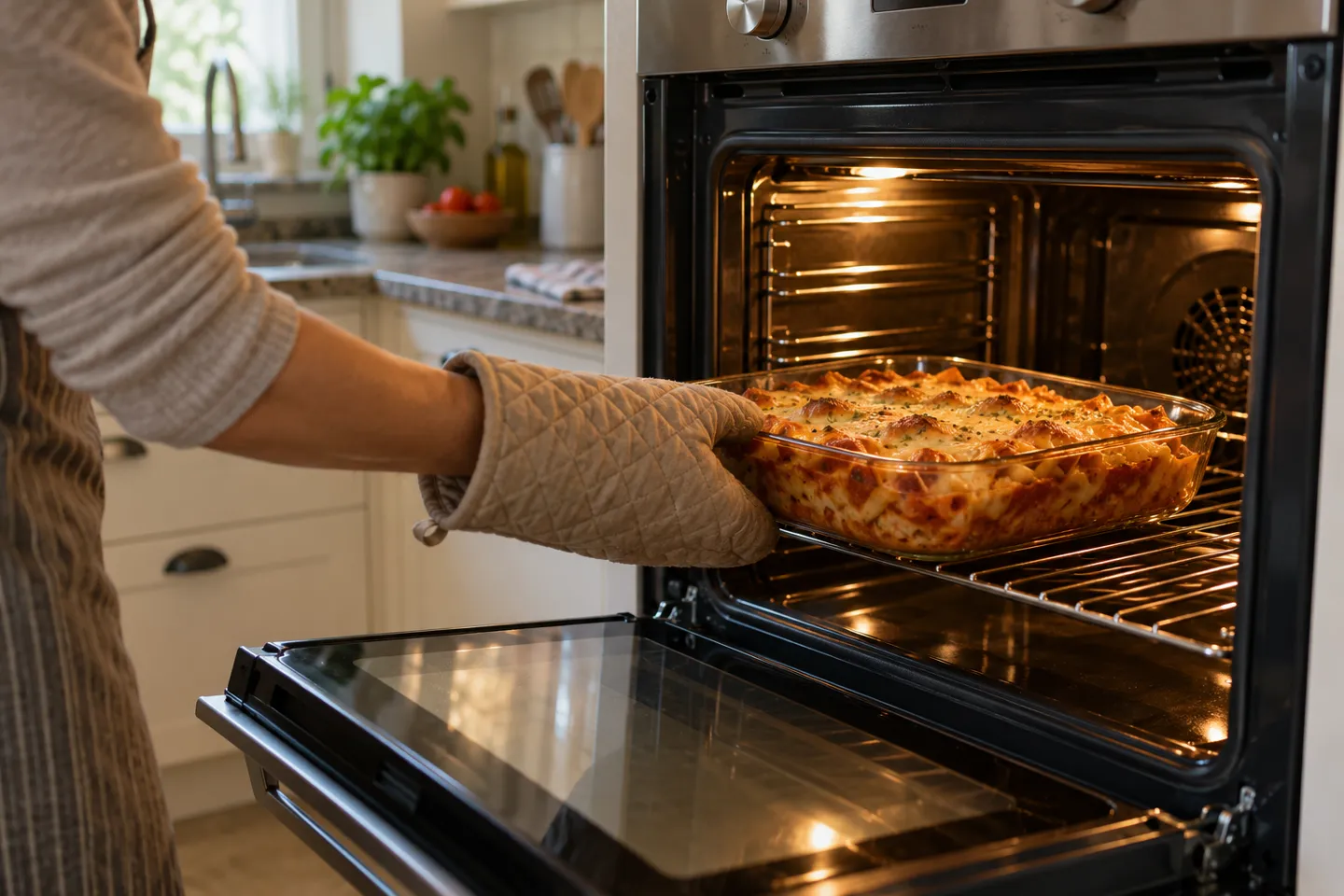
Brand names are a poor substitute for material identification. PYREX’s own current care guidance warns against moving its glassware directly from a freezer to a hot oven and against using it on or under a flame. Those instructions are more useful to a buyer than a general claim that one glass family is “oven safe.” Confirm the material, the exact product, and its permitted use before writing a claim on packaging.
Candle vessels need a similarly specific check. ASTM F2179-26 covers minimum performance requirements and associated tests for annealed soda-lime-silicate glass containers intended for filled candles, including annealing, thermal shock, and scratch requirements. It is not a blanket certification for all tempered jars. ASTM F2417 addresses candle fire-safety performance. The US Consumer Product Safety Commission lists both among relevant voluntary candle standards. A vessel test and a finished-candle burn test answer different questions.
For a candle project, share the intended fill weight, wax blend, fragrance load, wick series, and expected burn duration. A supplier can then suggest candidate vessels, while the candle maker validates the finished configuration. Changing the wick or wax after a successful trial can change heat distribution. Retest when the design changes materially, and keep the tested configuration in the product record.
Three Ways Soda-Lime Glass Cracks
- 1 Cold vessel meets hot liquid: a rapid temperature difference can create stress. Follow the vessel’s validated filling and care instructions.
- 2 Candle develops a local hot spot: wick, wax, vessel geometry, and burn conditions all matter. Test the assembled candle, not the empty jar alone.
- 3 “Tempered” is read as “heat-proof”: tempering can improve performance but is no universal rating. Request the applicable product test and use limits.
For many room-temperature products, soda-lime is a sensible starting point. If filling, washing, storage, shipping, or consumer use involves heat or sudden cooling, define that temperature path before selecting the vessel. The relevant comparison is between tested products under the intended conditions, not simply between material names.
When comparing two soda-lime jars, request the same evidence for both. A wall-thickness drawing, annealing information, agreed fill temperature, and a defined thermal-shock test are more useful than a verbal promise that one is “stronger.” If the closure contains a liner or coating, assess the assembled package as well as the glass body.
Borosilicate Glass: Lower Expansion, Product-Specific Limits
Borosilicate glass generally expands less with temperature than soda-lime glass. Corning lists about 3.25 × 10⁻⁶/K for a representative laboratory borosilicate against about 9 × 10⁻⁶/K for representative soda-lime glass. Lower expansion can reduce thermal stress, but it does not remove the need for product-specific instructions and testing.
That property makes borosilicate a candidate for laboratory vessels, some ovenware, and other products with demanding temperature changes. It does not mean every borosilicate item can move straight from freezer to hot oven or sit over a flame. Shape, wall thickness, manufacturing quality, attached parts, and the maker’s instructions determine the permitted use. Candle applications also need vessel and finished-candle testing rather than a material claim alone.
The tradeoff is commercial as well as technical. Borosilicate can carry a higher manufacturing or sourcing cost, while a particular tempered soda-lime product may offer different impact performance. Neither material name predicts the outcome of a drop onto tile. Compare matched sample designs, the documented test conditions, availability, and total unit cost.
At sourcing stage, ask which composition is supplied, how it is identified, and which thermal-shock method and temperature difference were used for the actual article. Request the acceptance criteria and sample size too. A single “heat safe” badge does not tell you whether the proposed bottle, jar, or dish fits your intended process.
A useful thermal specification states the starting temperature, destination temperature, exposure time, fill volume, and failure criterion. A laboratory can then reproduce the condition. If the product will see repeated dishwasher cycles, that is a different use pattern from one hot-fill event. Put both into the brief when both are expected.
Flint, Crystal and Clarity Grades: Where Premium Glass Actually Comes From
Heat performance is only one buying criterion. Fragrance, spirits, and prestige cosmetics also depend on how the glass transmits light, displays the formula, and feels in the hand. The vocabulary here often describes appearance rather than composition.
Flint Means Clear, Not Crystal
In packaging quotes, “flint” commonly describes clear or colorless glass. It does not, on its own, identify a chemical composition, pharmaceutical type, or lead content. Ask the supplier to state the actual material separately from its color or clarity label.
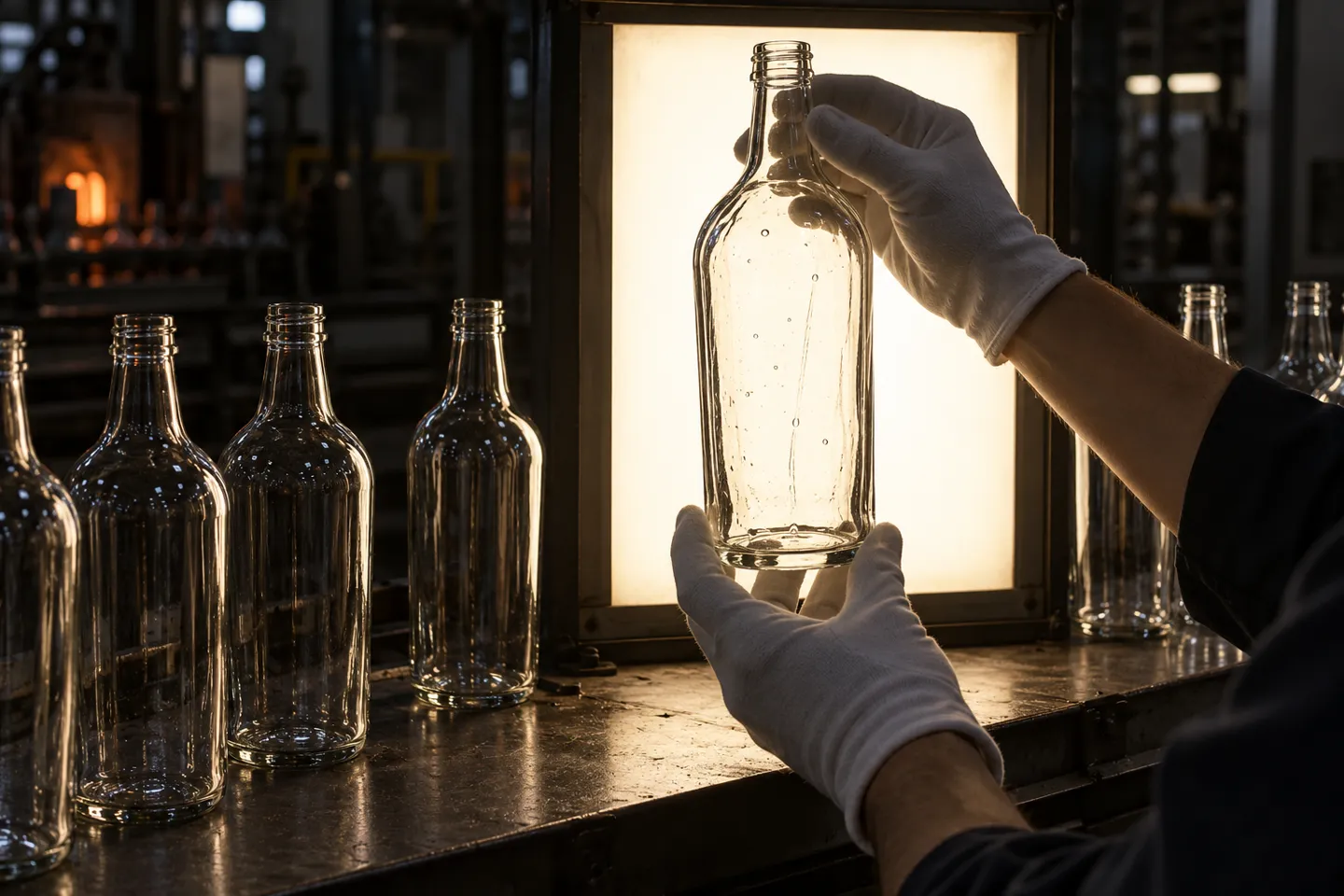
A clear bottle may still show a faint green, blue, or amber cast because of composition, thickness, and viewing conditions. The tint can be subtle in a small sample but obvious in a heavy base or when several units sit together. Agree on the visual standard with the actual bottle shape and wall thickness. If the bottle will be filled with a colored formula, inspect it both empty and filled.
Terms such as standard flint, high-white, extra-flint, and super flint may help a supplier organize its range, but they are not universal technical grades. Different factories can use the same term for different appearances. To make a comparison meaningful, specify a reference sample, acceptable tint, visible defects, and lighting conditions for inspection.
Coating, frosting, and decoration change how a vessel appears. Compare bare production samples before assessing a finish, and inspect them against a consistent light and background. Then compare finished samples for adhesion and color consistency. Record which appearance standard the approved production lot must match.
Ask to view the same bottle shape from more than one production batch. A single attractive sample says little about consistency. Record a practical inspection plan: distance from the light source, viewing angle, sample quantity, and which regions of the bottle are critical on shelf. For a fragrance bottle, the shoulder and front panel may be more visible than the base.
What Premium Actually Is, and Where Crystal Fits
Premium appearance does not establish the glass composition, pharmaceutical type, or heat rating.
For a premium pack, convert the visual impression into four checkable specifications:
- Clarity: agree on a reference sample, acceptable tint, and inspection lighting.
- Surface quality: define which bubbles, cords, scratches, or marks are allowed and how they are counted.
- Dimensions: specify neck finish, height, capacity, and any fit critical to filling or closures.
- Decoration: verify that coating, spraying, printing, or polishing survives the agreed use and handling checks.
These specifications make “premium” a repeatable purchase requirement. Agree on the measurement or inspection method, the allowable limits, and the approved sample before production begins.
Crystal is a separate category and may be leaded or lead-free. Its optical character and weight may suit decorative decanters or display pieces, but a bright appearance alone does not identify the composition. For food or drink contact, request the exact material and evidence for the destination market. Health Canada advises against storing food or drinks in lead crystal and warns that infants and children should not drink from it. Avoid treating a decorative decanter as automatically suitable for prolonged beverage storage.
If the pack is intended for fragrance rather than food, contact questions change, but material identification still matters. Alcohol-rich formulas, pumps, decorations, and adhesives should be assessed as a complete package. The vessel can look flawless while the closure leaks or a coating changes after storage. Separate the appearance approval from the compatibility approval.
What the label says vs what to actually check
| Label on the quote | What it may describe | What to verify before ordering |
|---|---|---|
| Crystal / crystal-clear | An appearance claim; composition is uncertain | Material identity, approved sample, and any food-contact evidence |
| Flint glass | Clear or colorless packaging glass | Composition and agreed tint / clarity criteria |
| Lead crystal | Leaded decorative glass | Lead content, intended contact, and destination-market requirements |
| Super flint / extra-flint | Supplier-specific clear-glass grade | Reference sample, visible-defect limits, and lot consistency |
Choosing the Right Glass: A Matching Matrix and the USP Types
The matrix below is a starting point for a specification conversation. It does not replace the use instructions and test results for the exact product.
Glass container materials: best use, failure boundary, and what to confirm
| Material | Potential use | Key limitation | Confirm before ordering |
|---|---|---|---|
| Soda-lime | Many room-temperature bottles and jars | Thermal shock depends on design and use | Composition, contact suitability, temperature path, closure fit |
| Tempered soda-lime | Products specified for added mechanical or thermal stress resistance | No universal heat rating; damage can matter | Actual tempering and product test evidence |
| Borosilicate | Selected labware, ovenware, and vessels needing lower expansion | Use still limited by design and care instructions | Composition, validated temperature limits, impact and handling tests |
| Clear / crystal grades | Appearance-driven packs and decorative vessels | Color term does not prove material or contact suitability | Material, lead content if relevant, appearance and compliance criteria |
The USP labels belong to a different decision framework: pharmaceutical glass containers. USP <660> classifies them by hydrolytic resistance as Type I, Type II, and Type III. Type I includes borosilicate compositions; Type II is treated soda-lime glass; Type III is soda-lime glass with its specified performance. There is no Type IV category in the current USP <660> classification. Do not apply these labels to ordinary food, beverage, or cosmetic packaging without an actual pharmaceutical specification and supporting tests.
Pharmaceutical buyers have a separate compatibility question: whether the chosen glass container is appropriate for the specific drug formulation and route of administration. USP type alone is not a complete compatibility decision. Surface treatment, extractables, closure system, sterilization process, and storage conditions can all enter the assessment. A perfume or sauce brand should not use a pharmaceutical type label as a shortcut for its own food-contact or cosmetic requirements.
Choose the container by its intended contents, contact requirements, temperature path, sealing system, and appearance target. Then ask the supplier to show how the proposed design meets those requirements. The glass name is only one line in that comparison.
Three short briefs illustrate the method. A room-temperature lotion bottle prioritizes finish compatibility, decoration, and chemical contact. A hot-filled sauce jar adds a defined fill-and-cool profile plus closure vacuum performance. A scented candle adds vessel testing and burn testing for the actual wick and wax. Each project can use clear glass, but their acceptance evidence should differ.
What This Means for Your Packaging RFQ
An RFQ becomes useful when another supplier can quote against the same conditions. State the product and fill process first, then request measurable dimensions, appearance criteria, relevant compliance evidence, and tests tied to actual use.
Name the glass composition or material family and describe the desired appearance separately. Specify neck finish, overall height, capacity, weight range, and closure fit with agreed tolerances. For hot filling or washing, state the highest and lowest temperatures and the time between them. For volatile formulas, ask about the assembled closure’s seal performance. For coated bottles, define an adhesion and appearance check. Candle projects need both a suitable vessel evaluation and finished-candle burn testing; ASTM F2179-26 applies specifically to annealed glass candle containers.
Evaluate representative production samples rather than relying only on showroom pieces. Inspect bare glass for tint and visible defects, then check decorated samples against the approved finish. Measure the neck and closure together. Have a qualified supplier or laboratory run the thermal, leak, or compatibility tests that match the real use case; improvised freezer-to-oven demonstrations are not a substitute for a controlled method.
Include the cost of variation in the comparison. A cheaper unit price may lose its advantage if dimensional variation causes filling-line stoppages, leaking closures, decoration rejects, or excess sorting. Ask how nonconforming units are counted, reported, and handled. Those terms can matter more to the total order than a small difference in a quoted clarity grade.
Small batches still need a proportionate written specification. At minimum, record the material, closure compatibility, intended temperature range, approved appearance sample, and any destination-market requirements. The document can be short; the acceptance criteria should still be clear enough to inspect the delivered lot.
When comparing quotes, ask each supplier to identify which claims belong to the material, which belong to the finished container, and which belong to the filled package. A composition certificate may identify the glass but cannot show a pump seal will hold. A dimensional report may prove fit but not thermal endurance. A finished-pack test gives a more direct answer, provided the tested configuration matches the product you will sell.
If recycled content or an extra-clear appearance matters, request a product-specific statement and the method used to verify it. Do not assume a percentage or optical grade from a general marketing page.
Packaging RFQ Checklist
- 1 Material and appearance grade recorded separately
- 2 Dimensions and closure-fit tolerances agreed in writing
- 3 Visible-defect criteria based on representative production samples
- 4 Thermal, leak, or decoration tests matched to intended use
- 5 Destination-market contact and category documents identified
- 6 Approved bare and finished samples retained for lot comparison
Send Your RFQ: Get Numbers, Not Adjectives
Share your product brief, closure, target market, and use conditions. Ask Nuvole Glass to propose a container and clarify the specifications and testing needed for your project.
Request a QuoteReferences
- Corning. Technical Information: Properties of PYREX Borosilicate Glass
- ASTM International. ASTM F2179-26: Annealed Glass Candle Containers
- US Consumer Product Safety Commission. Candles Business Guidance
- PYREX. Product Warranties, Safety and Usage
- United States Pharmacopeia. USP General Chapter <660>: Containers—Glass
- Health Canada. Reduce Your Exposure to Lead
- ASTM International. ASTM C149: Thermal Shock Resistance of Glass Containers