A serum changes color before its expected shelf life. A fragrance bottle loses liquid in storage. A cream jar arrives with cracked shoulders. Packaging can contribute to each problem, but the cause must be investigated with the actual formula, closure, handling, and transport conditions. Material choice and a clear specification give the team a better place to start.
This guide compares the main materials in cosmetic packaging, shows how to match them to formulas and use conditions, and turns appearance claims into measurable purchase requirements. It also covers stock and custom sourcing, compatibility testing, supplier evidence, and the path from a sample to a repeat order.

What Counts as a Cosmetic Packaging Material
Primary packaging directly holds or dispenses a cosmetic: a bottle, jar, tube, pump, or liner. Secondary packaging surrounds it, such as a carton or display box. Both affect protection and presentation, but primary-pack materials and their contact surfaces are central to compatibility. The EU cosmetic safety-report guidance asks assessors to consider information on packaging materials and their interactions with the formula (European Commission, 2013).
Common primary-pack systems use glass, plastics, and metals. Glass offers clarity, weight, and a familiar fragrance presentation; composition and design still affect its performance. PET, PP, and HDPE offer different forming, barrier, and closure options, so they should be named individually rather than grouped as one “plastic.” Aluminum provides opacity and a distinct feel, but an inner coating or liner may be needed depending on the formula. Paper and bamboo usually appear in outer shells, caps, or secondary components, with a separate contact layer when they are used near the product.
Recycled content is another attribute, not a separate base polymer. PCR PET and virgin PET may need different appearance and processing controls, yet both are PET systems. Ask whether a recycled-content claim refers to the bottle body, cap, or whole pack, and whether it is pre-consumer or post-consumer material. A bamboo-look cap may also contain a plastic liner or adhesive, which belongs in the bill of materials.
A catalog photo shows the package; it does not establish formula compatibility, seal performance, or how the decorated article travels. Make the first material shortlist from the product brief, then test the complete pack.

Matching the Material to the Formula and the Price Point
What each product type actually demands
Fine fragrance often uses glass because clarity, heft, and decoration contribute to presentation. Alcohol-rich formulas still need a compatible pump, gasket, and coating. Serums and oils may use glass or an appropriate plastic system; light-sensitive formulas can benefit from opaque or amber packaging, but color alone does not prove a protective effect for every active. Define the light exposure and run stability tests in the proposed package.
Creams and balms can be sold in glass, PP, PET, or other validated systems. A jar gives direct access but also exposes the formula during use; a pump or airless dispenser changes that interaction. High-volume washes and shampoos commonly use lightweight plastics, while metal may fit selected formats. In wet environments, assess breakage and handling risks when considering glass. None of these choices should be automatic: formula, user setting, fill method, and disposal route all matter.
Start the compatibility plan with the ingredients most likely to stress the pack: alcohol, oils, fragrance compounds, acids, dyes, and preservatives. Then consider oxygen and light exposure, headspace, dispensing behavior, and how often a consumer opens the container. A stable formula in an inert lab bottle can behave differently in its retail pack. The European Commission guidance explicitly recognizes testing in both inert and intended commercial containers when assessing stability.
Same material, different grades
Clear glass is offered under labels such as flint, high-white, extra-flint, and super flint. These labels are supplier-specific appearance descriptions rather than universal technical grades. Different melts, shapes, and wall thicknesses can affect tint and visible inclusions. To compare quotations, use the same bottle design, agreed lighting, an approved bare-glass sample, and a written defect definition.
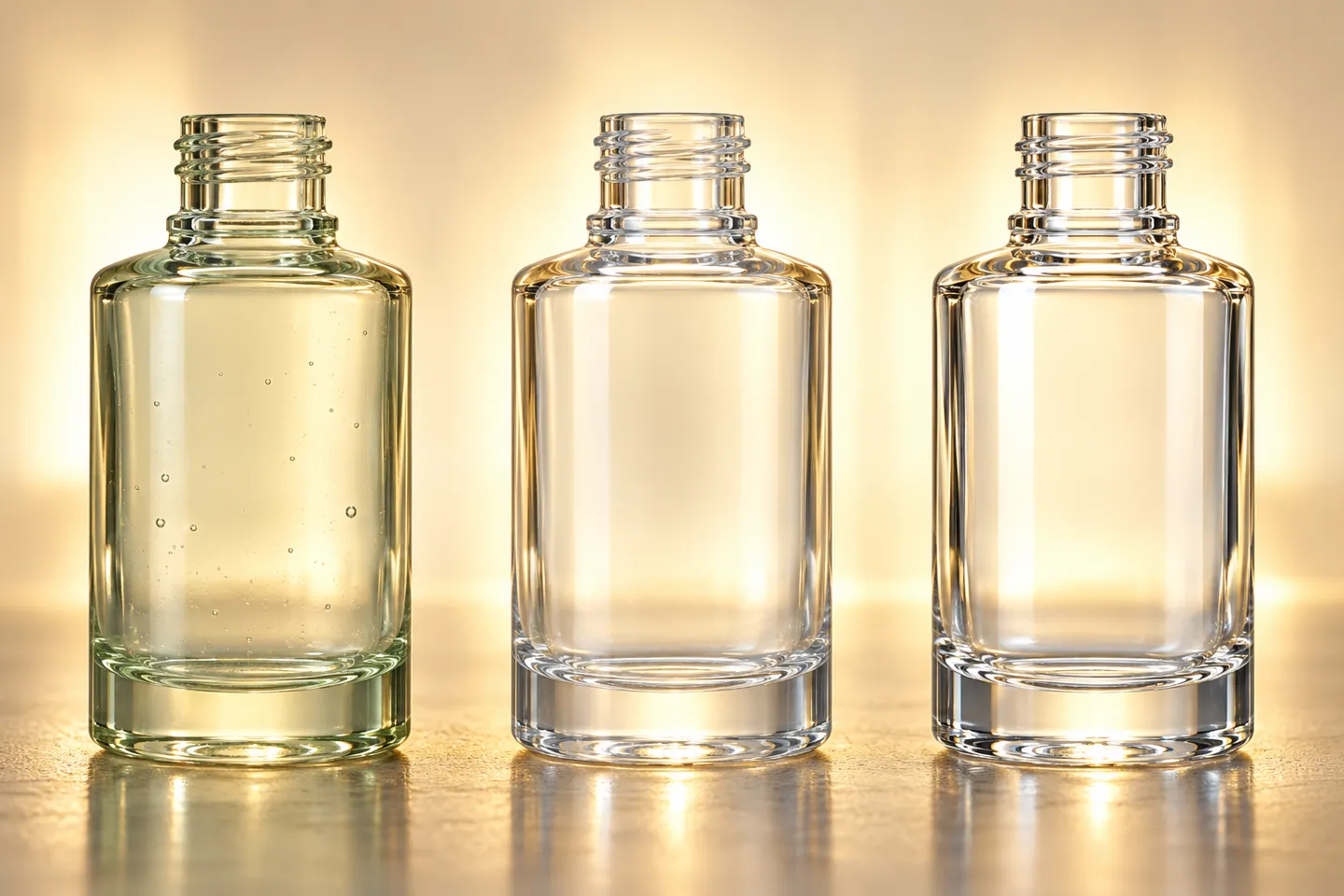
A clarity label becomes useful when it can be checked on a production lot. Record which surfaces are visually critical, how many samples will be examined, and what level of variation is acceptable. Decoration and coating should have their own approved sample and inspection criteria.
A practical sample set should include bare glass, decorated glass, and the assembled bottle with its final pump or cap. View the samples both empty and filled, because the formula changes the apparent tint. Photograph the approved set under fixed lighting, but keep a physical master sample too. Photos can help record an agreement; they are less reliable for judging subtle color and surface changes.
The boundary matrix
| Material | Potential fit | Key strengths | Confirm for this product |
|---|---|---|---|
| Glass | Fragrance, selected serums, oils, and prestige creams | Clarity, weight, decoration options | Formula, closure, breakage, and transport performance |
| PET, PP, or HDPE | Washes, lotions, travel and larger formats | Low weight and many forming options | Resin grade, formula interaction, barrier and fill conditions |
| Aluminum | Selected sticks, bottles, and opaque formats | Light barrier and metal appearance | Inner coating, dent resistance, closure and formula contact |
Environmental comparisons also depend on the use system. Refill frequency, package weight, transport distance, recycled content, and local collection all affect the result. The US Federal Trade Commission advises marketers to support and qualify recycled-content and broad environmental claims. Ask for evidence behind a specific claim instead of assuming any material is always the greener choice (FTC, Green Guides).
For this reason, the material decision should be made against the actual distribution and use scenario. A lightweight pack that travels far may have a different profile from a returnable glass bottle used repeatedly nearby. If an environmental claim will appear in marketing, define its boundary and verify the evidence before publication.
The consumer experience belongs in the same assessment. A bottle intended for a bathroom shelf faces handling and drop risks; a travel pack faces vibration, pressure changes, and repeated opening. A premium fragrance pack may need to display its liquid clearly, while an opaque formula can use a stronger light barrier without losing a key visual cue. Write these expectations into the brief so the material comparison reflects use, not only manufacturing cost.
How the Market Actually Sells Packaging: Stock, Semi-Custom, or Full Custom
Packaging can be sourced through stock, decorated stock, or a new mold. Stock uses an existing shape and finish; it can simplify sampling and tooling decisions, subject to availability. Decorated stock adds color, print, frosting, or another finish while keeping the base shape. A custom mold offers more control over silhouette and dimensions but adds tooling, validation, and production planning. Minimum order and lead time vary by supplier, product, decoration, and order schedule; request them for the specific quote.
Stock programs can help a brand validate a concept before investing in tooling. Their limits are equally important: the neck finish, capacity, and key dimensions may be fixed. A low advertised minimum may apply only to an undecorated item in current inventory. Ask which finish and stock quantity the offer covers, whether the closure is included, and how a later reorder will be matched to the approved sample.
Start with the least complex supply mode that can meet the product brief. Add decoration when the visual identity needs it, and consider a new mold when sales, handling, and fit requirements justify the tooling. At every stage, the purchase order should state the same acceptance criteria used to approve samples.
Before selecting a new mold, ask whether a stock shape can meet the closure and filling-line requirements. A distinctive silhouette is valuable only if it remains stable in production and works with a repeatable seal. If the design team changes shoulder shape, base thickness, or neck finish, revisit pack-out, filling, and transit tests. The new geometry can change failure modes even when the glass composition stays the same.
The Specs That Separate a Grade from a Claim
Put the grade on paper
A grade or adjective is not a measurement. Instead of assuming universal tolerances for capacity, weight, height, or neck bore, agree on limits for the specific drawing and filling line. The supplier should state how each dimension is measured, the sample size, and the pass criteria. Appearance standards need the same discipline: tint, bubbles, scratches, and coating variation should be defined against an approved production-representative sample.
A useful quality target has three parts: a defect definition, an inspection method, and an agreed acceptance level. A single defects-per-million number without those parts cannot describe what the buyer will actually receive.
For example, a small bubble in the base might be acceptable while the same mark on the front panel is not. A dimensional deviation may be harmless to appearance yet prevent a pump from sealing. Separate critical functional defects from visual defects, then agree on the sampling plan and action for a failed lot.
For a quantitative plan, define the measurement point and conditions. “Capacity” may mean brimful capacity or nominal fill, and the two are not interchangeable. A pump bore measurement must refer to a particular drawing datum. A color limit needs a standard light and background. Once those terms are explicit, different suppliers can quote and inspect to the same requirement.
| Specification | What it controls | What to request |
|---|---|---|
| Material and appearance | Contact surface, tint, clarity, finish | Material declaration plus approved bare and decorated samples |
| Capacity and weight | Fill target and package consistency | Product-specific limits on the drawing |
| Critical dimensions | Closure fit and line handling | Neck, height and other relevant limits with method |
| Visual defects | Shelf appearance and sorting | Defect examples, viewing conditions and sampling plan |
| Appearance defect rate (ppm level) | Shelf rejection rate, brand risk | Defect definition plus ppm figure |
Compatibility is a system, not a detail
The closure must match the bottle finish. CETIE publishes dimensions and guidance for perfume and cosmetic glass neck finishes, including crimp and screw variants. Ask the bottle and pump suppliers to identify the exact finish and mating component on their drawings. A nominal diameter alone does not prove interchangeability, and a fit check on the assembled pack is still necessary (CETIE).
Seal performance depends on the formula, gasket, pump, crimp or thread, fill level, and storage conditions. An alcohol-rich fragrance may interact differently with a seal than a water-based lotion. Do not apply a generic evaporation percentage or call one gasket material universally superior. Test the proposed assembly for leakage, mass loss, spray function, and visual change under conditions that reflect transport and shelf life. Apply the same system approach to decoration: assess adhesion and abrasion on the finished bottle.
A useful stability study records the filled package at defined temperatures and time points, then checks appearance, odor, mass, seal integrity, and dispensing. Include the orientation that will occur in transport: upright storage alone may miss a leak that appears when cartons are tilted. If the formula or closure supplier changes, assess whether the study needs to be repeated. Keep a control sample so a change in the formula is not mistaken for a package defect.
Acceptance actions that belong in the contract
Attach a verification method to each important specification. Request a leak or mass-loss method for the filled assembly, a defined visual-inspection method, retained color and finish samples, and a transport test selected for the distribution channel. ISTA lists different procedures for different shipping systems; its Procedure 3A, for example, addresses individual packaged products in parcel delivery. Name the appropriate procedure and version rather than writing only “ISTA tested” (ISTA).
Acceptance minimums
- Test method for the filled bottle and closure
- Visual standard with defect examples and viewing conditions
- Approved color and decoration samples retained
- Transit test selected for the shipping channel
- Relevant material and market documents identified
A stock purchase still permits useful acceptance terms. The mold geometry may be fixed, but the chosen finish, decoration, assembled closure, packing method, and lot-to-lot appearance can be agreed and checked.
Share your formula, container, closure, and decoration requirements. Nuvole Glass can help review suitable stock or custom options and the specifications to confirm in your quote.
Send Your Spec SheetWhat a Supplier Should Put on the Table
A supplier’s response to a clear brief is evidence of how the project will run. Look for specific answers in four areas: design and fit, sampling, quality records, and delivery responsibilities.
Ask for drawings and compatibility information for the chosen bottle and closure. Request samples representative of intended production, with any sample or freight charge stated up front. A useful quality response identifies the inspection plan, traceability method, and documents relevant to your market; a certificate name without scope is not enough. For delivery, agree on lead time, packing configuration, and how transit damage or rejected lots will be handled.
Request a bill of materials for every part that contacts the product. A glass bottle may still contain a plastic dip tube, elastomer gasket, metal spring, and coating on a closure. Each material has its own compatibility question. Ask which party owns the assembled-pack test and which supplier receives the result if a component changes. This prevents a bottle vendor and pump vendor from each assuming the other validated the seal.
Compare these replies against the same checklist. A detailed, testable answer is more valuable than a broad promise of “premium quality.”
Where Cosmetic Packaging Fails First
Packaging failures often become visible only after filling, shipping, or repeated use. Instead of attributing every cracked jar or leaking pump to one cause, trace the symptom back through material, design, process, closure, and distribution. The checks below are starting points for that investigation.
Failure and fix chain
1Transit breakage
Symptom Cracked shoulders on arrival.
Possible causes Glass design, inner packing, and handling may contribute.
Check Select a distribution test and inspect arrival damage by lot.
2Leaks or mass loss
Symptom Fill level falls or liquid appears around the pump.
Possible causes Seal, finish, assembly, or formula interaction may contribute.
Check Test the filled assembly under agreed storage and transport conditions.
3Decoration damage
Symptom Coating or print rubs or lifts.
Possible causes Pretreatment, coating process, or handling may contribute.
Check Check adhesion and abrasion on production-representative samples.
4Appearance drift
Symptom Lots differ in tint or visible defects.
Possible causes Material and process variation may contribute.
Check Compare with approved samples under one inspection method.
Each check should reflect the actual use and distribution channel. Some can be performed in-house; others require a supplier or qualified laboratory. Record the method and acceptance limit before testing, so a failed result leads to a clear decision.
The root-cause record should include lot numbers, photos, transport route, filling settings, and the number of affected units. This information helps distinguish a material issue from damage caused by a particular pallet, closure batch, or coating run. It also gives the supplier a focused corrective-action request rather than a general complaint that “the bottles are bad.”
The Buying Playbook: From RFQ to Repeat Order
Write the minimum spec set into the RFQ
A useful RFQ includes the material and approved sample; the bottle drawing and tolerances; the neck finish and mating closure; the decoration standard; the planned fill and storage conditions; and the test evidence needed for the final pack. Define visual defects and the inspection plan rather than demanding an arbitrary ppm figure. Ask for material declarations and market-specific documents where relevant.
RFQ minimum spec set
- Material and approved reference sample
- Capacity and critical dimensional tolerances
- Neck finish and matching closure drawing
- Visual defect definition and inspection plan
- Filled-pack leak or mass-loss test, where relevant
- Decoration and contact-compatibility checks
- Product-specific documents for the target market
- Transport test suited to distribution
Prove, then scale
Approve representative samples, then validate a small production run under real filling, shipping, and storage conditions. Compare the result with the signed sample, drawing, and test criteria. Track breakage, leaks, appearance variation, and delivery performance before increasing order size or paying for custom tooling. This sequence creates data for the next purchase order.
Keep the first production comparison simple: sample-to-lot color, critical dimensions, assembled leakage, arrival damage, and usability. Review failed units rather than only the average result. A low average breakage rate can still conceal one weak carton design or a recurring failure at the shoulder. Agree on what triggers rework, replacement, or a design change before the next run.
For a fragrance bottle, the first practical brief might state the fill volume, formula type, target market, closure finish, intended decoration, distribution channel, and forecast order size. Nuvole Glass can use that information to discuss stock and custom options. Confirm availability, minimum quantity, lead time, sample charges, and testing scope in the project quote rather than relying on a general number from a catalog.
The validation ladder
Samples
representative pack
Validation run
measured production batch
Repeat numbers
leaks, appearance, delivery
Custom molds
when the business case holds
The comparison is about the delivered pack, not just the empty bottle price. Add tooling, decoration yield, transit damage, filling-line performance, and returns to the decision. Then keep the approved sample and inspection records so a repeat order can be judged against the same standard.
If you are comparing quotes now, send the same brief and acceptance criteria to each supplier. Request current, product-specific documentation for any certification, recycled-content, or performance claim that matters to your decision.
Before approving a repeat purchase, keep one short decision record: the approved drawing, material declaration, physical samples, test reports, inspection limits, and the person who signed off each item. Record any approved deviation separately. A later supplier change, new resin grade, different pump gasket, or revised decoration process should trigger a review of the affected checks. This record protects the brand when staff change or a successful pilot is scaled to a larger order.
Put Your Next PO Through the Spec Filter
Send your product brief and ask for a quote that identifies the proposed material, closure, tolerances, sampling, and relevant test scope.
Start Your RFQReferences
- European Commission. Guidelines on Annex I to the Cosmetics Regulation: Cosmetic Product Safety Report
- US Food and Drug Administration. Good Manufacturing Practice Guidelines for Cosmetics
- CETIE. Bottling of Home and Personal Care Products and Perfumes
- International Safe Transit Association. ISTA Test Procedures
- US Federal Trade Commission. Environmental Claims: Summary of the Green Guides
- ISO. ISO 22715:2006 Cosmetics — Packaging and Labelling