The same bathroom shelf can hold a watery toner, a vitamin C serum, and a thick night cream. Their dispensing needs differ: a toner may suit a fine mist, a serum may need controlled dosing and protection from light, and a dense cream may work better in a jar or a pump designed for its viscosity. The bottle is only half the decision. The closure determines how the product leaves the pack, while the complete bottle, closure, and formula determine how it performs in use. This guide compares the main formats and shows what to verify before placing an order.
What Counts as a Cosmetic Bottle
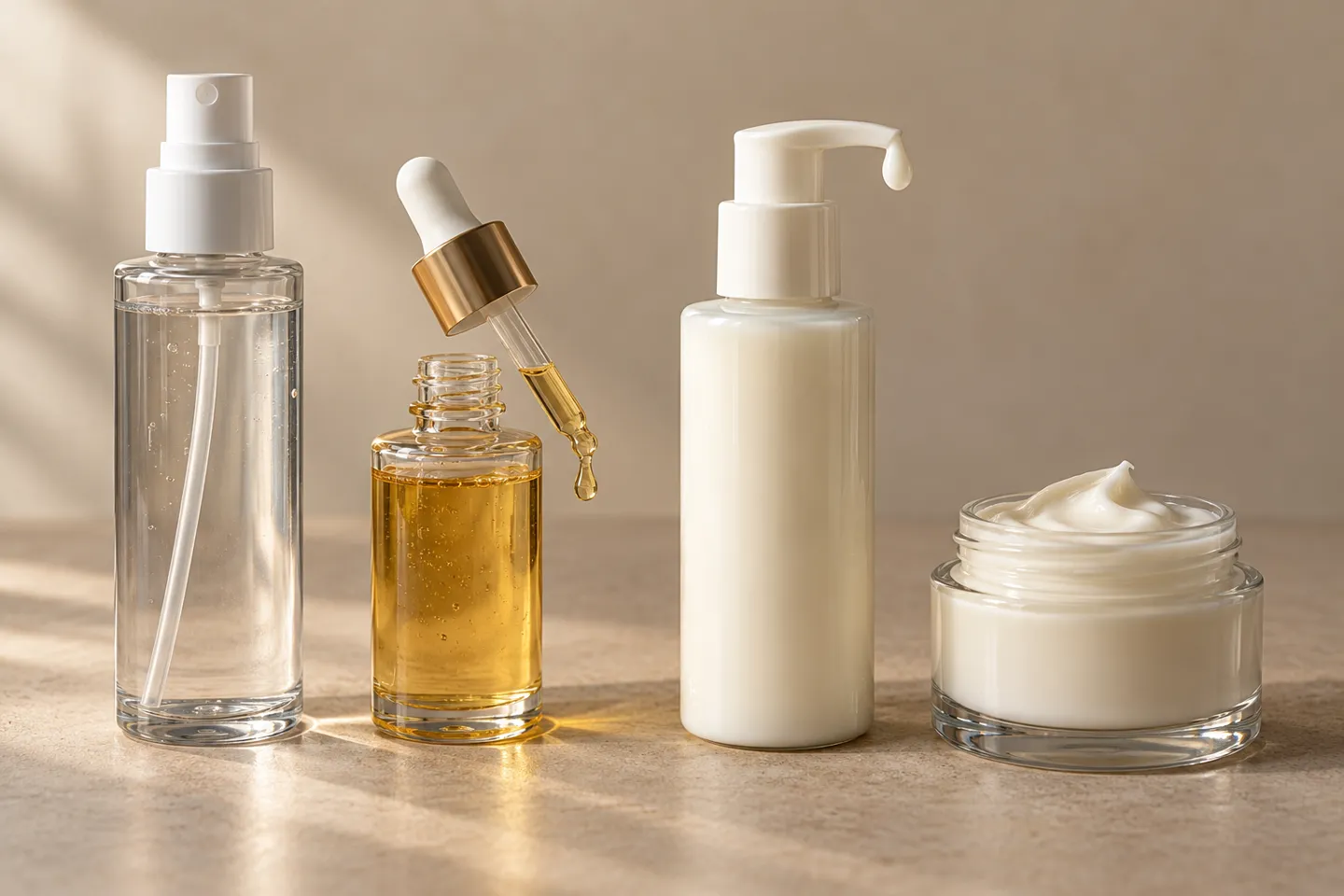
Cosmetic primary packaging includes bottles, jars, and tubes. A bottle usually has a relatively narrow neck with a cap, dropper, pump, roller, or sprayer; a jar has a wide opening; a tube dispenses when squeezed. These are useful categories, but the practical choice depends on the formula, the desired dose, and the conditions of storage and use.
A dropper releases drops, a pump delivers a stroke of product, a sprayer disperses a mist, and a roll-on transfers liquid through a moving ball. Each mechanism has a working range, so check its performance with the actual formula rather than choosing by appearance alone.
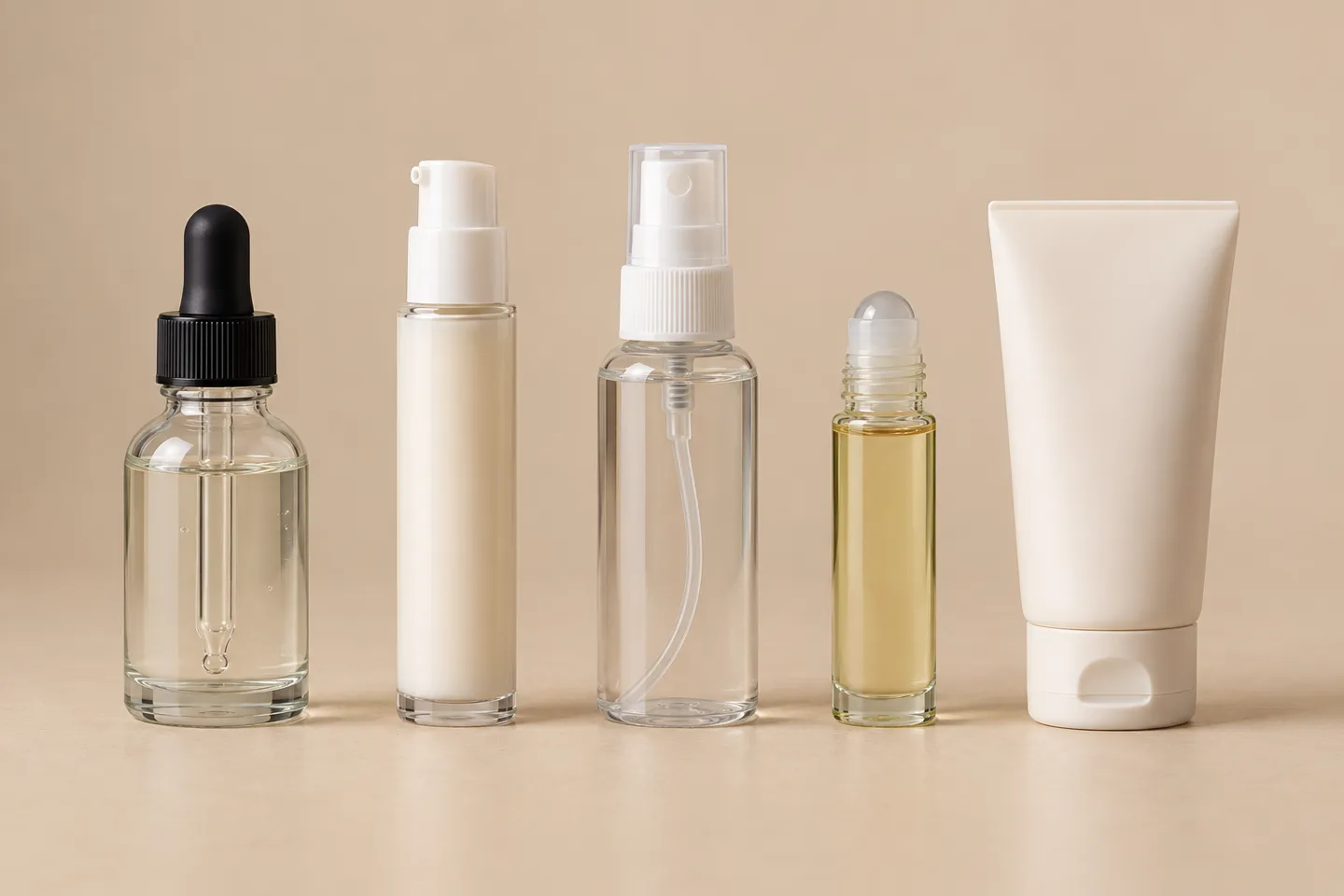
Start by comparing dispensing mechanisms. Then match the shortlisted packs to formula behavior, material, and supply requirements. Finally, ask for test results on the filled, assembled pack. This sequence keeps the attractive option on the table only if it also works as a product.
The Bottle Types, by How They Dispense
The most useful way to compare cosmetic bottles is by the way their closures dispense the formula.
Lotion and treatment pumps
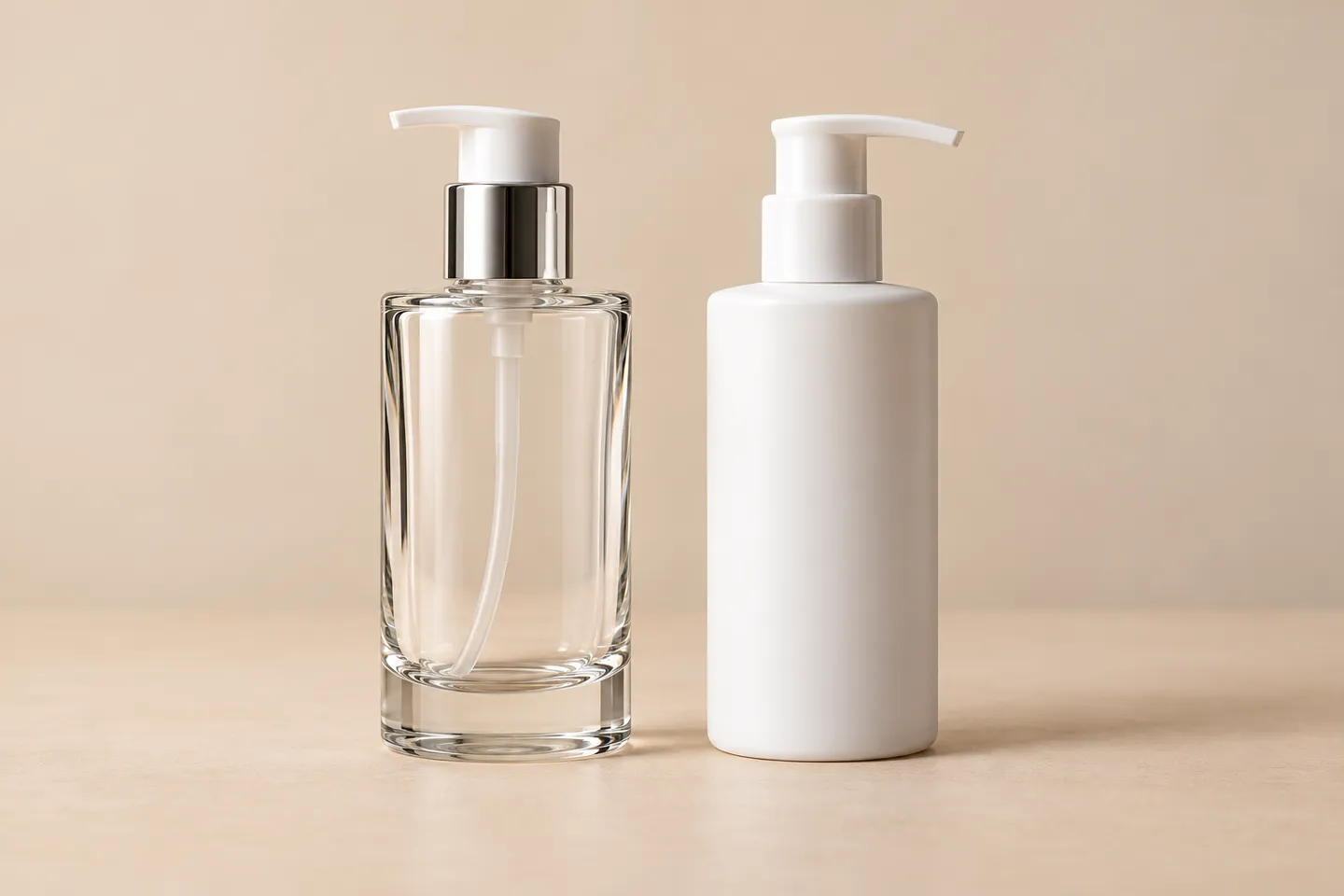
A lotion pump uses an actuator and dip tube to dispense a fluid or lotion with each press. Treatment pumps are generally selected when a smaller, more controlled output is wanted for serums and eye products. The output is a property of the specific pump and formula, not the category name. Ask the supplier for its nominal dose and test several filled units. For illustration, a 30 ml fill at 0.25 ml per full stroke yields 120 theoretical strokes before allowing for residual product and variation in use.
A dense cream may not prime or dispense reliably through a standard pump. Check whether the formula contacts metal parts, and confirm the spring, gasket, and dip-tube materials with the closure supplier. Compatibility requires testing with the finished formula.
For a product used twice a day, the feel of one press matters as much as the number printed on the pump drawing. Compare how quickly the first dose appears, whether the actuator returns cleanly, and whether product collects around the nozzle after repeated use. Test with wet hands if the pack will live beside a sink. If a travel size uses the same visual design as the full-size bottle, verify its pump separately: a smaller dip tube or different headspace can change the experience. Record the chosen actuator and output in the specification so a later reorder does not quietly change the dose.
Airless pumps
Many airless packs use a rising piston or a collapsible inner pouch to dispense product while limiting the amount of replacement air entering the reservoir. This may help formulas sensitive to repeated air exposure, and the relatively closed system can also reduce opportunities for contamination during use. The level of protection and product recovery still depend on the specific pack and formula (Cosmetics Preservation review, 2018).
Airless packs often add components and cost, but there is no universal price premium or viscosity limit. Compare quoted assemblies and test priming, dose consistency, leakage, and product recovery with the actual batch before treating airless as the safer choice.
Dropper bottles
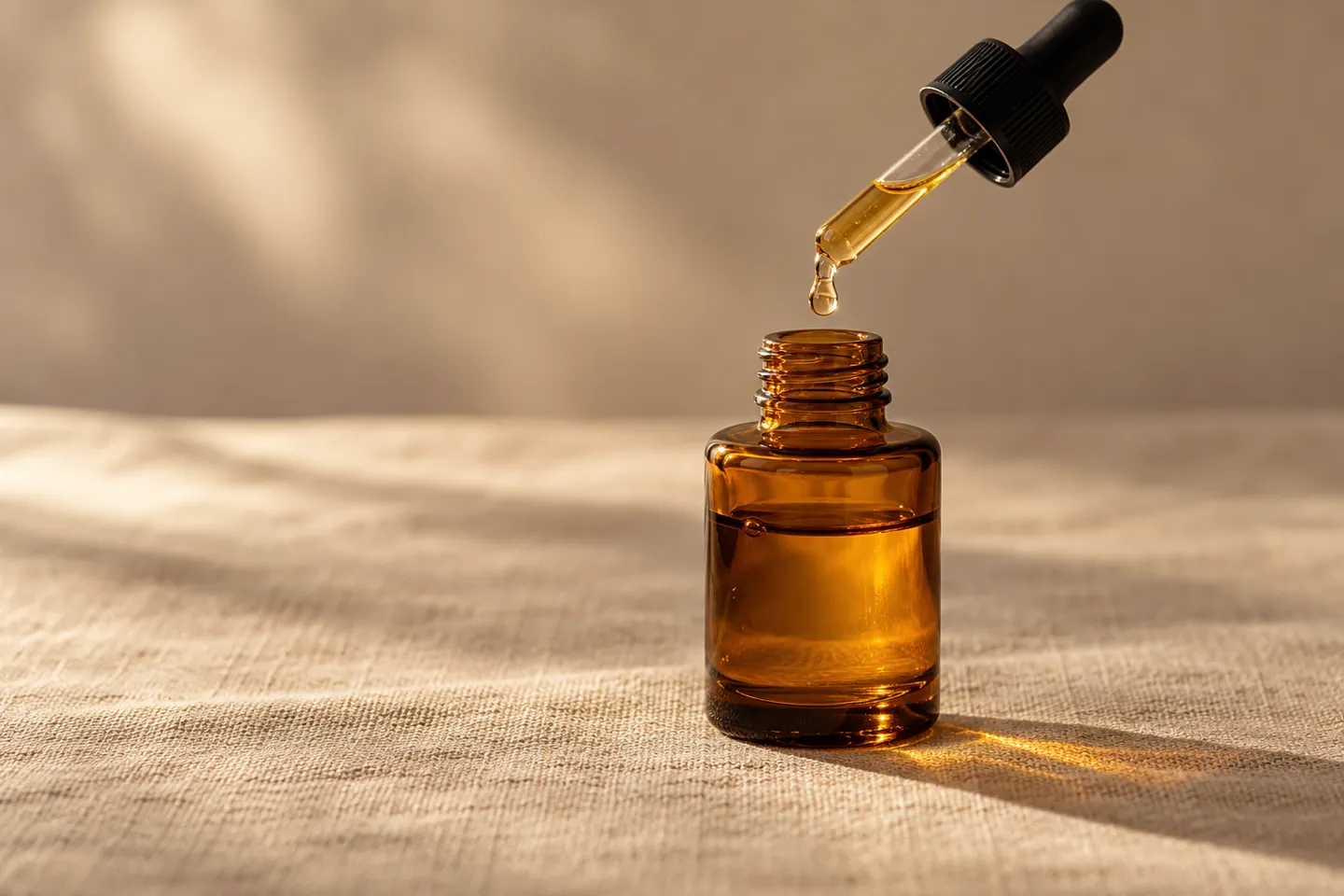
A dropper uses a pipette and bulb to draw up a small amount of liquid. It suits many oils and low-viscosity serums and offers a familiar apothecary appearance. The actual volume per drop varies with the liquid, pipette, and user technique. Colored or opaque packaging can reduce some light exposure, but the protection must be checked against the formula’s stability needs.
Droppers become awkward when a user needs a large amount of product or when a thick formula does not draw into the pipette. Opening the bottle repeatedly also admits air. Check pipette reach, bulb compatibility, and the filled pack’s stability over the intended shelf life.
Fine-mist sprayers
A fine-mist sprayer disperses a low-viscosity formula into small droplets. It can suit toners, facial mists, and setting sprays. Spray output, pattern, and droplet feel vary by actuator and formula, so request filled samples and compare the pattern at the distance a customer would actually use.
Viscosity and suspended ingredients can affect priming or clog the orifice. Some oil-containing formulas can spray successfully with a compatible system; the filled-pack test is the deciding evidence.
Roll-on and squeeze bottles
A roll-on transfers a thin liquid through a ball, making it useful for targeted application such as spot products or fragrance oils. The ball, housing, and formula must be checked for smooth movement and leakage. Squeeze bottles with flip-top or disc caps suit many cleansers and body products, though the user controls the dose less precisely than with a calibrated pump.
These formats also make useful small packs, but portability is a separate test from shelf appearance. Put a filled roll-on or squeeze bottle in the position it will occupy inside a bag, then check the closure after handling and temperature changes. A cap that looks secure on a display shelf may loosen during travel; an overly stiff squeeze bottle may make a small opening frustrating to use. For a roll-on, test whether the ball starts moving after storage and whether the formula leaves an even film. The smallest pack should still feel like the same product, not a disposable afterthought.
Where jars fit
Jars sit beside bottles in many cosmetic ranges. Their wide mouth makes dense creams, balms, and masks easy to access. The opening also exposes more product during use, and finger contact can introduce contamination. An inner lid may help contain the product in transit, but it does not replace a suitable preservation system or a filled-pack challenge test (Cosmetics Preservation review, 2018).
The boundary matrix
Boundary matrix: what each bottle type is for, and when it fails
| Bottle type | Best for | Fails when |
|---|---|---|
| Lotion pump | Body lotions and cleansers in 100 ml-plus formats | Output or priming is poor with the filled formula; closure materials are incompatible |
| Treatment pump | Serums and eye products in 15 to 50 ml | Specified dose is not verified on the filled pack |
| Airless pump | Oxidation-sensitive actives and premium positioning | Piston or pouch is incompatible with formula viscosity or filling process |
| Dropper | Face oils and classic serums | Formula is too viscous, large doses are needed, or repeated opening affects stability |
| Fine-mist sprayer | Toners and setting sprays | Filled formula clogs the orifice or gives an unsuitable spray pattern |
| Roll-on | Under-eye and spot treatment and EO blends | Formula does not flow well or the ball leaks |
| Squeeze bottle | Cleansers and sunscreens and travel sizes | Precise dosing is essential or closure leaks in transit |
| Jar | Thick creams and balms and masks | Formula needs tighter in-use protection than the tested jar provides |
Matching the Bottle to Your Formula
Once you have a shortlist, run four checks with the formula and the intended user in mind.
- Measure the formula. Record viscosity across the temperatures relevant to filling, shipping, and use. This narrows the dispensing choices.
- Set the dose. Define the amount per use and check the number of uses against the intended fill volume, allowing for residual product.
- Check sensitivity. Review exposure to air, light, and contact materials, then plan stability and compatibility testing in the proposed pack.
- Choose the look. Select material, color, and decoration after the functional shortlist is established.
Two common debates show why the finished pack matters more than a rule of thumb.
L-ascorbic acid can degrade in response to oxygen, light, heat, pH, and metal ions (Yin et al., 2022). That does not make every vitamin C product unsuitable for a dropper or every airless pack automatically safe. The formulation, concentration, stabilizing system, and packaging all affect the result. Ask for stability data on the final formula in the proposed retail pack, including performance after opening, rather than assuming a shelf life from the bottle color or closure. EU guidance likewise calls for stability assessment in the intended packaging (European Commission, 2013).
The same principle applies to airless packs and jars. A more closed system may help reduce in-use contamination, while a jar may be the easiest way to dispense a dense cream. Neither format alone guarantees shelf life. Compare the finished packs against the formula’s stability and preservation requirements, then weigh the user’s preferred application experience.
A three-product line might use a pump or squeeze bottle for a gel cleanser, a tested dropper or treatment pump for a serum, and a jar or cream-capable pump for a night cream. Keep the visual identity consistent across the line, but do not force all three formulas into one closure for the sake of a matching silhouette.
When two closures remain plausible, define what would make one win before looking at samples. For a serum, that may be a comfortable single-use dose, easy one-handed application, and acceptable stability after opening. For a cleanser, it may be clean dispensing in a wet bathroom and minimal product left at the bottom. Give both candidates the same formula, fill level, and trial conditions, then have people who have not seen the design brief use them. Note where they hesitate, spill, or use more product than expected. The result is a more useful selection record than an opinion about which bottle looks premium.
Formula-to-bottle checklist
- Formula viscosity at filling and use temperatures.
- Target dose, fill volume, and expected uses per pack.
- Sensitivity to air, light, and contact materials.
- Finished-pack stability, compatibility, leakage, and transport tests.
Glass or Plastic, and How to Buy
Glass and plastic each solve different problems. Glass offers a strong barrier and a weight that many brands use as a premium cue, but it increases shipping weight and can break. PET, HDPE, and PP offer different combinations of clarity, squeezability, and structural performance; the exact resin and additives matter. Plastic is generally lighter, but its barrier properties depend on the material and wall design. For either material, recycling in practice depends on local collection, sorting, and the complete pack, including its closure and decoration.
The grades inside “glass”
Most cosmetic bottles use soda-lime glass. Borosilicate has different thermal and chemical properties, but it should be specified for a demonstrated formula or process need, not as a blanket quality upgrade. Ask the supplier for the glass composition and run compatibility tests with the filled product when the formula or process warrants it.
Clear glass can vary visibly in tint and clarity, especially at a thick base. Terms such as flint, high flint, and extra flint are used commercially, but the exact appearance and composition should be confirmed with physical samples and an agreed specification. Compare samples at the same wall thickness and under the lighting in which the product will be sold.
Send your formula type, target fill, and closure preference. Nuvole Glass can help shortlist stock bottles and compatible components for sampling.
Request Bottle SamplesColor can serve both presentation and protection. Amber, opaque, and coated finishes transmit different amounts of light, and a decorative coating can wear during filling, transport, or use. If light protection matters, request transmission or stability evidence for the exact bottle and finish. If the goal is visual identity, test the finish for adhesion and abrasion on production-equivalent samples.
Plastic can be the better choice where low shipping weight, impact resistance, or squeezability is central to the product. Glass may suit a premium serum or fragrance but raise freight and breakage costs for a large body-care format. Compare the total filled-and-shipped pack, not the empty bottle price alone.
The specs to settle before you order
The order-sheet specifications, at a glance
Neck
Bottle and closure drawings, fit, and seal
Fill
Nominal volume, headspace, and residual product
Dose
Output per stroke with the finished formula
Supply
MOQ, samples, tooling, and lead time by component
Lock the bottle and closure drawings together. A nominal neck diameter does not prove that two parts seal correctly: thread profile, finish height, sealing land, and tolerances all matter. Ask for an assembled sample and a written compatibility confirmation for the specific bottle and closure, then verify it through leak and handling tests.
Set the nominal fill, headspace, target dose, and expected uses per pack before requesting quotes. Ask suppliers to separate the MOQ for a stock component from any minimum for decoration or custom tooling. Obtain the sample plan, tooling schedule, and production lead time in writing; they vary with the design and the factory’s capacity. Check the numbers against your forecast and cash requirements rather than applying a category-wide MOQ rule.
Glass vs plastic at a glance
| Factor | Glass | Plastic |
|---|---|---|
| Premium feel | Often used for premium presentation | Can be designed for premium presentation |
| Gas barrier | Generally strong | Depends on resin and construction |
| Shipping weight | Usually heavier | Usually lighter |
| Breakage | Can break on impact | Often more impact-resistant |
| Recyclability | Depends on local collection and pack design | Depends on resin, components, and local collection |
| Unit cost | Compare finished-pack quotes | Compare finished-pack quotes |
The Quality Gap a Catalog Will Not Show You
Two bottles can have the same capacity and near-identical catalog photos yet perform differently. The critical differences may be in the closure, tolerances, and quality controls, which are hard to judge from images alone.
Ask for the nominal output per stroke and a practical range measured with your formula. Multiply the output by the intended number of uses to check whether the pack size makes sense. If the product is meant to be applied in small amounts, a dose that feels excessive can undermine the experience even when the bottle looks right.
Confirm every material in contact with the formula, including springs where exposed, gaskets, liners, dip tubes, and adhesives. Acidity, alcohol, oils, and fragrance can affect different components in different ways. Do not infer compatibility from a material name alone; test the assembled pack over the expected storage and use conditions.
Agree on a test plan before approving production. Measure output over repeated strokes, check priming and residual product, and run leakage tests in the orientations and temperatures the pack may encounter in distribution. Add compatibility, decoration durability, and transport testing where relevant. Set acceptance limits with the supplier and filler for this product, record the method, and request batch-level evidence for the controls that matter. The European Commission’s cosmetic safety guidance emphasizes stability testing in the packaging intended for sale (European Commission, 2013).
Keep a reference sample from each approved component lot and label it with the supplier, revision, and approval date. When production units arrive, compare them with that sample before filling begins: check color, print position, cap fit, visible defects, and the first few dispensing cycles. If the pump supplier changes a gasket or the bottle supplier revises a neck finish, repeat the tests affected by that change. A successful trial on last season’s components does not validate a new assembly. This simple change-control habit helps the brand, filler, and packaging supplier discuss the same physical pack when a complaint or delay appears.
The specification to remember
Dose per stroke
Request the nominal output and verify it with the finished formula and closure.
Specify a measured dose range on the purchase order.
Reading the Category as a Business
When you buy packaging for a range, the selection becomes an inventory decision as well as a design decision. Separate the requirements for each SKU, then look for components that can sensibly be shared.
A stock bottle may reduce tooling work, while a custom closure or finish may help distinguish the line. Neither route is automatically cheaper in the finished pack. Compare quotes with the same fill volume, closure specification, decoration, carton, and test requirements. A low bottle price can hide a costly pump, high decoration minimum, or extra assembly step.
MOQ and lead time should be checked for each component and decoration step. The bottle, pump, cap, and carton may have different minimums, so the highest one can determine how much finished inventory you must fund. Start with a narrower assortment when demand is uncertain, and ask whether a stock shape can carry different labels or finishes across the range. Revisit a private mold when repeat demand justifies the tooling and inventory commitment.
Turn the technical questions into a comparable quote sheet: bottle drawing, closure drawing, materials in contact with the formula, nominal dose, test methods, acceptance limits, decoration specification, MOQ by component, lead time, and replacement policy for defects. This makes price differences easier to interpret and gives the filler a usable specification.
Ask each bidder to identify any item they have assumed rather than priced: freight, assembly, protective dividers, printing setup, or a new mold. A quote that names the bottle but leaves the closure open is not yet comparable to a complete pack quote. Once the scope matches, calculate the cost per filled saleable unit, including expected handling and packing needs, and keep the assumptions beside the price. That document makes the next reorder faster because the team can see exactly what was approved.
Before approving a quote, request assembled samples and the supporting test plan. If a supplier cannot provide the component details you need, record that gap and evaluate another closure or pack combination.
Nuvole Glass lists more than 500 stock bottle designs and over 500 cap styles in its fragrance range, alongside custom decoration options (Nuvole Glass). For a cosmetic project, share the formula type, target fill, closure preference, and artwork requirements so the team can confirm which specific bottle and closure combinations are available and suitable for testing.
Put the specification beside the quote
Share your formula and target pack. Ask for drawings, component details, samples, and a test plan before you commit.
Discuss Your Bottle ProjectReferences
- Yin, X. et al. “Chemical Stability of Ascorbic Acid Integrated into Commercial Products.” Antioxidants, 2022. https://pmc.ncbi.nlm.nih.gov/articles/PMC8773188/
- Halla, N. et al. “Cosmetics Preservation: A Review on Present Strategies.” Molecules, 2018. https://pmc.ncbi.nlm.nih.gov/articles/PMC6099538/
- European Commission. Guidelines on Annex I to Regulation (EC) No 1223/2009 on Cosmetic Products, 2013. https://eur-lex.europa.eu/legal-content/EN/TXT/?uri=CELEX%3A32013D0674