The bottle is empty, the recycling bin is open, and the sprayer will not budge. That half second of hesitation is the whole question in miniature. The honest answer has two halves, and you need both before the bottle goes anywhere.
Container glass can be remelted into new glass without the material losing its basic quality, but that does not mean every perfume bottle belongs in every household recycling bin. Collection rules, bottle size, coatings, and the attached dispenser all matter. The US EPA reported a 31.3% recycling rate for glass containers in 2018; that figure covers the broader container category, not perfume bottles specifically (US EPA).
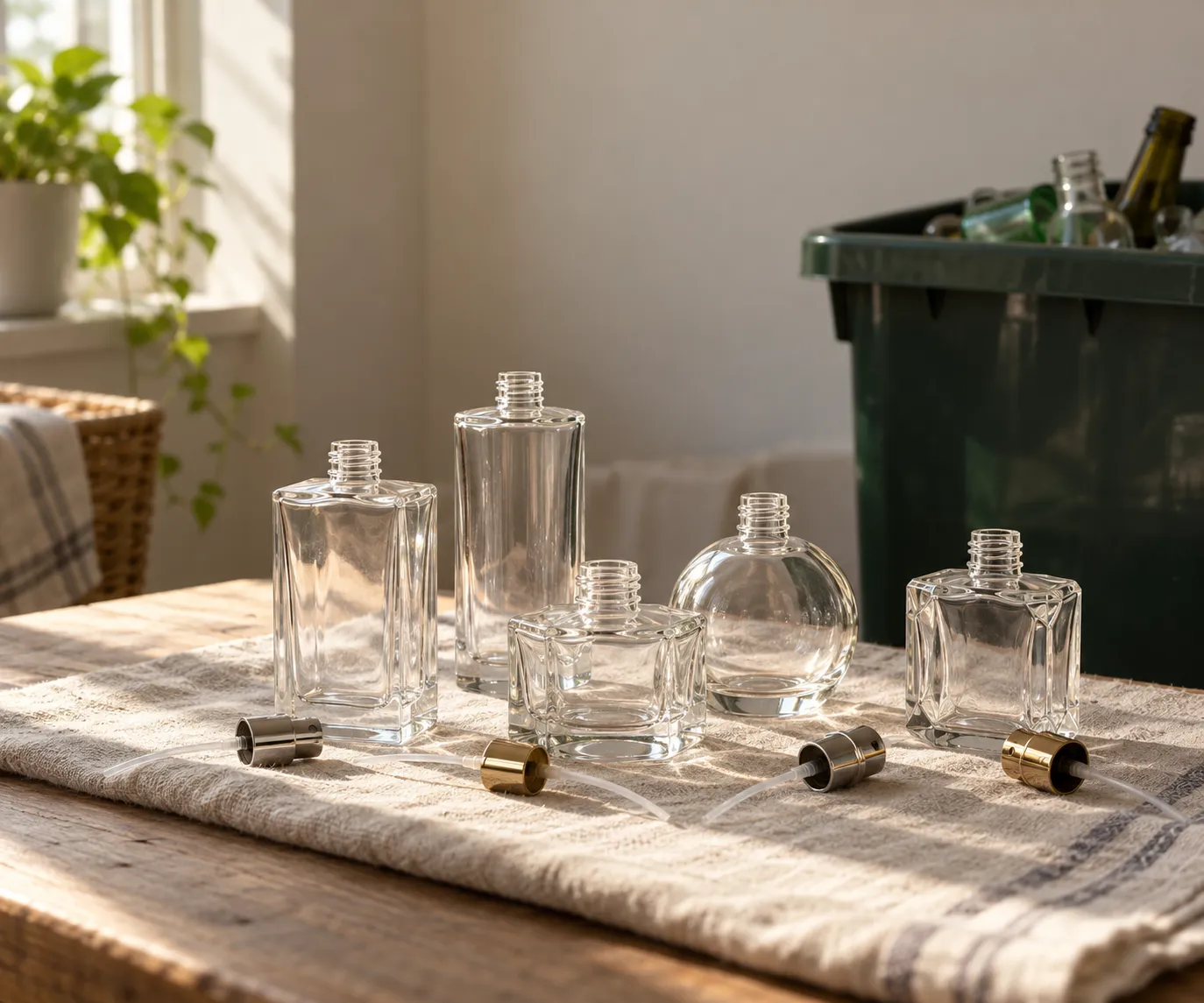
A perfume pack is a combination of a glass body, spray mechanism, collar, cap, and sometimes decorative finishes. Some programs accept empty perfume bottles as container glass; others require a removable closure or exclude the format. For example, UK guidance explicitly lists non-food bottles such as perfume among recyclable glass containers, while instructing readers to check their local collection route (Recycle Now). The material has a recycling route only when the local system can collect and sort that particular pack.
The short verdict
The glass body
Often recyclable where the local program accepts perfume bottles as container glass.
The bottle as a whole
Check the attached sprayer, residual liquid, and your collector’s instructions first.
Empty it, separate only what comes off safely, then follow the receiving program’s rules.
The useful question is therefore practical: is the bottle empty, what can be separated safely, and what does your local collector accept? Work through those checks before choosing a bin.
Consider two empty bottles. The first has a threaded sprayer that unscrews by hand, and your local authority lists perfume bottles among accepted glass containers. Follow its cleaning and cap instructions, then place the glass in the specified stream. The second has a fixed crimped pump and your collector excludes attached dispensers. Do not force the collar off. Look for a specialist program that accepts the relevant assembly or ask the local authority for its residual-waste instruction. The glass in both bottles is similar; the available route is not.
Before It Leaves Your Hands: Emptying, Cleaning and the Leftover Perfume Problem
Start with the product left inside. A bottle that still contains a meaningful amount of fragrance is not an empty container, and liquid can leak during collection. If the perfume is usable, finish it, give it away, or transfer it to a suitable refillable atomizer. Keep the liquid in a compatible, labeled container and away from heat while you decide what to do with the original bottle.
For fragrance you cannot use, check the product label and your local waste authority before disposing of it. Some perfume products can be flammable (Michigan EGLE), so avoid pouring a substantial remainder into a drain or putting a partly filled bottle into a recycling bin. In the United States, the EPA advises residents to use local household hazardous waste guidance for potentially hazardous leftovers and warns against drain disposal (US EPA). Local instructions differ: Hennepin County accepts perfume at hazardous-waste drop-offs, while Albuquerque provides a different rule for small amounts. A residual film in an empty bottle is also different from half a bottle of liquid.
Once the bottle is genuinely empty, follow the cleaning standard set by the collection program. Many ask for a quick rinse and no free-flowing liquid, rather than a spotless container. UK bottle guidance says to empty and rinse glass packaging (Recycle Now); Pact asks for clean, unbagged beauty empties with no liquid inside (Pact Collective). Avoid using excessive water or trying to flush away significant leftover perfume as part of the rinse.
Cleaning also depends on the destination. A glass collector may care primarily that the bottle is empty and free of loose liquid. A beauty-packaging take-back program may ask for a cleaner pack because staff sort items by hand. Read the exact preparation instructions before you rinse, bag, or remove a component. If an item still smells of perfume after a quick rinse, that alone does not tell you whether it is accepted; the receiving program’s criteria do.

Look at the closure before trying to remove it. A threaded sprayer may unscrew by hand; a crimped metal collar usually will not. Remove a component only if the bottle was designed for that action and it comes away without force. Prying at the neck with pliers can break the glass. If the pump stays attached, ask the collector whether it accepts the assembled bottle or directs it to another route.
Photograph the bottle if its construction is unclear. A picture of the neck and pump is useful when asking a recycling authority or retailer about acceptance, and it helps distinguish a metal collar from a decorative overcap. Keep small parts together until you know their route so that a loose cap does not disappear into mixed recycling by accident.
Before the bin
Handle remaining liquid: use it or ask your local waste authority how to dispose of it; avoid drain disposal of a substantial remainder.
Clean the empty bottle: follow the collector’s rinse and dryness requirements.
Inspect the closure: remove only parts designed to come off by hand; do not pry at a crimped neck.
Check the local route: confirm glass collection, attached-pump rules, cap instructions, and size limits.
What the Bottle Is Actually Made Of: the Parts That Decide Everything
The bottle body may be conventional container glass, but the closure is a small mixed-material assembly. Collection rules are written for what a sorting system can handle, not just for the substance printed on a label. That is why the same empty perfume bottle can receive different answers in different places.
The Glass Body: the Part Worth Saving
The body of a typical perfume bottle is usually container glass. Its thick base may make it feel different from a food jar, but thickness alone does not tell you whether a local glass processor accepts it. Color, coating, and the closure can also affect sorting. Where perfume bottles are accepted, the clean body can enter the container-glass stream. Ask the local program about the complete bottle rather than assuming its weight or clarity guarantees recovery.
The distinction is between a recyclable material and an item your collection program actually accepts.
Recyclable glass is a material fact. Bin acceptance is a local collection fact.
Check both before discarding the bottle
The Pump and the Crimp Neck
A fine-mist pump commonly contains plastic and metal parts, and a crimped collar is pressed onto the bottle neck during assembly. Many perfume sprayers use this construction because it provides a secure fit, but threaded and refillable designs also exist. The neck finish and attachment method, rather than the bottle silhouette, tell you whether the dispenser can be removed without tools.
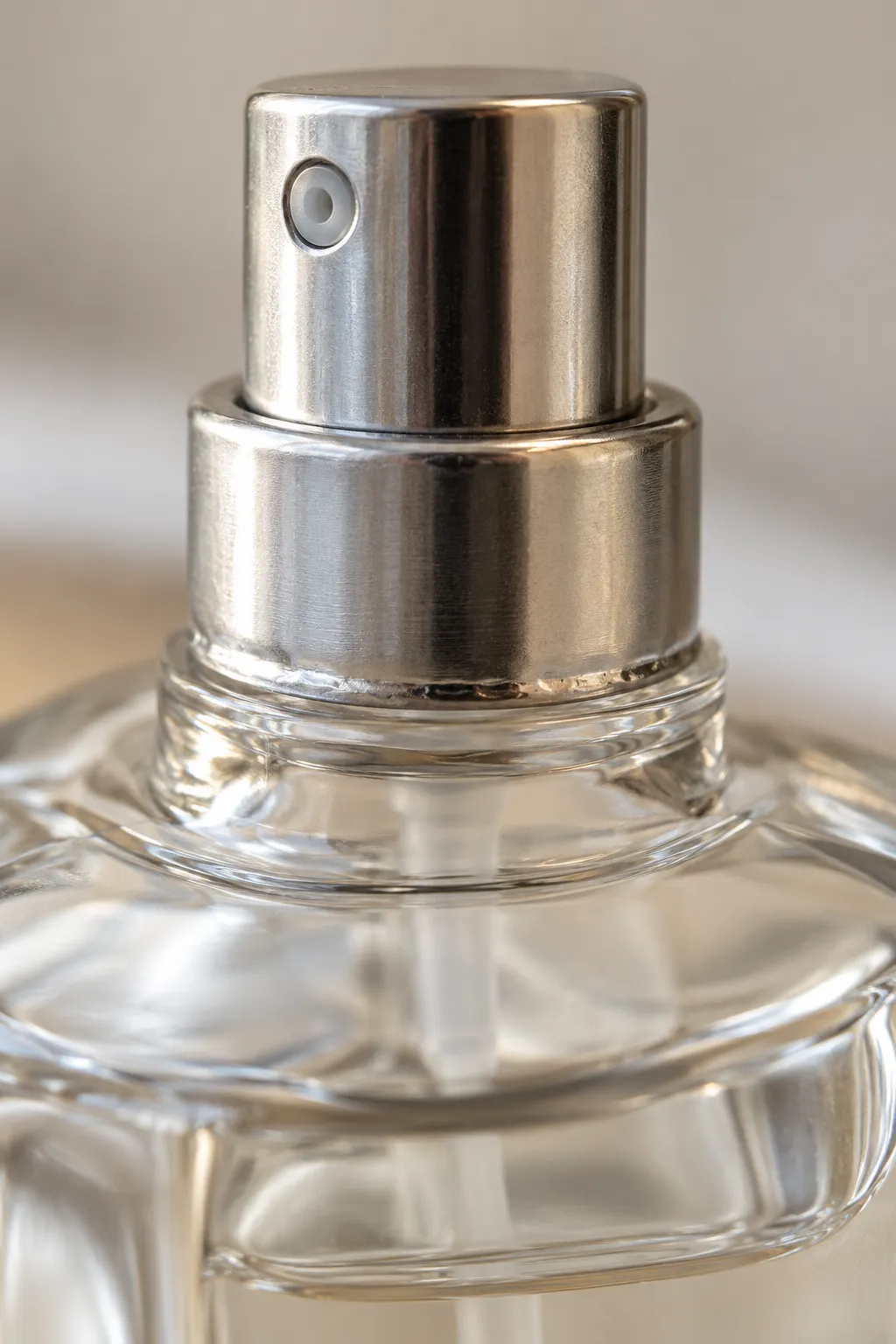
Do not assume every visible seam is a screw thread. Try a gentle hand twist only if the design appears removable. If the collar does not turn, leave it in place. Breaking a neck to separate materials creates a sharp-glass hazard without proving that the remaining pieces will be accepted. Ask your local collector or a specialist take-back program how it handles attached pumps.
Threaded travel atomizers, some refillable bottles, and certain roller formats can be easier to separate. Still, the removed pump and small cap may have a different destination from the glass body. Check each component against the same local rules before placing it in a bin.
The Cap, the Liner and the Coating
A cap can be metal, plastic, or a combination with an inner weight or liner. Its appearance is not enough to identify the material. Small loose components may be lost during sorting; for example, one Vermont recycling district excludes items under two inches in two dimensions (CSWD). Other programs give different cap instructions. Check the collector’s rule before leaving caps attached or separating them. Heavy coatings and metallized finishes also deserve a specific question because their acceptance depends on the glass processor.
The table is a decision aid, not a universal disposal label. Confirm the route shown with your municipality or collection operator.
Perfume bottle parts: what they are and where they go
| Part | Material | Household recycling? | Practical next step |
|---|---|---|---|
| Glass body | Usually container glass | Depends on local acceptance | Empty and follow the local glass route |
| Pump assembly | Mixed plastic and metal parts | Usually a separate question | Check specialist collection or local residual-waste guidance |
| Crimp collar | Often metal, fixed to the neck | Ask whether attached pumps are accepted | Leave attached if removal would require force |
| Metal cap | Steel, aluminum, or mixed construction | Depends on size and local rules | Follow the collector’s cap instruction |
| Plastic cap and liner | Resin or mixed materials | Depends on material, size, and local rules | Check local guidance or eligible take-back |
| Leftover fragrance | Liquid that may contain alcohol | No | Use it or follow local waste-authority guidance |
The attached pump is often the decision point. Calgary explicitly accepts empty, clean perfume bottles with pumps, while Rossendale Borough Council asks that the spray end be removed where possible. Neither answer can be inferred from the fact that the body is glass. Follow the instruction published by the program that will receive your bottle.
Where the Answer Changes: Local Rules and Glass That Breaks the Pattern
Local collection systems differ. Some accept container glass at the curb, some use separate glass bins or drop-off points, and some do not collect it through household recycling. The instructions may also distinguish perfume bottles from ordinary beverage containers. Check the current rules for your address, including whether attached sprayers, loose caps, colored glass, and small bottles are accepted. A national guide can explain the principle; the receiving program decides the actual route.
A quick search is more useful when it includes both the material and the object: try “perfume bottle,” “glass bottle with pump,” and “small glass bottle” on the local waste authority’s site. If those terms return no result, use its contact form and describe whether the sprayer is threaded or crimped. Ask about a dedicated glass drop-off even if the curbside cart excludes glass. Save the answer, and check that it is still current when the next bottle is empty.
Read the answer for the collection method you actually use. A city may accept glass at a staffed drop-off yet exclude it from a mixed curbside cart. It may also accept an empty perfume bottle while rejecting a separate loose pump. If a search result names only “glass bottles,” ask whether that includes non-food cosmetic containers and attached sprayers. The distinction matters more than a general statement that glass is recyclable.
Your city’s page, three questions
Does the program accept non-food glass bottles such as perfume?
Must the pump or cap be removed, and can it remain attached?
Are there size, color, or drop-off requirements?
Material can create another exception. Recycle Now lists perfume bottles as possible container glass but excludes glass cookware and drinking glasses from that stream (Recycle Now). A decorative vintage flacon is not automatically lead crystal merely because it is faceted; identify its material before assigning a route. If it is lead crystal or a non-container glass object, do not mix it with ordinary bottle glass unless your local processor explicitly accepts it. An intact collectible may be better kept, sold, or donated.

Size can matter, particularly for tiny sample vials and loose caps. CSWD, a Vermont recycling district, excludes containers smaller than two inches in two dimensions from its blue-bin stream (CSWD). That is a local sorting rule, not a global cutoff for every 5 ml bottle. Check whether your own program has a minimum size or a separate drop-off route before throwing a miniature bottle into mixed recycling.
Glass and size exceptions: questions for your local collector
| Glass type | Typical curbside handling | Why |
|---|---|---|
| Clear container glass | Check local program | Perfume bottles may be accepted as non-food containers |
| Colored container glass | Check local color rules | Collection and sorting routes vary |
| Heat-resistant glass | Keep out of bottle-glass stream | Different material from ordinary container glass |
| Confirmed lead crystal | Keep out of bottle-glass stream | Not ordinary container glass; seek a separate route |
| Miniature bottles | Check minimum size | Small items may be lost in sorting |
Your Four Disposal Routes, Compared
Four routes are worth considering: ordinary glass collection, a specialist beauty-packaging program, reuse, and residual waste. Their order depends on the bottle in your hand and the services available where you live.
Four disposal routes for an empty perfume bottle
| Route | Condition | What actually happens | Effort |
|---|---|---|---|
| Local glass collection | Empty perfume bottle accepted by that program | Collected for processing; final use depends on the system | Check local rules |
| Specialist take-back | Component appears on the current accepted-items list | Sorted for the routes available to the collector | Check location and list |
| Reuse or refill | Intact bottle designed for safe reuse | Stays in use if a practical refill route exists | Check compatibility |
| Residual waste | No accepted recovery route or unsafe broken item | Managed by the local waste system | Handle sharp glass safely |
Store Take-Back Programs: How They Actually Work
Specialist take-back can help with components that ordinary recycling does not accept, but the program’s material list matters. Pact Collective’s current Ulta Beauty guidance accepts clean, empty pumps, dispensers, caps, and some colored glass; it directs clear or frosted glass bottles toward local curbside programs where those programs accept them (Pact Collective). Ulta’s program is brand-agnostic, and its guidance asks for empties free of liquid and loose bags. Sephora also operates a Beauty (Re)Purposed collection program with Pact in participating North American stores (Sephora). Check the current accepted-items list and location before making a trip; collection does not promise that every component becomes a new bottle.
Do not treat “take-back” as a synonym for bottle-to-bottle recycling. A collector may sort eligible glass, metal, and plastic into different recovery routes, and some hard-to-recycle pieces may be used for lower-value products or energy recovery. Pact describes those possible outcomes in its program information (Pact Collective). The useful benefit for a consumer is a documented destination for an item that the household program will not take, provided the item is on the current accepted list.
Before visiting a store, check three things on the program page: whether that location has a collection bin, whether it takes your bottle material, and how clean the empty must be. Bring components loose only if the program asks for separation. A pump accepted on its own does not mean every glass bottle belongs in the same bin. Programs update their lists as processing options change, so use the current instructions rather than a photo of an older collection box.
Planning a refillable or easier-to-separate perfume pack? Compare neck, closure, finish, and filling requirements before choosing a design.
Discuss Closure OptionsReuse It or Keep It: When Recycling Is Not the Best Ending
An intact bottle may have another useful life, especially when it was designed to refill. Reuse only if the neck, closure, and container remain sound and the new contents are compatible. Do not put an unidentified liquid into an unlabeled fragrance bottle or assume that a crimped bottle can be safely reopened. A decorative or vintage flacon may be worth keeping, gifting, or selling. For an ordinary empty bottle, however, recycling through an accepted route is often simpler than forcing a reuse idea that no one will maintain.
Match your bottle’s state to its route
Intact bottle designed for refilling
Reuse or refill following the maker’s instructions
Empty bottle with attached crimped pump
Ask whether local glass collection accepts it; check eligible take-back
Broken glass or a non-container flacon
Follow local sharp-glass or special-material instructions
The local collector’s accepted-items list is the final check.
What This Means for the Brands Behind the Bottles
End-of-life choices begin during design. A removable closure may make material separation easier; a permanent crimp may offer a particular seal or presentation. Decoration, label coverage, bottle size, and refill access also affect what a consumer can do later. None of these decisions can be solved by printing a recycling symbol on a pack that the local system cannot process.
Brands should describe the exact component and route behind a recycling claim. In the United States, the FTC’s Green Guides caution against broad “recyclable” claims when a significant component limits recovery, and call for qualifications when appropriate (FTC). “Check local rules for the empty glass bottle; remove the cap if your collector requires it” is more useful than an unsupported promise that the whole assembly is recyclable everywhere. Clear consumer instructions can also explain what to do with a pump that cannot be removed.
For a new bottle brief, compare a crimped version and a removable-closure version under the same filling, leakage, transport, and user tests. Ask the supplier which parts are separable by hand, what each part is made from, and whether the decorated glass has an established collection route in target markets. A design meant for refill needs a practical cleaning and refill procedure, not just a neck that technically opens.
Packaging teams can make the consumer instruction part of the design brief. Write one sentence for the body, one for the pump, and one for the cap, using the disposal systems in the markets where the product will be sold. Test that instruction on a finished decorated sample, not just a component drawing. If the route changes by location, say so plainly and direct the buyer to local guidance. This is a more defensible claim than a generic recycling icon on a complex pack.
Nuvole Glass offers stock and custom glass-bottle options, including different closure and decoration choices (see the design range). For a new perfume line, ask for the bottle, pump, cap, and finish as one assembly so the team can compare appearance, performance, and end-of-life instructions together.
Design the bottle and its next use together
Share your target market and refill goals. Nuvole Glass can help compare stock and custom bottle-and-closure assemblies.
Start a Packaging ReviewReferences
- US EPA. How Do I Recycle Common Recyclables?
- US EPA. Household Hazardous Waste (HHW).
- Michigan EGLE. Household Hazardous Waste.
- Hennepin County. Perfume and cologne.
- City of Albuquerque. Personal Care Waste.
- Recycle Now. Glass bottles and jars.
- Chittenden Solid Waste District. Blue-Bin Recycling.
- City of Calgary. How to recycle perfume bottles.
- Rossendale Borough Council. What goes in each bin?
- Pact Collective. Ulta Beauty: The Beauty Dropoff.
- Sephora. Beauty (Re)Purposed program announcement.
- US Federal Trade Commission. Environmental Claims: Summary of the Green Guides.