The flacon goes into the glass bin. The pump does not. That small difference decides whether a perfume’s packaging actually gets a second life, and it is exactly where most “eco-friendly” launches quietly fail. A perfume package is not one material but five or six working together: bottle, pump, cap, box, insert, label. Each one carries its own recycling rules, its own cost behavior, and its own ways of breaking a sustainability claim.
This guide walks the full decision chain. First the parts and what really happens to them. Then the material options with their real trade-offs. Then the route choices: refillable, recyclable, lightweight. Then the engineering details that make “recyclable” true. Finally, how to verify a supplier’s claims before money moves.

What Perfume Packaging Is Actually Made Of
Open a standard 50 ml perfume set and you are holding a materials puzzle. The bottle is glass, usually soda-lime or a high-clarity flint grade. The pump is a layered plastic housing around a metal spring, often with a glass or plastic dip tube. The cap can be plastic, metal, zamac, or wood. The box is paperboard, sometimes coated, sometimes lined. Inside sits an insert: vacuum-formed plastic, foam, or molded pulp.

Glass is the easy part. It is one of the few packaging materials that recycles in a true closed loop, back into bottles again and again without losing quality. The European glass industry puts it plainly: container glass can live up to 50 lives (FEVE, 2024). Melting recycled cullet also lowers the energy needed per new bottle, which is why many glass plants run cullet levels near a third of the batch or higher.
The pump is where good intentions stop. A standard atomizer mixes several plastics, a metal spring, and elastomer seals. Sorting lines cannot separate that sandwich, so guidance is simple: pull the pump off before the bottle goes in the bin. In practice almost nobody does, which is why the “glass bottle” in the recycling stream often arrives as a contaminated unit.
The box adds a second trap. Plain paperboard recycles well. Coated, laminated, foil-stamped, or plastic-windowed boxes often cannot, because the coating and the paper separate into different streams, or worse, one contaminates the other. Recycling rates tell the story of this friction. Some European countries collect over 80% of their glass bottles. The United States, by contrast, recycled only about a third of its glass food and beverage containers in the most recent detailed count (Glass Packaging Institute, 2018).
The brands getting this right do two things. They simplify: one material where possible, separable parts where not, inserts made of molded pulp instead of foam. And they treat the packaging as a system, not a bottle with decoration. That system view is where the real decisions start.
The Sustainable Material Map: Glass, Paper, and Biobased Options
Every material family solves a different problem, and each one charges you differently. A new fragrance brand usually meets this decision with a fixed budget and a minimum order quantity. The trade-offs below are written in those terms, not in abstract eco points.
Glass: Virgin Crystal Versus PCR Recycled
Virgin glass is the benchmark. A high-clarity flint or crystal-white grade shows the juice color truthfully, takes polishing and decoration well, and signals quality the moment it is picked up. Its weakness is weight and the energy of first production, which is exactly what recycled content attacks.
PCR (post-consumer recycled) glass melts recovered bottles back into new ones. The physics is sound: glass recycles without property loss, so a PCR bottle is still glass in every mechanical sense. The engineering challenge is cosmetic. Feedstock purity decides clarity. Lower-grade cullet carries tiny impurities that turn a crystal-clear bottle grey or green, and color shifts between batches are real unless the supplier controls and tests incoming cullet. The best PCR lines keep crystal-grade transparency at high recycled content, but that clarity is a quality-control achievement, not a given. When you compare PCR quotes, ask what recycled content is guaranteed per batch, and what the acceptance limits on color and transparency are.
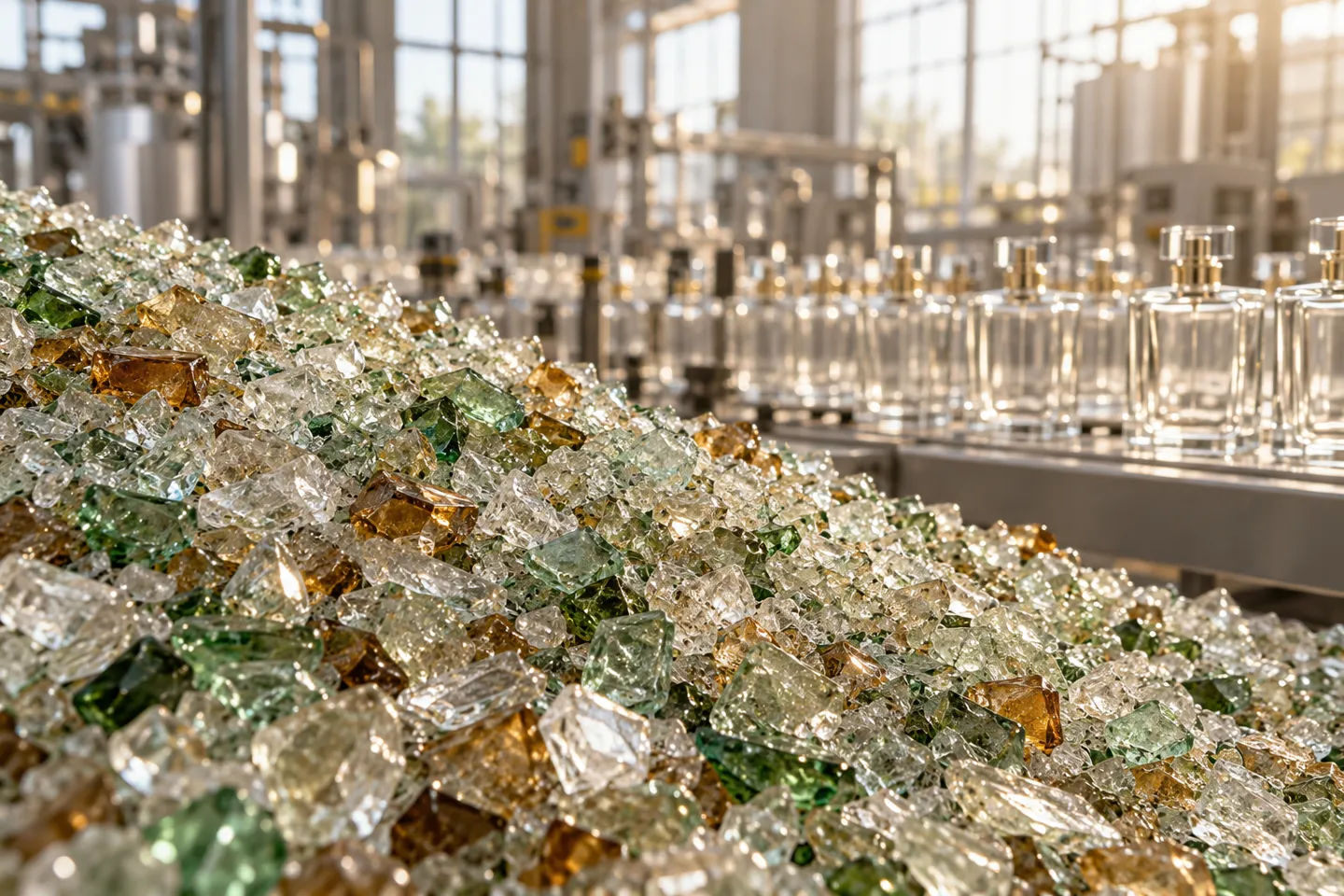
Glass also gives you a sustainability lever that plastics do not: lightweighting. Trimming wall and base thickness cuts material per unit permanently. Every gram removed also reduces transport emissions for the life of the product. Well-run lines shave 15-25% of material without giving up the premium heft buyers expect. There is a floor, though: thin it too far and breakage rates in transit start eating the gain.
Paper: FSC, Recycled, and Molded Pulp
Paper carries the outer story. FSC-certified board means the fiber comes from responsibly managed forests, with a chain-of-custody number you can verify. Recycled board closes the loop on paper itself. Both are mature, cheap to print, and easy to shape into rigid boxes that still feel luxurious.
Paper gets most interesting at the insert. Molded pulp trays, the same technology as egg cartons refined for retail, replace vacuum-formed PVC and foam blocks. They protect as well in most drop scenarios, they recycle with the box instead of against it, and they remove the worst plastic from the unboxing experience. Two boundaries to respect: pulp loses rigidity in sustained high humidity, and very heavy bottles still want an engineered insert, not a generic one.
The paper trap is invisible until recycling day. A coated or film-laminated box can undo every good choice inside it.
The safest box spec
Uncoated mono-material board, soy-based inks: it recycles whole, with nothing to separate and nothing to contaminate.
Biobased Plastics and Coatings
PLA and other biobased plastics look like an easy win and usually are not. Most need industrial composting to break down, and that infrastructure exists in only a few markets. In a home compost bin or a landfill they behave much like conventional plastic. Use them where a specific market’s composting stream makes them true, not as a default green badge.
Coatings follow the same logic. Water-based, low-VOC coatings keep a box recyclable; thick lamination does not. On glass, spray coatings and silk-screen inks burn off safely in the cullet furnace. Electroplated metallic finishes do the opposite: they contaminate the recycling stream, a point that matters enough to get its own section below.
Sustainable Perfume Packaging Materials at a Glance
| Material | Look and feel | End of life | Cost behavior | Best fit | Watch out for |
|---|---|---|---|---|---|
| Virgin flint/crystal glass | premium clarity, true color, takes polish and decoration | Infinitely recyclable in closed loop | Higher unit cost, mold amortization | Flagship and luxury lines | Weight drives freight, first-melt energy |
| PCR glass | glass performance with recycled story | Fully recyclable, clarity depends on feedstock control | Small premium over virgin at quality grades | Eco lines that must stay premium | Batch color shifts without cullet QC |
| Lightweight glass | same as parent grade | Recyclable, cuts transport emissions | Tooling for thin-wall may cost more | Volume lines with freight pressure | Breakage floor if over-thinned |
| FSC/recycled board | printable, rigid, premium with finishing | Widely recyclable if uncoated | Low tooling cost, fast iterations | Boxes, sleeves, mailers | Coatings and laminations kill recyclability |
| Molded pulp insert | matte, tactile, modern | Recycles with the box | Pulp tooling moderate | Insert replacing foam/PVC trays | High humidity softens it |
| PLA/biobased | similar to base plastic | Only industrially compostable | Higher resin cost | Markets with composting streams | Home compost claims usually false |
Refillable, Recyclable, or Lightweight: Picking Your Path
Three routes dominate sustainable packaging strategy, and brands waste money by choosing them like trends instead of like business models.
Refillable packaging turns the bottle into a keepsake and sells the juice cheaper the second time. It only works when two conditions hold. The closure system must be built for repeated opening: a screw cap or a purpose-designed refill interface, not a one-piece crimp seal made to be pierced once. And customers must actually come back, which is why refill lines cluster in luxury perfume, where the bottle earns counter space and the repurchase cycle is short. The market is voting: refillable perfume bottles alone are projected to grow from roughly USD 3.8 billion in 2025 to USD 6.4 billion by 2035 (Future Market Insights, 2025). Without a repurchase model behind it, a refill system is cost with no story.
Send Nuvole Glass your bottle spec and repurchase plan, and our engineers will tell you which of the three routes your line can actually carry.
Get a Route RecommendationRecyclable packaging is the quiet workhorse. Done honestly, it means every component either recycles or separates cleanly, which is an engineering spec, not a material choice. This route is also becoming the floor rather than the ceiling. The EU’s packaging regulation enters application in August 2026, and from 2030 all packaging placed on the EU market must meet design-for-recycling grades (European Commission, 2025). If Europe is in your plan, recyclability is no longer a differentiator. It is admission.
Lightweighting is the accountant’s favorite. Less glass per unit means less material, less freight, and lower emissions on every shipment, forever. Its boundary is mechanical: below a certain wall thickness, breakage in transit and on shelf starts costing more than the glass saved. The right weight is found by drop testing, not by eye.
For most brands the answer is a stack, not a pick. A recyclable core forms the compliance floor. Lightweighting goes where the structure allows, and refill only where the repurchase model pays for it.
Three Sustainability Routes Compared
| Route | What it requires | Where it fails | Pays off when |
|---|---|---|---|
| Refillable | refill-ready closure system, retail refill format, customer habit | No repurchase cycle, one-piece crimp closures, low engagement categories | Luxury and repeat-purchase fragrance |
| Recyclable | separable parts, mono-material choices, clean decoration | Mixed materials, glued components, contaminating finishes | Always, and mandatory for EU from 2030 |
| Lightweight | thin-wall engineering, drop and vacuum testing | Over-thinned bottles breaking in transit | High-volume lines where freight is real cost |
Engineering a Bottle That Actually Gets Recycled
Recyclability is designed, not declared. Two bottles of identical glass can sit side by side: one welcomed by the recycling plant, one rejected. The difference is a pump that cannot come off and a finish that cannot burn off.
Design for Disassembly: Pumps, Caps, and Mono-Material
Start at the neck. A screw-cap or drop-in stopper format lets the consumer separate glass from hardware in two seconds. A crimp-top atomizer is pressed on permanently: beautiful, tamper-evident, and effectively welded to the bottle’s afterlife. If the sustainability story matters to the product, specify a closure the user can remove, and say so on the pack.

Then simplify outward. Mono-material boxes (one board, one ink system) recycle whole. Where mixed parts are unavoidable, design the joints as separations: a pulp insert that lifts out, a cap that unscrews, a label that releases cleanly. Each separable joint is a line in your recycling story that a regulator or a retailer can check.
Recyclability is designed, not declared.
Spec-Checking PCR Quality and Batch Consistency
PCR quality lives or dies in the supplier’s incoming inspection. The questions to write into your RFQ: What recycled content percentage is guaranteed per batch? What are the acceptance limits for color and light transmission? Is cullet sourced and tested in-house or bought on the open market? A serious supplier answers with numbers and batch records; a greenwashed one answers with adjectives.
The same discipline applies to lightweight bottles. Thin-wall designs should come with drop-test results and vacuum-test records, because a leak discovered after filling is a lost batch, not a spec adjustment. Ask for the test protocol, not just the pass rate.
The RFQ shortlist
State the guaranteed PCR percentage per batch, in writing.
Set acceptance limits for color and light transmission.
Name the cullet source: in-house tested or open-market.
Require batch-level drop-test and vacuum-test records.
Decoration Choices That Contaminate or Comply
Most recyclable packaging dies at decoration. Electroplated and metallic-film finishes put a metal layer on glass that the cullet furnace cannot remove, so those bottles downgrade the recycled stream. Spray coatings, silk-screen printing, and organic inks, by contrast, burn off cleanly at glass melting temperatures. On paperboard the same rule holds with different actors: foils and plastic lamination contaminate, water-based coatings and soy inks do not.
If a design insists on metallic glamour, localize it: a metalized cap that unscrews and recycles as metal is fine; a metalized film over the whole bottle is not.
Sustainable Packaging Options: Fit and Failure Boundaries
| Solution | Works best for | Fails or struggles when | Confirm before ordering |
|---|---|---|---|
| Virgin crystal/flint glass bottle | flagship lines needing true color and polish | Budget lines where freight dominates | Clarity grade, lead and cadmium compliance |
| PCR glass bottle | eco lines that must stay premium | Brands needing perfect batch-to-batch color without supplier QC | Guaranteed recycled %, color/transparency acceptance limits, cullet sourcing |
| Lightweight glass bottle | high-volume lines with freight pressure | Fragile gift sets, very thin walls without test data | Drop test records, vacuum test records, breakage allowance |
| FSC/recycled box | outer packaging for any line | Humid climates with coated board | Chain-of-custody number, coating spec, mono-material build |
| Molded pulp insert | replacing foam and PVC trays | Extremely heavy bottles needing engineered support | Pulp grade, humidity performance, drop test with bottle |
| Screw-cap/removable closure | recyclability-led and refill-adjacent lines | Tamper-critical markets requiring crimp seals | Neck finish spec, opening torque, refill compatibility |
| Mono-material box design | EU-bound products post-2030 | Designs demanding mixed foil effects | Material list per component, separable joints |
| Metallic/electroplated decoration | none, from a recyclability view | Anything claiming recyclable with full-body plating | Ask for cullet-safe alternatives: spray, silk-screen, organic inks |
Sourcing Sustainable Packaging Without Getting Greenwashed
Suppliers know sustainability sells, so the words are cheap. The documents are not. A four-step verification keeps the difference clear.
Step one: verify certifications, not slogans. FSC comes with a chain-of-custody number you can check in the FSC public database. ISO 14001 comes with a certificate number and a registrar. Factory audit reports (BSCI or equivalent) can be requested directly. If a certificate has no number, treat it as absent.
Step two: demand batch-level evidence. For PCR glass that means guaranteed recycled content per batch, color and transmission acceptance limits, and incoming cullet test records. For any bottle it means vacuum and drop test protocols. A sample that passed is not a production run that passes; ask what is checked on every batch.

Step three: price the whole system. Mold amortization, unit price at your quantity, freight by weight, breakage allowance, and the cost of compliance documentation all land in different lines of your P&L. PCR or lightweight options can carry a modest unit premium and still win on total cost once freight, breakage history, and EU market access are counted.
Step four: check the calendar against the regulation. The EU Packaging and Packaging Waste Regulation applies from 12 August 2026. From 1 January 2030, packaging must meet recyclability performance grades, and recycled-content minimums phase in for plastic components (European Commission, 2025). Packaging ordered today for a 2027 launch lives its whole life under those rules, so the time to spec for them is now.
Sustainable Packaging Supplier Verification
- 1Collect certificate numbers: FSC chain-of-custody, ISO 14001, BSCI audit; verify each in the issuer’s public database.
- 2Request batch records: PCR recycled-content guarantee, color and transmission limits, vacuum and drop test protocols.
- 3Rebuild the quote as total cost: tooling amortization + unit price + freight by weight + breakage allowance + documentation effort.
- 4Map the launch date to PPWR: application from Aug 2026, recyclability grades from Jan 2030; confirm the design meets the grade it will be sold under.
What This Means for Your Line Sheet
Read the sections above as a buyer and one pattern repeats: every honest sustainability claim reduces to a document. Recyclability reduces to a design specification. Recycled content reduces to a batch record. Compliance reduces to a date on a regulation. A packaging product without its paperwork is just a story, and stories do not survive a retailer’s compliance check or a customs inspection.
For a distributor or trading company, that converts directly into selection criteria. Stock lines from suppliers who can produce certificate numbers, batch test reports, and separable designs on request. The ones who cannot will sit in your warehouse when the EU’s 2030 recyclability grades start deciding what retailers may shelf. Glass holds the strongest position in this shift. It recycles in a closed loop without quality loss, it lightweights without changing material, and its decoration can be made cullet-safe without losing luxury finishes.
This is the standard we hold our own line to at Nuvole Glass. Our perfume bottles run on ISO 9001-certified production, with CE, RoHS and TUV compliance documented and BSCI audits on file. You can check our current certification documents before any commitment (current certification documents). Our PCR glass perfume packaging (PCR glass perfume packaging) is engineered with up to 85% recycled content while keeping crystal-grade clarity, and our bottles use 15-25% less material than standard-wall equivalents. Our pharmaceutical-grade silicone and PTFE sealing system holds annual evaporation below 0.1%. Whoever you buy from, ask for those three numbers in writing.
If you want to pressure-test a supplier against the checklist above, request a free sample from Nuvole Glass and compare the documents side by side (request a free sample).
Pressure-Test Your Next Packaging Supplier
Certifications, batch records, and an 85% PCR sample from Nuvole Glass, one request away.
Request a Free SampleReferences
- European Commission. “Packaging waste.” 2025. https://environment.ec.europa.eu/topics/waste-and-recycling/packaging-waste_en
- FEVE – The European Container Glass Federation. “Why choose Glass?” 2024. https://feve.org/about-glass/
- Glass Packaging Institute. “Glass Recycling Facts & Benefits.” 2018. https://www.gpi.org/facts-about-glass-recycling
- Future Market Insights. “Mini Refillable Perfume Bottles Market.” 2025. https://www.futuremarketinsights.com/reports/mini-refillable-perfume-bottles-market